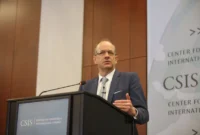

The Center for Strategic and International Studies (CSIS) has convened a high-level assembly of government officials, military analysts, and policy experts under its Defense360 initiative to dissect the intricacies of the Fiscal Year 2017 (FY17) defense budget request. As the Pentagon balances legacy commitments with the demands of an evolving global threat landscape, this half-day conference serves as a critical forum for evaluating the strategic calculus that underpins the administration’s financial roadmap for national security. The gathering, moderated by Todd Harrison, Director of Defense Budget Analysis at CSIS, provides a platform to bridge the gap between abstract strategic goals and the tangible realities of federal funding.
The Strategic Context of the FY2017 Request
The FY2017 defense budget request represents a pivotal moment in the tenure of the outgoing administration, reflecting a transition in focus from the counterinsurgency operations of the previous decade toward the complexities of "great power competition" and rapid technological modernization. At the heart of the debate is the administration’s attempt to reconcile the Budget Control Act of 2011 (BCA)—which mandated strict sequestration-level spending caps—with the emergence of unconventional threats, including cyber warfare, anti-access/area-denial (A2/AD) capabilities in the Pacific, and the resurgence of geopolitical tensions in Eastern Europe.
The request, which totaled approximately $582.7 billion in base and Overseas Contingency Operations (OCO) funding, was framed by the Department of Defense as a "pivot" budget. By prioritizing research, development, and procurement for next-generation platforms, the administration sought to ensure that the U.S. military maintained its technological edge despite the fiscal headwinds.
Chronology of the Budgetary Deliberations
The rollout of the FY17 defense request followed a rigorous interagency process characterized by intense scrutiny from both the Office of Management and Budget (OMB) and the Pentagon’s own internal audit mechanisms.
- Early February 2016: The formal submission of the President’s budget request to Congress, signaling the administration’s primary fiscal goals.
- February – March 2016: A period of legislative assessment, during which the House and Senate Armed Services Committees began their initial hearings to challenge the administration’s reliance on OCO funding as a budgetary "slush fund" to bypass base budget caps.
- Conference Convening: The CSIS Defense360 conference occurs during this critical window of evaluation, providing an objective space for the primary architects of the budget—including Under Secretary of Defense (Comptroller) Mike McCord and CAPE Director Dr. Jamie Morin—to justify the strategic rationale behind specific line items.
Key Architectural Figures and Their Roles
The morning session features a triumvirate of key defense officials who have been instrumental in crafting the current fiscal posture. Mike McCord, in his capacity as the Under Secretary of Defense (Comptroller) and Chief Financial Officer, provides the necessary oversight of the department’s multi-billion-dollar portfolio. His role is to ensure fiscal accountability while managing the difficult trade-offs between force structure, readiness, and modernization.
Dr. Jamie Morin, serving as the Director of Cost Assessment and Program Evaluation (CAPE), brings a rigorous analytical framework to the discussion. CAPE is essentially the "numbers" engine of the Pentagon; it is responsible for the independent assessment of program costs and the long-term viability of major weapon systems. Robert Scher, the Assistant Secretary of Defense for Strategy, Plans, and Capabilities, offers the essential link between the budget and national security objectives. His participation clarifies how the department intends to operationalize the National Defense Strategy within the constraints of the FY17 request.
Analysis of Defense Strategy and Connectivity
The conference transitions from a government-led discussion to an expert panel assessment, focusing on the "connectivity" between policy and spending. Participants such as Tina Jonas, former Under Secretary of Defense (Comptroller), and Andrew Hunter, Director of the Defense-Industrial Initiatives Group at CSIS, bring deep institutional knowledge to the evaluation of the procurement lifecycle.
The panel also includes voices from the broader policy community, such as Shawn Brimley of the Center for a New American Security (CNAS) and Roger Zakheim of the American Enterprise Institute (AEI). These experts provide a necessary external critique, questioning whether the FY17 budget sufficiently addresses the "readiness gap"—the phenomenon where high-tempo operations and deferred maintenance have strained the force’s ability to respond to major theater contingencies.
Supporting Data and Fiscal Implications
The data presented during the conference sessions highlights several trends of significant concern to policymakers. The reliance on OCO funding, for example, is a point of contention. In the FY17 request, the administration utilized the OCO account to fund $58.8 billion in operations, a move that critics argue masks the true cost of baseline military requirements.
Furthermore, the data suggests a shift in procurement priorities. There is a marked increase in funding for the "Third Offset Strategy," an initiative designed to leverage breakthroughs in robotics, autonomous systems, and artificial intelligence to maintain parity against peer adversaries. According to CSIS analysis, the FY17 request reflects a transition toward:
- Increased Investment in Cyber-Resilience: Recognizing that the digital domain is the new theater of warfare.
- Modernization of the Nuclear Triad: A significant long-term fiscal commitment to replace aging strategic deterrent platforms.
- Readiness Recovery: A push to restore the training and maintenance cycles that were depleted by years of budgetary uncertainty and sequestration.
Official Responses and Legislative Reactions
The reactions to the FY17 request have been polarized. While Department of Defense leadership maintains that the budget is the "most responsible" path forward given the legal constraints of the Budget Control Act, congressional reaction has been mixed. Lawmakers on the House and Senate Armed Services Committees have frequently voiced frustration, arguing that the administration’s request fails to provide the level of funding required for "full-spectrum" readiness.
Conversely, fiscal hawks have raised concerns about the sustainability of the long-term debt profile associated with current defense spending levels. The CSIS conference serves as an unofficial arbiter in these disputes, providing the raw data and expert testimony necessary to inform the legislative process. By hosting officials alongside independent analysts, CSIS ensures that the debate remains grounded in empirical evidence rather than mere political rhetoric.
Broader Impact and Long-term Implications
The implications of the FY17 budget extend far beyond the immediate fiscal year. The decisions made regarding force structure and procurement will dictate the military’s capabilities for the next decade. If the modernization programs funded in this cycle fail to materialize, the U.S. risks a "hollow force" scenario, where personnel and equipment levels remain high, but the technological superiority required to deter adversaries diminishes.
Additionally, the conference addresses the growing movement for defense reform. As part of the Defense360 initiative, CSIS has launched a survey on defense reform, inviting public and expert input on how to streamline the Pentagon’s bloated acquisition bureaucracy. This effort acknowledges a growing consensus in Washington: that the current defense budget process is too slow, too rigid, and too disconnected from the pace of technological innovation.
Conclusion
The CSIS Defense360 conference on the FY2017 defense budget stands as a critical checkpoint in the national security calendar. By facilitating a transparent dialogue between the architects of the Pentagon’s financial strategy and the policy analysts who hold them to account, the event provides the clarity necessary for effective governance. As the United States navigates an era of renewed systemic competition, the success of its defense strategy will depend on its ability to align its fiscal resources with its most pressing strategic imperatives. The insights gleaned from this conference will undoubtedly influence the legislative debates that follow, shaping the future of American national security for years to come. Through rigorous analysis and high-level discourse, the international security community continues to refine its understanding of the delicate balance between the demands of the battlefield and the constraints of the ledger.