
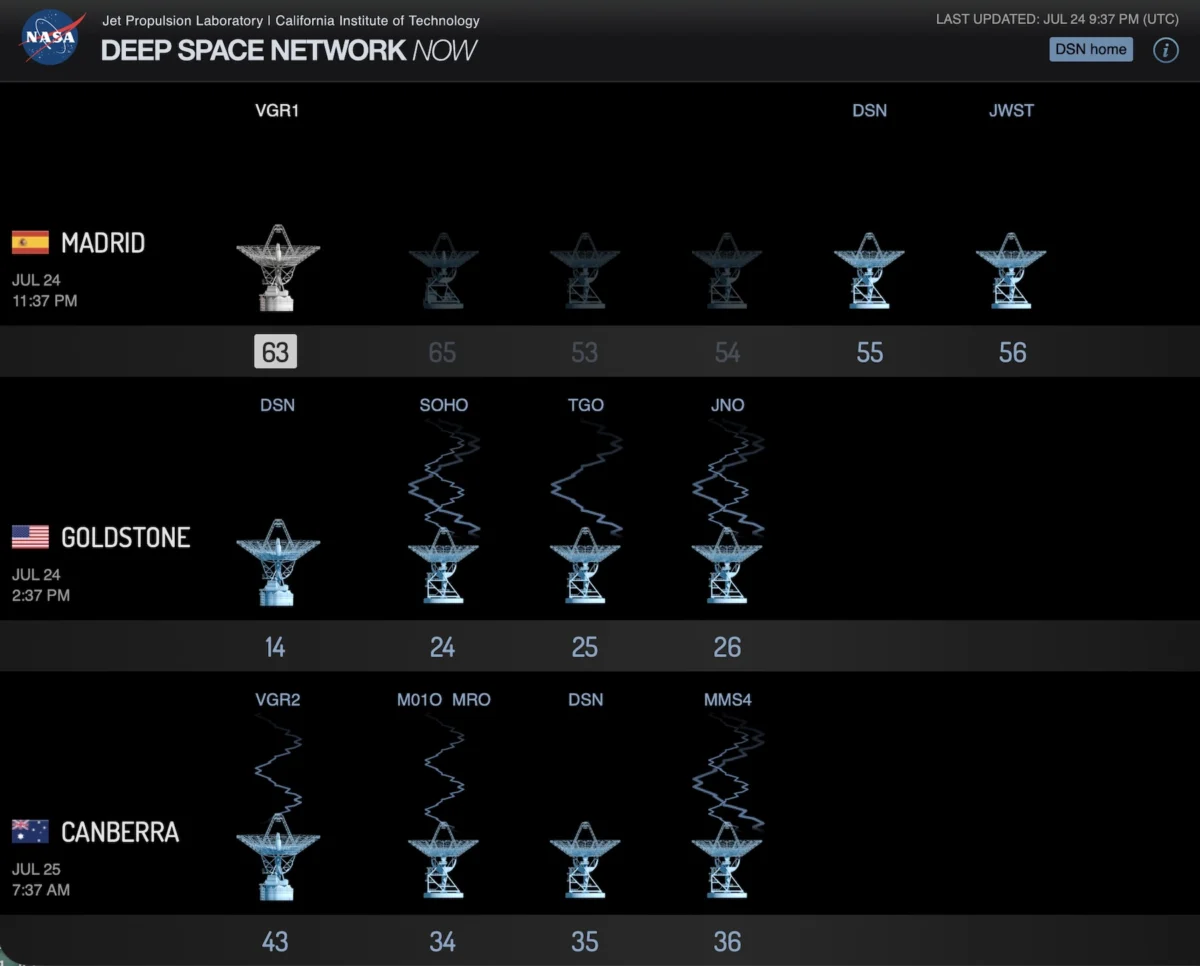
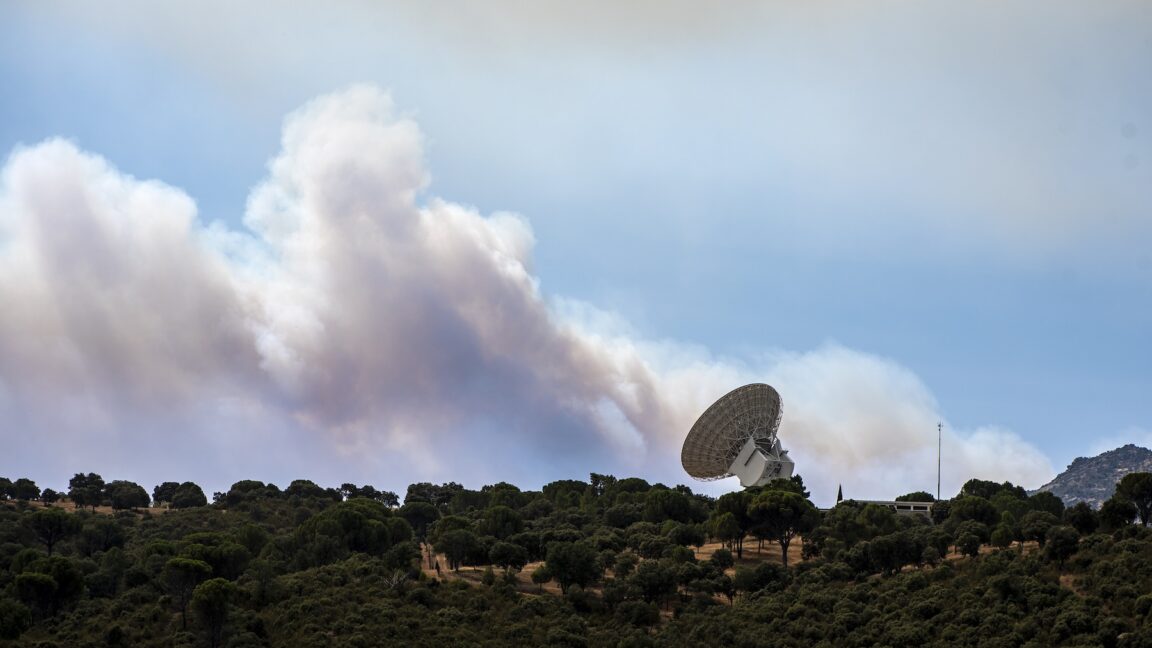
The Madrid Deep Space Communications Complex, a critical node in NASA’s global infrastructure for interplanetary communication, has been forced to cease all operations as aggressive wildfires ravage the landscape west of the Spanish capital. As of Friday afternoon, real-time status monitors operated by NASA showed no activity at the site, with all antennas offline as personnel were evacuated to ensure their safety. This disruption marks a significant challenge for the Deep Space Network (DSN), which relies on a triad of strategically positioned stations to maintain constant contact with spacecraft exploring the solar system and beyond.
While the Madrid site remains dark, the other two legs of the DSN—located in Goldstone, California, and Canberra, Australia—continue to facilitate communications with vital missions, including the Voyager 2 probe currently traversing interstellar space and the Juno spacecraft, which remains in orbit around Jupiter. However, the loss of the Madrid complex significantly diminishes the network’s redundancy at a time when the agency is already grappling with long-term infrastructure limitations.
A Region Under Siege: The Context of the Evacuations
The emergency at the NASA facility is part of a broader, catastrophic wildfire event currently unfolding in the mountains west of Madrid. According to reports from Reuters and local Spanish authorities, the situation has necessitated the mandatory evacuation of more than 19,000 residents from surrounding municipalities. The scale of the response has been massive, with the Spanish government mobilizing over 2,000 emergency personnel and a fleet of 10 specialized aircraft to combat the blazes.
The wildfires have been fueled by a combination of factors that have plagued the Iberian Peninsula throughout the summer. A prolonged, punishing heat wave, coupled with chronic, multi-year drought conditions, has rendered the vegetation in the region tinder-dry. These environmental stressors have created a high-risk landscape where even minor ignitions can rapidly evolve into uncontrollable infernos. The proximity of the threat to high-value infrastructure is evident: the Cebreros tracking station, owned and operated by the European Space Agency (ESA) as part of their Estrack network, was also forced to evacuate, leaving a significant gap in international deep-space tracking capabilities.
In an official statement, NASA underscored that the well-being of its workforce remains the primary focus during this volatile period. "The safety and well-being of our personnel is our highest priority and our thoughts are with the families and neighbors who are also experiencing the impact of the wildfires in the surrounding communities," the agency stated. "We will provide updates as conditions evolve."
The Deep Space Network: A Fragile Global Lifeline
The Deep Space Network is the most sensitive and largest scientific telecommunications system in the world. It provides the essential radio links between Earth-based mission control centers and spacecraft engaged in planetary and solar system exploration. The network operates on the principle of geographic diversity; because the Earth rotates, a single antenna can only maintain contact with a spacecraft for a portion of the day. By placing three stations approximately 120 degrees apart—in California, Spain, and Australia—NASA ensures that at least one antenna can always "see" a spacecraft, regardless of the Earth’s rotation.
The current blackout in Madrid exposes the vulnerability of this system, particularly when combined with existing maintenance issues at other facilities. The network is currently down to a single operational 70-meter radio antenna located in Australia. This is a precarious situation, as the 70-meter antenna at the Goldstone facility in California has been out of commission since a major accident last year.
The Goldstone incident involved a structural failure during routine operations that led to an "over-rotation" of the massive antenna. The resulting mechanical stress damaged critical cables and water lines, leading to a significant flood at the base of the structure. The spill involved approximately 200,000 gallons of water mixed with glycol, a chemical coolant that poses a notable environmental hazard, necessitating a complex cleanup process.
NASA has projected that the repair and restoration of the California antenna will cost between $4.1 million and $4.6 million. Rather than performing a simple repair, the agency has opted to integrate the necessary fixes with a series of planned infrastructure upgrades. Consequently, the Goldstone 70-meter antenna is not expected to return to active service until 2028. The simultaneous unavailability of the Madrid and California sites leaves the agency with limited capacity to handle high-bandwidth telemetry and emergency maneuvers, should they be required by the current fleet of robotic explorers.
Implications for Future Exploration and Artemis
While the current operational strain is severe, the timing of the disruption offers a small buffer for the agency’s most ambitious upcoming program: the Artemis lunar exploration initiative. The Artemis missions are notoriously demanding on the DSN, requiring high-precision telemetry, robust command links, and high-speed imagery downlinks to support the requirements of human spaceflight.
The next mission in the sequence, Artemis III, is scheduled to remain in low-Earth orbit to conduct rigorous testing of the Orion capsule in conjunction with commercial lunar landers developed by SpaceX and Blue Origin. Because this mission does not involve a deep-space trajectory, it does not exert the same extreme pressure on the DSN as the subsequent, more complex missions.
Artemis IV, which represents the program’s next major milestone—the first planned lunar landing with a human crew—is not targeted for launch until no earlier than 2028. This provides NASA with a narrow window to restore the global network to full strength. However, the events of this past week highlight that the agency’s ability to maintain a human presence in space is fundamentally tethered to the stability of its ground-based infrastructure, which remains vulnerable to the increasingly unpredictable impacts of global climate change.
Analysis: Operational Resilience in a Changing Climate
The evacuation of the Madrid site serves as a case study in the challenges of modern infrastructure management. Historically, site selection for major scientific facilities focused on radio-frequency interference and line-of-sight requirements. Today, however, the "geography of risk" has shifted. As wildfires grow more frequent and intense, sites that were once considered safe havens are now in the path of environmental disaster.
The reliance on a 70-meter antenna in Australia for the entirety of the network’s high-gain, long-range capability represents a "single point of failure" scenario that mission planners typically seek to avoid at all costs. Should the Australian site face technical difficulties or regional climate events, the agency could face a total loss of high-bandwidth communication with missions in the deep solar system.
Moving forward, the agency will likely face pressure to accelerate the transition toward more decentralized or resilient communications technology, such as optical (laser) communications, which are currently being tested on missions like Psyche. Furthermore, the incident will almost certainly trigger a review of the physical security and fire-mitigation strategies at all remote tracking complexes.
As the recovery efforts in Spain continue, the scientific community remains in a holding pattern. The silence from the Madrid antennas is a stark reminder that while our reach into the cosmos is expanding, our ability to stay connected is still entirely dependent on the stability of the ground beneath our feet. For now, the global space community watches the horizon, waiting for the smoke to clear and for the Madrid Deep Space Communications Complex to resume its role as a vital bridge between Earth and the stars.