On March 4, 2016, the Center for Strategic and International Studies (CSIS) hosted a landmark security seminar dedicated to the evolving dynamics of the U.S.-Japan alliance, with a specific focus on maritime security in the increasingly contested Asia-Pacific region. Held in Washington, D.C., the event brought together high-ranking military officials, academic experts, and policy architects to dissect the operational, diplomatic, and geopolitical challenges facing the two nations. The seminar served as a pivotal platform for evaluating the implementation of the 2015 Guidelines for U.S.-Japan Defense Cooperation, a landmark agreement that expanded the scope of military interoperability between the Japan Self-Defense Forces (JSDF) and the United States Armed Forces.
The Strategic Backdrop of the 2016 Seminar
The 2016 seminar took place during a period of heightened regional anxiety. Throughout 2015 and early 2016, the South China Sea had become a focal point of geopolitical friction. China’s rapid construction of artificial islands and the subsequent militarization of features in the Spratly and Paracel archipelagos prompted concerns among regional powers regarding freedom of navigation and the stability of the rules-based international order.
For Tokyo and Washington, the challenge was twofold: maintaining the integrity of international maritime law and ensuring that the U.S.-Japan security umbrella remained a credible deterrent against coercion. By the time of the March 4 proceedings, Japan had already passed its controversial security legislation in 2015, which reinterpreted the Japanese Constitution to allow for "collective self-defense" under specific, limited circumstances. The CSIS seminar provided the intellectual space to discuss what these legal changes meant in practical, naval terms.
Chronology of the Proceedings
The seminar, supported by the Ministry of Foreign Affairs of Japan, was structured to transition from high-level strategic vision to granular operational reality.
The event commenced at 3:00 p.m. with welcoming remarks from Michael J. Green, the Senior Vice President for Asia and Japan Chair at CSIS. Green, a former senior official in the George W. Bush administration, set the stage by emphasizing the centrality of the alliance to U.S. foreign policy. He was joined by Yoshiji Nogami, President of the Japan Institute of International Affairs (JIIA). Their dialogue highlighted the shift from a Cold War-era bilateral defense posture to a more integrated, regional security partnership.
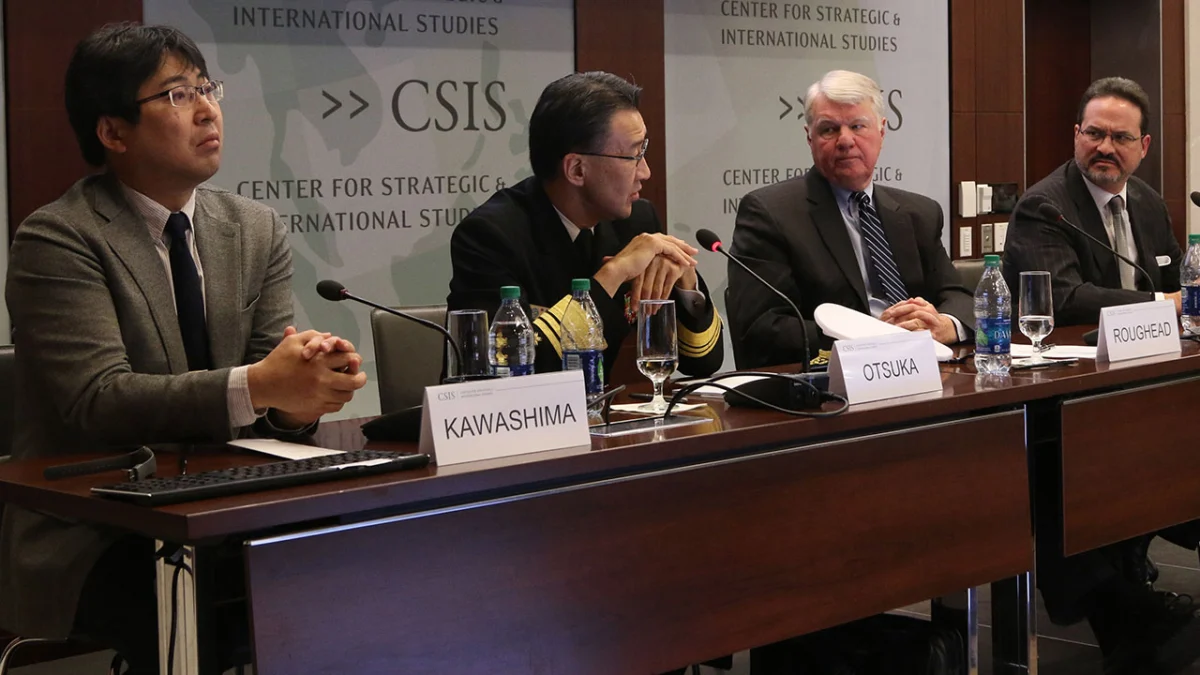
At 3:15 p.m., the core session—"The U.S.-Japan Alliance and Maritime Security in the Asia-Pacific Region"—commenced. The panel featured Vice Admiral Umio Otsuka, President of the Japan Maritime Self Defense Force Command and Staff College; Professor Shin Kawashima of the University of Tokyo; and Admiral Gary Roughead, USN (Ret.), the former Chief of Naval Operations.
The discussion focused on how the two navies could better integrate their intelligence, surveillance, and reconnaissance (ISR) capabilities. Following the expert panel, a 4:30 p.m. Q&A session allowed members of the foreign policy community, journalists, and defense analysts to interrogate the speakers on the feasibility of joint patrols in the South China Sea—a topic that remained a sensitive point of debate in Tokyo at the time.
Supporting Data and Strategic Considerations
To understand the weight of the discussions held at the 2016 seminar, one must consider the military balance of the era. According to 2016 figures from the International Institute for Strategic Studies (IISS) Military Balance, the Chinese People’s Liberation Army Navy (PLAN) was in the midst of the world’s largest naval expansion program.

The seminar participants weighed several critical metrics:
- The Proliferation of Submarines: The rapid growth of the Chinese submarine fleet was identified as a primary threat to regional stability, necessitating enhanced anti-submarine warfare (ASW) coordination between the U.S. 7th Fleet and the Japan Maritime Self-Defense Force.
- A2/AD Capabilities: Much of the discussion centered on "Anti-Access/Area Denial" (A2/AD) strategies. Experts discussed how China’s development of long-range anti-ship ballistic missiles—such as the DF-21D—threatened the traditional naval superiority of the United States in the Western Pacific.
- Defense Budgeting: The seminar noted the steady, albeit modest, increases in Japan’s defense spending under the administration of Prime Minister Shinzo Abe, which were intended to bolster maritime patrol aircraft and helicopter-carrying destroyers.
Expert Analysis: The Shift in Naval Interoperability
Admiral Gary Roughead’s contribution was particularly significant. Having served as the top officer in the U.S. Navy, he provided a blunt assessment of the "hardware versus software" problem. While the hardware—ships, planes, and radar—was generally well-aligned, the "software"—the shared doctrine, communication protocols, and legal frameworks for joint operations—required constant updating.
Professor Shin Kawashima provided the academic grounding for the discussion, analyzing how the Japanese public’s perception of maritime security had shifted. He argued that the persistent presence of Chinese coast guard vessels in the waters surrounding the Senkaku Islands had fundamentally altered the domestic Japanese political climate, making the public more receptive to a proactive security posture than at any point in the post-war era.
Implications for the Asia-Pacific Order
The 2016 U.S.-Japan Security Seminar was not merely a diplomatic exercise; it was a blueprint for the "Free and Open Indo-Pacific" (FOIP) strategy that would later become the standard doctrine for both Washington and Tokyo.
The implications of the discussions were profound:
- Deterrence Through Integration: The seminar solidified the idea that the U.S.-Japan alliance could no longer be viewed as a static protectorate. It had to become a mobile, integrated network capable of responding to gray-zone aggression—incidents that fall below the threshold of declared war but undermine regional status quos.
- Multilateralism: While the focus was on the bilateral alliance, speakers frequently alluded to the necessity of involving other regional actors, such as Australia, India, and the Philippines, foreshadowing the eventual revitalization of the Quadrilateral Security Dialogue (the "Quad").
- Institutional Continuity: By involving the Ministry of Foreign Affairs of Japan directly, the seminar underscored that security policy was being driven by the highest levels of the Japanese government, signaling a departure from the more reactive defense policies of the 1990s and early 2000s.
Broader Impact and Legacy
The 2016 seminar remains a benchmark for understanding how the U.S.-Japan alliance evolved to meet 21st-century threats. The issues discussed—maritime domain awareness, the integration of defense technologies, and the management of tensions with Beijing—have only increased in urgency since that date.
The archival value of this event lies in its candid assessment of the risks. By bringing together the intellectual architects of the security policies of the time, the CSIS seminar ensured that the strategic community had a clear-eyed understanding of the costs of failure. The emphasis on "maritime security" acted as a diplomatic shorthand for the preservation of international norms, specifically the right to freedom of navigation in the world’s most critical commercial shipping lanes.
In the years following the seminar, the cooperation between the U.S. and Japan deepened significantly, leading to more frequent joint exercises, deeper technology sharing, and a more synchronized response to regional crises. The 2016 seminar was, in many ways, the intellectual launchpad for this deeper integration. It provided the clarity needed to navigate a period of historic transition, ensuring that the U.S.-Japan alliance remained the "cornerstone of peace and security in the Asia-Pacific," as it is frequently described in official joint statements.
As geopolitical tensions in the region continue to fluctuate, the lessons drawn from the 2016 CSIS security seminar remain highly relevant. The focus on inter-agency coordination, the necessity of clear communication channels, and the commitment to a rules-based maritime order continue to inform the policy decisions made by both Washington and Tokyo today. Through the lens of this seminar, one can see the clear trajectory of a strategic partnership that has adapted its capabilities and its vision to remain relevant in an era of great power competition.