
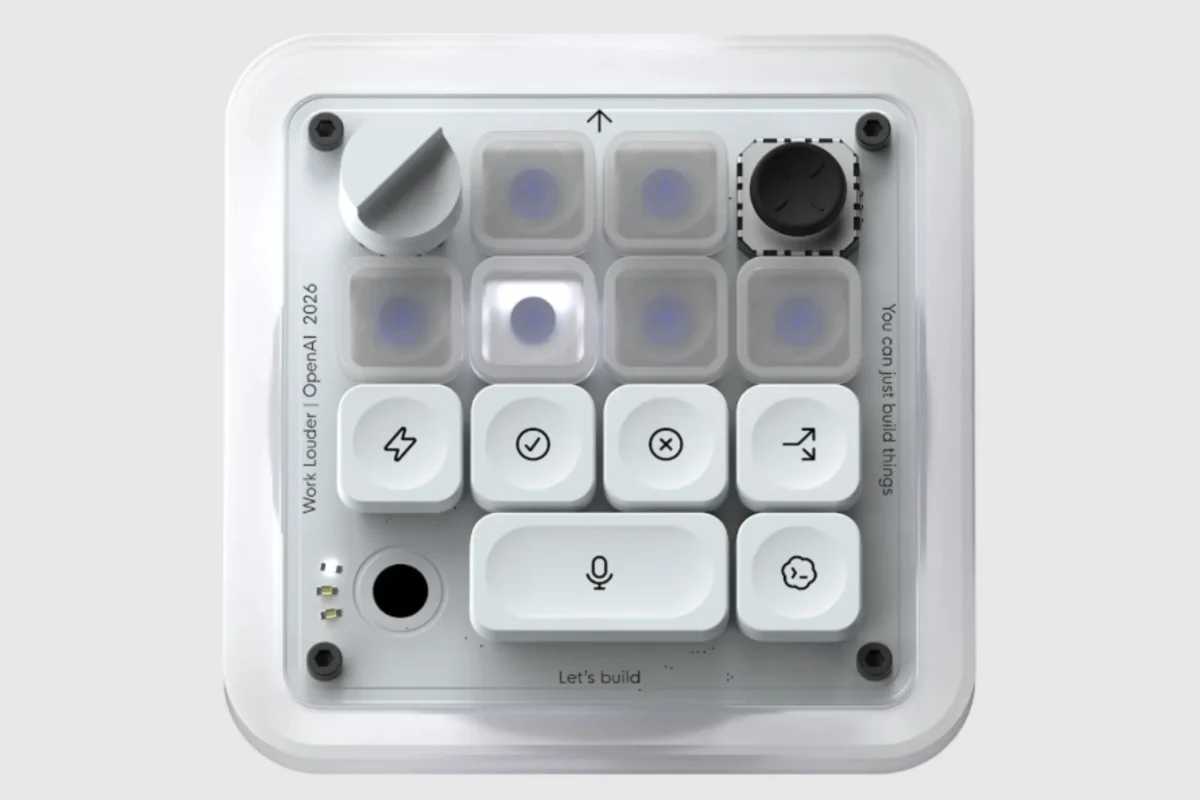
OpenAI, the industry-leading artificial intelligence research organization, officially ventured into the hardware sector last week with the release of Micro, a specialized macro keypad designed to interface directly with the ChatGPT ecosystem. Developed in strategic partnership with niche hardware designer Work Louder, the device represents the company’s first tangible foray beyond software and cloud services. Positioned as an artisanal productivity tool, the Micro keypad is designed to offer tactile, customizable control for ChatGPT and its associated agentic coding platform, Codex. However, the debut arrives during a period of significant corporate tension for the startup, characterized by high-profile litigation and internal shifts regarding product strategy.
The device itself is a compact, mechanical peripheral featuring six customizable “agent” keys for task-specific workflows and six command keys for system navigation. While the aesthetic—a stark, minimalist white box—has drawn comparisons to Apple’s signature design language, the functionality is distinctly geared toward power users of generative AI. By allowing users to assign specific ChatGPT sessions to physical buttons and integrating a dedicated voice-dictation interface, OpenAI intends to streamline the interaction loop between human intent and machine execution.
A Chronology of Escalating Hardware Ambitions
The launch of the Micro keypad does not exist in a vacuum; it is the most recent development in a rapidly evolving hardware roadmap for the San Francisco-based AI giant. The timeline of OpenAI’s hardware push is marked by both aggressive development and external scrutiny:
- Early 2026: Reports emerge regarding internal divisions at OpenAI concerning the feasibility of developing proprietary hardware, leading to the recruitment of several high-level engineers formerly employed by Apple.
- July 2026 (Early): Apple initiates a formal lawsuit against OpenAI, alleging the unauthorized acquisition of trade secrets related to proprietary hardware designs and neural engine architectures. This litigation marks a significant escalation in the rivalry between the two Silicon Valley titans.
- July 2026 (Mid): Speculation intensifies regarding a secondary hardware project: a screenless, mobile smart speaker capable of ambient AI interaction, purportedly designed by the aforementioned former Apple engineering talent.
- July 2026 (Launch Week): OpenAI officially releases the Micro keypad, a collaboration with Work Louder, as its first public-facing hardware product.
The timing of this launch suggests an attempt by OpenAI to establish a presence in the physical workspace while the company navigates the broader legal challenges posed by Apple. For observers of the tech industry, the move is reminiscent of early-stage attempts by software companies to define the hardware interfaces of their future platforms.
Design, Functionality, and the User Experience
The Micro keypad is engineered for high-frequency interaction. Beneath its chassis, the device employs mechanical switches, offering the tactile feedback that has become a hallmark of the premium mechanical keyboard market. Connectivity is handled through a dual-input system, supporting both Bluetooth for wireless setups and USB-C for a low-latency, hardwired connection.
Customization is managed entirely within the ChatGPT interface. Users can access a dedicated “Micro” tab to map specific project workflows, adjust key-light brightness, and configure the behavior of the agentic keys. The device uses a visual feedback system through colored LEDs: white denotes an idle state, blue indicates active processing, green signifies task completion, and red alerts the user to a system error.
Despite these features, the device has encountered significant resistance from the very demographic it was intended to serve: software developers and "power users." Critics argue that the $230 price point is difficult to reconcile with the existence of affordable, open-source macro pads or programmable keyboards that offer similar, if not superior, functionality through existing software like QMK or VIA. Independent reviews have characterized the device as an expensive novelty, raising questions about whether the value proposition justifies the cost for users who are already proficient with standard input methods.
Economic and Strategic Implications
The introduction of the Micro raises a fundamental question: Is there a demand for dedicated hardware in an era of rapidly evolving software interfaces? Historically, companies that successfully bridge the gap between hardware and software—such as Apple or Logitech—do so by creating a seamless ecosystem where the hardware unlocks capabilities that were previously inaccessible.

For OpenAI, the Micro serves as a beta test for its broader hardware strategy. If the company intends to pivot toward agentic AI—systems that perform tasks autonomously on behalf of the user—the interface becomes a critical bottleneck. A dedicated physical button for triggering an agent, as seen on the Micro, reduces the cognitive load of navigating a graphical user interface (GUI). However, the success of this model depends on the reliability of the agents themselves. If the AI experiences latency or frequent errors, the hardware becomes a physical manifestation of that frustration.
Furthermore, the legal implications of the Apple lawsuit loom large. If the courts determine that OpenAI’s hardware designs incorporate intellectual property protected by Apple, the company may be forced to halt production, recall units, or pay substantial damages. This would not only affect the Micro but could also jeopardize the development of the rumored screenless speaker and other future initiatives.
Industry Reception and Market Positioning
The industry response to the Micro has been polarized. Tech enthusiasts have praised the build quality and the aesthetic commitment to "artisanal" design. Conversely, the developer community has been largely dismissive, citing the high price and the steep learning curve required to integrate the keypad into a professional coding environment.
From a market perspective, the Micro occupies a strange middle ground. It is too expensive to be a casual impulse buy for the average ChatGPT user, yet it lacks the professional-grade programmability required by serious engineers. This suggests that the device may be intended as a “halo” product—a tangible item that reinforces the OpenAI brand identity rather than a primary revenue generator.
Analysis: The Path Forward
The integration of artificial intelligence into the physical world is inevitable, but the form factor remains an open question. OpenAI’s decision to launch a physical keypad is a signal that the company is interested in controlling the full stack of the user experience. By owning both the AI model and the physical point of interaction, OpenAI can theoretically create a more cohesive and efficient workflow.
However, the current iteration of the Micro demonstrates the risks of this approach. Without deep, system-level integration that goes beyond simple macro mapping, the hardware risks being perceived as a redundant accessory. To succeed in the hardware market, OpenAI will likely need to move toward more complex devices that leverage the unique capabilities of its large language models—such as voice-responsive, context-aware hardware that can anticipate user needs.
The ongoing litigation with Apple will likely serve as a constraint on these ambitions. If OpenAI is forced to defend its intellectual property in court, the pace of its hardware development may slow, forcing the company to focus more heavily on its core software competencies. Conversely, if the company prevails or settles, it may feel empowered to pursue even more ambitious hardware projects, potentially challenging the status quo of the consumer electronics industry.
Ultimately, the Micro keypad is a microcosm of OpenAI’s current standing in the tech world: it is bold, highly visible, and intentionally disruptive, but its long-term viability remains unproven. Whether this device becomes the first of many successful hardware innovations or a footnote in the history of AI, it represents a significant pivot point for a company that has, until now, operated exclusively in the digital realm. As users continue to evaluate the utility of the Micro, the tech industry will be watching closely to see how OpenAI balances its software-first roots with its burgeoning hardware aspirations.