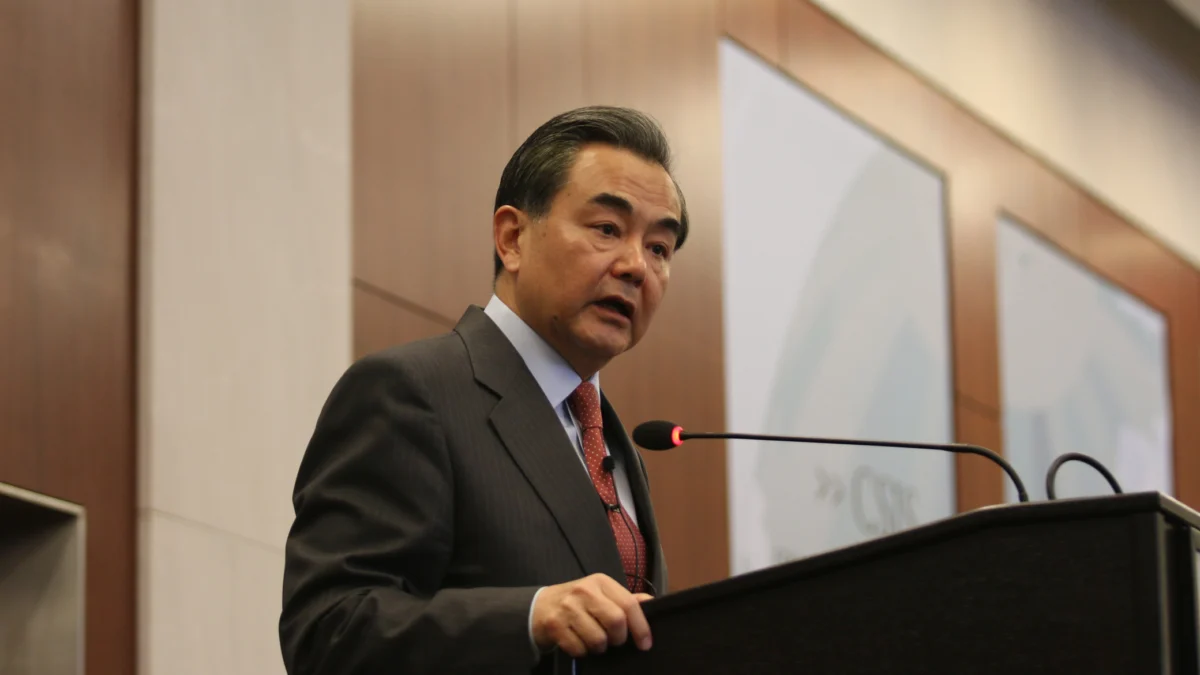
On February 25, 2016, the Center for Strategic and International Studies (CSIS) hosted a landmark edition of its "Statesmen’s Forum," featuring a keynote address by Wang Yi, the Minister of Foreign Affairs for the People’s Republic of China. The event, which took place during a critical juncture in the evolution of the U.S.-China bilateral relationship, served as a platform for Beijing to articulate its strategic vision for global governance and its expectations for the future of the Pacific security architecture. Moderated by Christopher K. Johnson, then the Freeman Chair in China Studies at CSIS, the discussion provided rare, direct insight into the diplomatic calculus of the Chinese leadership during a period defined by intensifying maritime disputes and shifting economic realities.
Context and Historical Backdrop
The 2016 forum occurred against a backdrop of increasing friction in the South China Sea. During this period, the United States was actively reinforcing its "pivot to Asia," a strategic realignment aimed at bolstering alliances and maintaining the regional status quo. Conversely, China was undergoing a significant phase of infrastructure development and military modernization, particularly concerning its artificial island-building projects in the Spratly Islands.
The visit by Foreign Minister Wang Yi to Washington D.C. was characterized by high-stakes diplomatic maneuvering. It followed a series of contentious exchanges between Washington and Beijing regarding freedom of navigation operations (FONOPs) conducted by the U.S. Navy. The primary objective of the CSIS engagement was to de-escalate regional tensions and provide a venue for the Chinese government to frame its maritime actions as defensive and developmental rather than expansionist.
Chronology of the 2016 Diplomatic Mission
Minister Wang Yi’s presence at CSIS was part of a broader two-day diplomatic trip to the United States. His itinerary included:

- February 24, 2016: Minister Wang met with U.S. Secretary of State John Kerry. The discussions focused on the denuclearization of the Korean Peninsula, specifically following North Korea’s fourth nuclear test in January 2016, and the ongoing civil war in Syria.
- February 25, 2016 (Morning): Wang met with President Barack Obama at the White House. The White House readout emphasized the importance of a constructive relationship despite deep-seated disagreements.
- February 25, 2016 (Evening): The CSIS Statesmen’s Forum, featuring welcoming remarks by CSIS President and CEO John Hamre. This session allowed for a public airing of China’s perspective on its "Peaceful Rise" doctrine, a recurring theme in Chinese foreign policy discourse since the early 2000s.
Analysis of the Core Message
During the forum, Wang Yi emphasized that China’s foreign policy remained committed to the preservation of the international order, provided that such order evolved to reflect the shifting power dynamics of the 21st century. He argued that the U.S. and China were not "destined" for conflict—a direct rebuttal to the "Thucydides Trap" theory popularized by Graham Allison.
Wang focused heavily on economic integration, highlighting the bilateral trade volume between the two nations, which had grown exponentially since the normalization of relations in 1979. By 2016, the trade relationship had reached roughly $600 billion annually. He posited that the sheer depth of this economic interdependence served as a "ballast" for the overall relationship, preventing individual political disputes from spiraling into total systemic failure.
Supporting Data: The U.S.-China Economic Landscape
To understand the gravity of the 2016 conversation, one must look at the economic data of the era. In 2016, China was the United States’ largest trading partner in goods, and the U.S. remained one of the largest recipients of Chinese foreign direct investment. However, this was also the year that began to signal a shift in U.S. public sentiment toward protectionism. The rhetoric regarding intellectual property theft, forced technology transfers, and the state-led subsidy models of the Chinese economy—issues that would later define the trade wars of the late 2010s—were already bubbling beneath the surface of the diplomatic dialogue.
Official Responses and International Reactions
The forum elicited a variety of reactions from policy analysts and government officials. Proponents of engagement argued that hosting the Foreign Minister was essential for maintaining open channels of communication, particularly during times of military friction. Critics, however, expressed concern that such platforms allowed Beijing to utilize American institutions to propagate narratives that ignored the concerns of smaller Southeast Asian nations regarding maritime sovereignty.
John Hamre, in his welcoming remarks, underscored the necessity of the forum by noting that the U.S.-China relationship is "the most important bilateral relationship in the world." His framing served as a reminder that regardless of tactical disagreements, the strategic imperative of avoiding kinetic conflict remained the highest priority for both Washington and Beijing.

Broader Implications and Long-Term Impact
The 2016 CSIS Statesmen’s Forum served as a snapshot of the "era of engagement" that characterized U.S. foreign policy toward China for several decades. With the benefit of hindsight, the event represents the final years of a period where both nations believed that deep economic ties could effectively mitigate ideological and geopolitical competition.
The issues raised by Minister Wang—the need for mutual respect for "core interests" and the call for a "new model of major-country relations"—have since become the standard vocabulary of Chinese diplomatic overtures. In the years following 2016, the relationship shifted from one of competitive engagement to one of systemic rivalry. The concerns raised by Christopher Johnson and other CSIS experts regarding regional stability in the South China Sea proved prophetic, as the militarization of those features has continued to evolve into a primary point of contention in modern U.S. Indo-Pacific strategy.
Furthermore, the 2016 dialogue highlighted the inherent difficulty in translating diplomatic rhetoric into actionable policy. While Minister Wang articulated a vision of harmony and cooperation, the subsequent years saw a divergence in expectations. The U.S. shifted toward a policy of "strategic competition," while Beijing accelerated its efforts to decouple from Western-led technological standards and financial systems.
Conclusion: The Legacy of the Forum
The transcript and video record of the February 25, 2016, event remain vital for scholars of international relations. They offer a baseline for comparing the state of U.S.-China relations in the mid-2010s against the current climate of heightened security competition. By examining the specific language used by Wang Yi—his emphasis on sovereign equality and his warnings against Cold War-style containment—one can trace the ideological foundations that have guided Chinese foreign policy decisions in the subsequent decade.
The CSIS Statesmen’s Forum of 2016 did not resolve the fundamental differences between the two global powers, nor was it intended to. Rather, it performed a essential function of diplomacy: the articulation of national intent. As the world navigates a period of renewed great-power competition, the discussions held that evening serve as a historical reference point, illustrating how both nations attempted to manage a complex and increasingly fragile relationship through the traditional mechanisms of public diplomacy and elite institutional engagement. The legacy of the event is found not in the immediate resolution of the disputes of that time, but in the enduring record of a dialogue that sought, however briefly, to reconcile the divergent paths of two of the world’s most influential nations.