On March 4, 2016, the Center for Strategic and International Studies (CSIS) hosted a landmark security seminar dedicated to the enduring partnership between the United States and Japan. Held against a backdrop of increasing geopolitical friction in the Asia-Pacific, the event served as a high-level forum for policymakers, military leaders, and academics to deliberate on the future of the U.S.-Japan security architecture. The seminar, supported by the Ministry of Foreign Affairs of Japan, brought together experts to examine the critical intersection of maritime security, regional stability, and the evolution of the bilateral alliance in an era of rapid transition.
The Strategic Context of the 2016 Security Landscape
The 2016 seminar took place during a pivotal year for Asia-Pacific security. By the spring of 2016, the security environment in the region was defined by a combination of traditional territorial disputes and emerging technological threats. The South China Sea had become a focal point of international concern, as expansive maritime claims led to increased friction between regional actors and heightened the U.S. commitment to ensuring a “free and open” Indo-Pacific.
For Japan, the year was marked by the practical implementation of the 2015 Legislation for Peace and Security, which allowed the Japan Self-Defense Forces (JSDF) to exercise the right of collective self-defense under specific, restricted circumstances. This legislative shift represented the most significant change in Japan’s post-war security posture, signaling a move toward a more proactive role in regional stability. The seminar at CSIS was therefore not merely an academic exercise but a necessary discussion on how these legislative changes would be translated into operational reality within the U.S.-Japan alliance framework.
Chronology of the Seminar Proceedings
The event commenced at 3:00 p.m. with welcoming remarks from Michael J. Green, the Senior Vice President for Asia and Japan Chair at CSIS, and Yoshi Nogami, President of The Japan Institute of International Affairs (JIIA). Their opening statements underscored the necessity of the alliance as the cornerstone of regional peace. Mr. Green, a scholar of Japanese politics and a former senior official in the U.S. government, emphasized that the alliance had moved beyond a static bilateral agreement into a dynamic mechanism for addressing global security challenges.
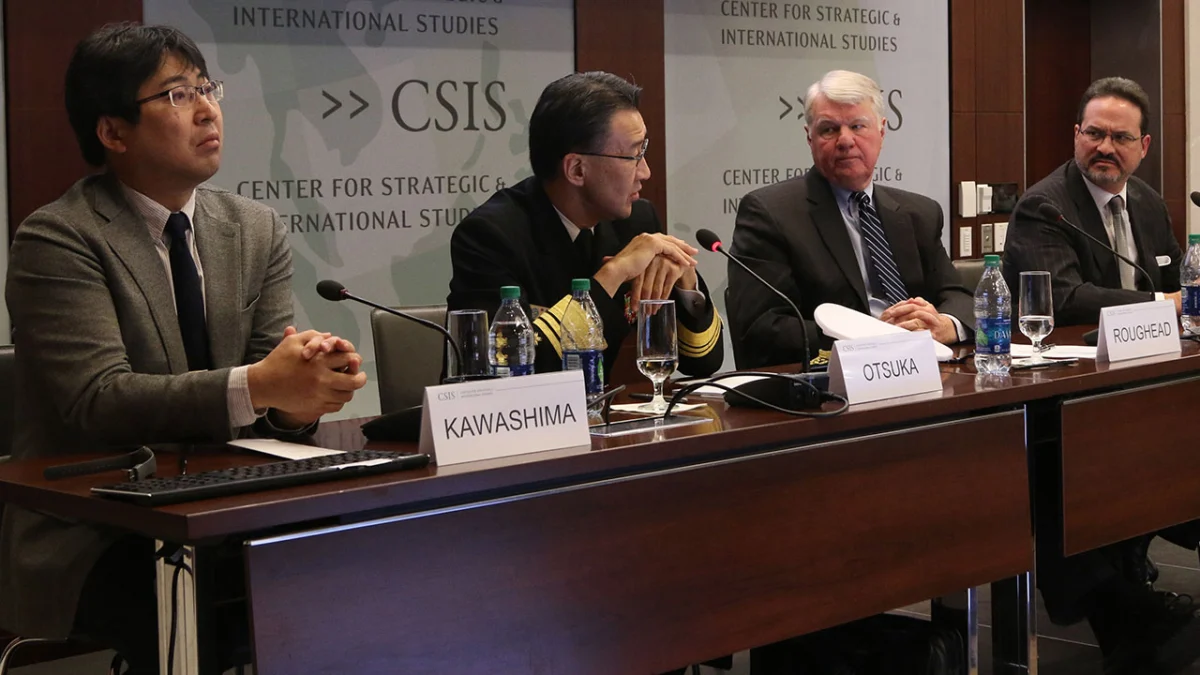
Following the introductions, the core of the seminar—a deep dive into maritime security—began at 3:15 p.m. The panel featured a distinguished group of experts: Vice Admiral Umio Otsuka, then-President of the Japan Maritime Self-Defense Force (JMSDF) Command and Staff College; Professor Shin Kawashima of the University of Tokyo; and Admiral Gary Roughead, a retired Chief of Naval Operations for the United States Navy.
The discussion focused on the operational synergy between the U.S. Navy and the JMSDF. The panelists analyzed the changing nature of maritime domain awareness, the integration of intelligence, surveillance, and reconnaissance (ISR) capabilities, and the importance of interoperability during high-intensity scenarios. By 4:30 p.m., the floor was opened for a Q&A session, where participants discussed the implications of China’s naval modernization and the role of third-party regional partners in maintaining the rules-based order. The event concluded at 5:00 p.m., followed by a reception that facilitated further networking among the defense and policy communities.
Supporting Data and Strategic Implications
To understand the weight of the 2016 discussions, one must look at the data governing the regional maritime environment at the time. In 2016, the Asia-Pacific region accounted for nearly 30% of global trade, with a vast majority of that commerce traversing the South and East China Seas. The increasing frequency of incursions into the Senkaku Islands’ contiguous zone by Chinese coast guard vessels created a sustained pressure on Japanese maritime assets.

According to data available to defense planners in 2016, the JSDF had been managing a record number of scrambles and maritime monitoring operations. The seminar highlighted that the U.S.-Japan alliance was tasked with a dual mission: deterring unilateral changes to the status quo through force and maintaining diplomatic channels to prevent accidental escalations. The panel underscored that maritime security is not just about kinetic capabilities, but also about international legal frameworks, specifically the United Nations Convention on the Law of the Sea (UNCLOS), which served as the bedrock of the rules-based order the alliance sought to protect.
Official Responses and Academic Perspectives
The contributions from the Ministry of Foreign Affairs of Japan were instrumental in setting the tone for the seminar. By sponsoring the event, the Ministry signaled that public discourse and transparent communication between American and Japanese experts were vital to maintaining domestic support for the alliance.
Admiral Gary Roughead’s insights during the panel were particularly salient, as he brought decades of command experience to the table. He argued that the “human element” of the alliance—the personal relationships between American and Japanese sailors and officers—was as important as the hardware systems shared between the two nations. Professor Shin Kawashima provided a crucial historical context, reminding the audience that maritime disputes in the region were deeply rooted in 20th-century history, requiring a nuanced, long-term diplomatic strategy rather than short-term tactical responses.
Broader Impact and Long-term Significance
The 2016 CSIS U.S.-Japan Security Seminar left a lasting impact on the trajectory of bilateral policy. It served as a bridge between the legislative shifts of 2015 and the practical, day-to-day naval cooperation that defined the latter half of the decade. The discussions helped frame the "Free and Open Indo-Pacific" (FOIP) concept, which would soon become the central pillar of U.S. regional strategy under successive administrations.
Furthermore, the seminar highlighted the importance of "middle power" diplomacy. By involving academics like Professor Kawashima alongside high-ranking military officials, the event illustrated that security is a holistic endeavor. It requires not just the deployment of destroyers, but a robust understanding of the political, economic, and historical currents that drive regional actors.
The implications of the seminar were clear: the U.S.-Japan alliance was no longer focused solely on the defense of the Japanese home islands. Instead, it was evolving into a global partnership capable of projecting stability across the Indo-Pacific. This shift required a more sophisticated approach to alliance management, characterized by frequent joint exercises, shared technological development, and synchronized messaging regarding international law.
Conclusion: A Foundation for the Future
Looking back at the transcriptions and recordings of the March 4, 2016 event, it is evident that the concerns raised by the panelists remain highly relevant in the contemporary security climate. Issues such as grey-zone coercion, the vulnerability of undersea cables, and the modernization of naval aviation were all nascent topics during the 2016 seminar that have since matured into central challenges.
The seminar remains a testament to the institutional memory of organizations like CSIS and JIIA. By providing a platform for critical analysis, these institutions ensured that the U.S.-Japan alliance was equipped with the intellectual rigor needed to face an increasingly complex international order. The 2016 event did not merely recount the history of the alliance; it helped define its future, establishing a roadmap for security cooperation that continues to influence the strategic calculations of both Washington and Tokyo today. As the Asia-Pacific region continues to evolve, the lessons from that March afternoon—emphasizing cooperation, vigilance, and the adherence to a rules-based order—remain the essential tenets of the U.S.-Japan relationship.