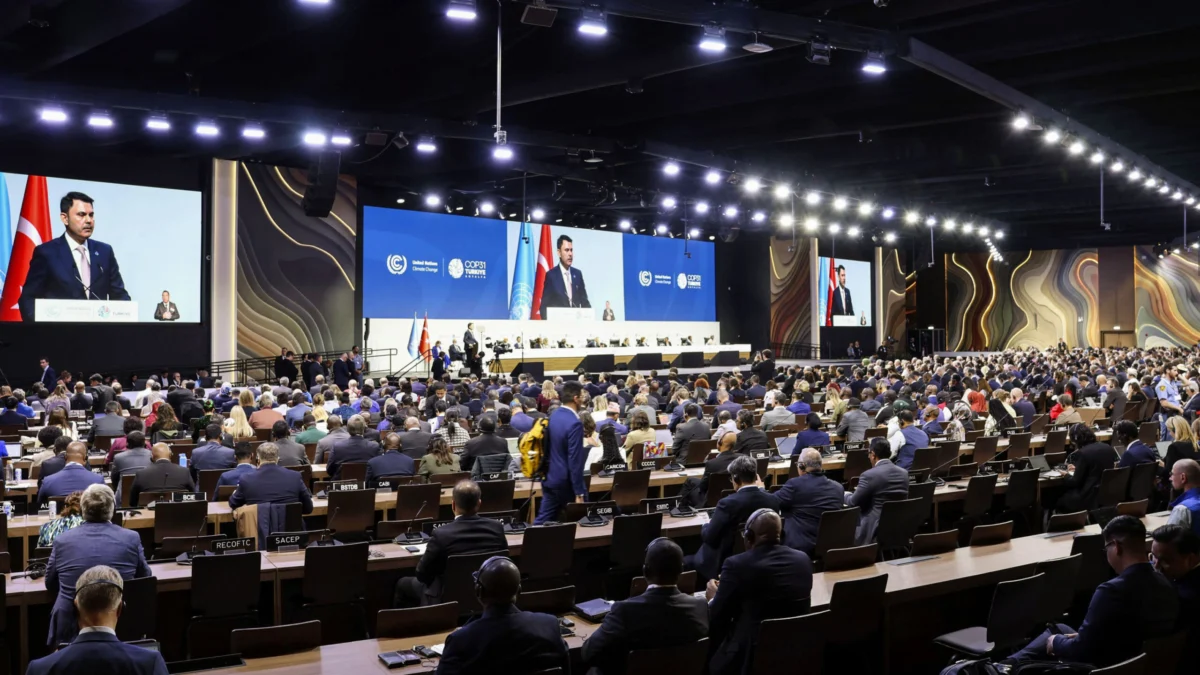
Thousands of delegates, industry lobbyists, policymakers, and international journalists have converged on the Mediterranean coastal city of Antalya, Turkey, for the formal opening of the United Nations Climate Change Conference, widely known as COP31. Commencing on November 8, the two-week summit runs through November 20, serving as a critical global temperature check on humanity’s collective ability to mitigate, finance, and adapt to accelerating global climate change.
Co-hosted by Turkey and Australia, COP31 arrives during a period of acute geopolitical instability and profound ecological anxiety. Against the backdrop of volatile energy markets, ongoing regional conflicts in the Middle East, and growing frustration over stalled emissions targets, the formal agenda focuses heavily on two contentious pillars: comprehensive climate finance and the future trajectory of fossil fuel dependency.
As negotiators settle into plenary halls and closed-door drafting sessions, the overarching consensus among climate scientists and policy analysts is that the conference faces an uphill battle. With global temperatures creeping dangerously close to breaching critical thresholds established by international treaties a decade ago, the pressure on delegations to deliver actionable, binding commitments has arguably never been higher.
A Fractured Landscape: Geopolitical Tensions and US Absence
The atmosphere at COP31 is notably charged, shaped in large part by shifting geopolitical alliances and domestic political realignments in major industrialized nations. Most notably, this year’s summit marks the second consecutive Conference of the Parties convened without a formal diplomatic delegation from the United States. Following the formal withdrawal of the country from the Paris Agreement earlier in the year, the administration has continued procedural steps to exit the broader UN Framework Convention on Climate Change (UNFCCC)—the foundational treaty that enables direct participation in the negotiations. The absence of the world’s second-largest historical emitter casts a long shadow over discussions concerning global burden-sharing and financial contributions.
Compounding these diplomatic hurdles is the continuing fallout from the war in Iran and broader conflict in the Middle East. The resulting disruption to regional oil and gas supplies has sent shock waves through international energy markets, triggering spikes in fuel prices that have complicated domestic political calculations for governments hesitant to impose stringent fossil fuel restrictions on their constituents.
Furthermore, confidence in the durability of the Paris Agreement—forged eleven years ago with the central objective of limiting global warming to 1.5 degrees Celsius above pre-industrial levels—is severely tested. A landmark report published by the UN Environment Program (UNEP) in September confirmed that global warming is tracking well beyond the 1.5-degree ceiling, with scientists projecting that the threshold will likely be breached within the next few years. This grim scientific reality has transformed the dialogue at COP31 from an abstract debate over long-term goals into an urgent triage operation.
Chronology of Climate Commitments: From Paris to Antalya
Understanding the baseline of COP31 requires examining the trajectory of recent UN climate summits and the incremental, often contentious progress made by member states:
- December 2015 (COP21): The adoption of the landmark Paris Agreement, establishing the aspirational goal of holding global temperature increases to well below 2 degrees Celsius while pursuing efforts to limit the increase to 1.5 degrees Celsius.
- November 2023 (COP28 in Dubai): For the first time in the history of the UN climate talks, the final agreement text explicitly called on nations to transition away from fossil fuels in energy systems, signaling a historic, albeit non-binding, rhetorical shift.
- November 2024 (COP29 in Baku): Delegates established a new collective quantified goal, committing to mobilize $300 billion per year by 2035 to assist developing nations with emission reductions and climate adaptation. Concurrently, developed countries surpassed their previous $100 billion annual climate finance benchmark, with the Organisation for Economic Co-operation and Development (OECD) reporting contributions reaching $136.7 billion.
- November 2025 (COP30 in Belém): The final agreement emphasized adaptation funding, setting a target to triple financial support for climate resilience over the following decade. However, final text conspicuously omitted any direct mention of "fossil fuels," prompting criticism from vulnerable nations and environmental advocates.
- November 2026 (COP31 in Antalya): Current negotiations grapple with the implementation gap, seeking to bridge the chasm between financial pledges and actual capital deployment while managing the divergent economic interests of the co-hosts.
Financing Adaptation and the Rising Toll of Loss and Damage
At the core of the negotiations is the perennial friction between wealthy industrialized nations historically responsible for the majority of greenhouse gas emissions and developing economies bearing the brunt of ecological destruction. While frameworks like the $300 billion annual mobilization target by 2035 provide a long-term horizon, immediate liquidity remains chronically insufficient.
The human and economic cost of this funding gap was underscored earlier this year in the Himalayas. In August, a catastrophic glacier collapse triggered massive, unprecedented flooding across Nepal, resulting in approximately 1,500 fatalities, more than 5,000 missing persons, and nearly $5 billion in infrastructure and agricultural damage. In response, the UN’s dedicated loss and damage fund committed $20 million to assist Nepal’s recovery—a figure representing less than 1% of the total estimated economic loss suffered by the nation.
Developing countries at COP31 are pressing for more predictable, grant-based financing rather than debt-inducing loans, arguing that climate-vulnerable states should not be forced into fiscal insolvency to recover from disasters they did nothing to cause.
The Fossil Fuel Debate and Host Country Paradoxes
The formal agenda’s treatment of fossil fuels remains a touchstone for the credibility of the UN process. Three years after COP28 explicitly referenced transitioning away from coal, oil, and gas, subsequent texts have grown softer due to pushback from petro-states and resource-dependent economies.
The selection of Turkey and Australia as co-hosts has injected additional irony and scrutiny into the proceedings. Australia remains one of the world’s leading exporters of metallurgical and thermal coal, alongside liquefied natural gas (LNG), while Turkey’s domestic power grid continues to rely heavily on coal-fired electricity generation. Both nations face intense domestic and international pressure to reconcile their national economic models with their diplomatic obligations as COP presidents.
Side Agendas, AI Sustainability, and Electrification Targets
Beyond the rigid constraints of the formal negotiation text, COP31 President Murat Kurum, serving as Turkey’s environment minister, has championed an ambitious parallel side agenda. While these informal initiatives lack the binding enforcement mechanisms of the official treaty, they serve as political barometers for voluntary international cooperation.
One prominent initiative involves a voluntary pledge aimed at improving the environmental sustainability of artificial intelligence (AI) infrastructure. As data centers expand globally to train and host resource-intensive AI models, their electricity and water demands have surged. However, critics note that the current draft of the pledge contains no mandatory compliance frameworks or regulatory penalties, rendering it largely symbolic.
A more concrete target advanced by the COP leadership focuses on the electrification of the global economy. According to current international energy data, electricity accounts for approximately 23% of total global energy consumption, with the remainder powered directly by fossil fuels such as petroleum for transportation and natural gas for industrial heating and residential spaces. The new voluntary initiative challenges member nations to expand electricity’s share of total energy consumption to 35% by 2035, provided that the newly generated power comes from clean, renewable sources.
Outlook and Implications
As delegates navigate two weeks of intense diplomatic maneuvering in Antalya, expectations remain pragmatically tempered. Billed by organizers as an "implementation COP," the summit’s ultimate success will not be measured by the rhetoric of its opening speeches, but by whether participating governments can translate past promises into transparent, verifiable domestic policies.
With global emissions continuing to challenge international containment efforts and financing mechanisms struggling to match the velocity of climate disasters, COP31 stands as a crucial test of multilateralism’s capacity to deliver real-world solutions before critical ecological tipping points are permanently crossed.