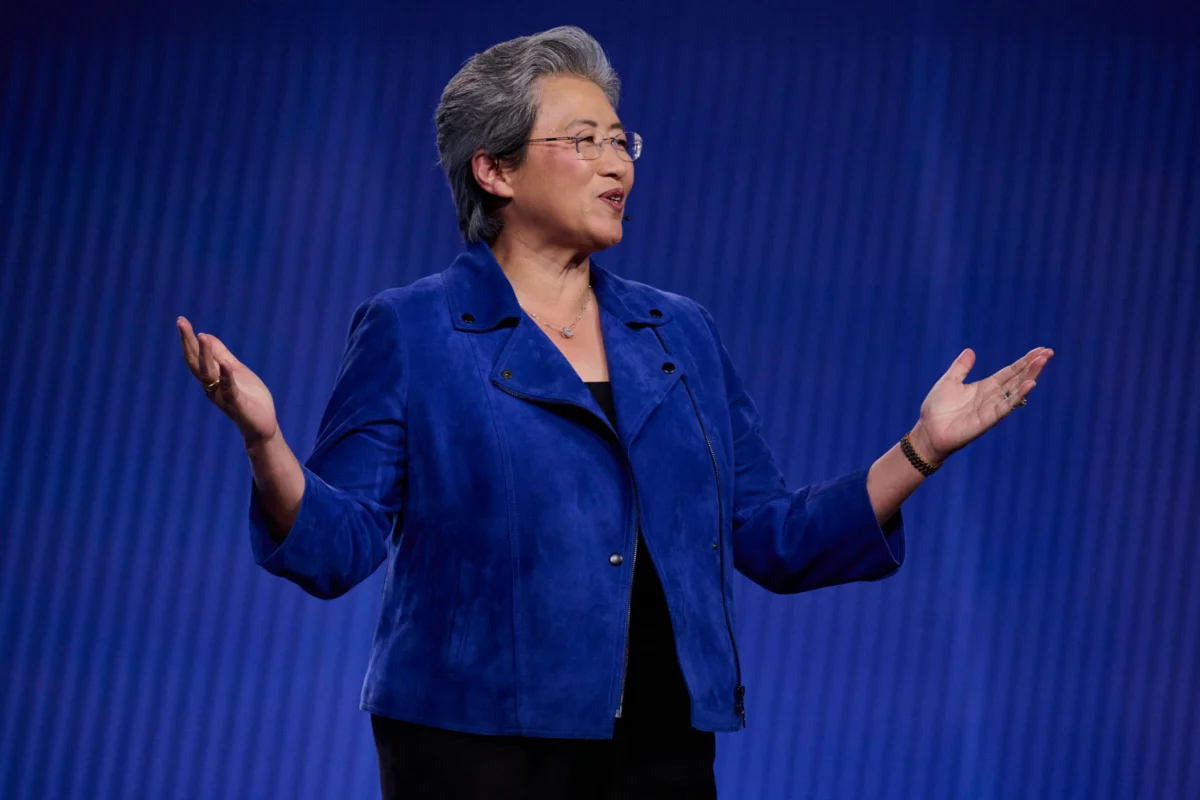
At the sold-out Advancing AI conference in San Francisco this Thursday, Advanced Micro Devices (AMD) moved to solidify its position as a primary architect of the artificial intelligence era. Chair and CEO Dr. Lisa Su unveiled the company’s latest strategic pivot: the Helios rack-scale system. Designed to meet the gargantuan compute requirements of the world’s most sophisticated AI laboratories, Helios represents AMD’s most direct challenge to date against Nvidia’s long-standing hegemony in the high-performance computing (HPC) and data center sectors.
The announcement signals a maturation in AMD’s hardware roadmap, moving beyond mere component manufacturing to offer comprehensive, integrated infrastructure solutions. As global hyperscalers scramble to build out capacity for increasingly complex "frontier" AI models, the battle for the data center has shifted from individual GPU performance to the efficiency and scalability of full-stack, rack-scale systems.
A Technological Powerhouse: Understanding the Helios System
A rack-scale system is the foundational unit of modern AI infrastructure. By combining dozens of high-performance processors, memory modules, and interconnects into a single, optimized enclosure, these systems allow for the training and inference of massive neural networks that would be impossible to manage on disparate hardware.
Helios is marketed by AMD as the industry’s highest-performance AI rack. While technical specifications are granular, early reports suggest that the system’s performance benchmarks in specific workloads may exceed those of Nvidia’s current flagship offerings, including the Vera Rubin and Grace Blackwell architectures. The system is engineered to handle gigawatt-scale deployments, providing the dense compute capacity required for training next-generation large language models (LLMs).
The physical scale of the hardware is as significant as its digital throughput. First teased in 2025 and displayed on stage at CES 2026, the Helios rack is an engineering feat that reflects the immense thermal and power demands of modern silicon. Its deployment is expected to be a key driver for AMD’s revenue growth as it ships to enterprise customers later this year.
Strategic Adoption: Building an Ecosystem of Hyperscalers
The viability of a new hardware architecture in the data center market depends heavily on adoption by the world’s largest cloud service providers. AMD has effectively secured a roster of blue-chip clients, signaling strong market confidence in the Helios platform.
Microsoft has emerged as a central partner, with CEO Satya Nadella confirming that the company plans to integrate Helios into its Azure cloud infrastructure. This move is significant, as it provides AMD with a massive pipeline for scaling its hardware within one of the world’s largest AI ecosystems. Furthermore, a strategic partnership announced on Wednesday between AMD and Anthropic involves the deployment of up to two gigawatts of the company’s Instinct MI450 series GPUs via the Helios platform.
The list of confirmed partners—which also includes Meta, OpenAI, and Oracle—underscores a collective industry desire for a viable alternative to Nvidia’s closed-loop software and hardware ecosystem. By offering an open, programmable silicon environment, AMD is positioning itself as the "developer-friendly" choice for firms wary of vendor lock-in.
The Venice-X CPU and Future-Proofing
Beyond the Helios rack, AMD is preparing for the next iteration of general-purpose data center compute. The company introduced the Venice-X CPU, slated for a 2027 release. Featuring 96 cores and a massive 1,152 MB of 3D V-Cache, the Venice-X is designed to handle the high-intensity data management tasks that accompany AI model training.
This hardware, built on the Zen 6 architecture, serves as a pillar for the "full-stack" approach Su is championing. As AI models become more memory-bound, the ability of the CPU to feed data to the GPU—and to manage complex orchestration tasks—becomes a critical bottleneck. The Venice-X is intended to solve these latency issues, ensuring that the GPU clusters within the Helios racks operate at peak efficiency.
Market Projections: The Trillion-Dollar Horizon
During her keynote address, Dr. Su provided a macroeconomic outlook that frames the current arms race as a fundamental shift in the global economy. Projecting the total addressable market (TAM) for AI accelerators, she cited a figure of $1.4 trillion by 2030.
"What that means is, by the end of the decade, the AI accelerator market is going to approach the size of the entire semiconductor market today," Su stated. This observation aligns with data from industry analysts who note that the demand for "agentic AI"—systems capable of reasoning, tool-calling, and autonomous decision-making—is creating an exponential increase in compute demand.
Unlike previous waves of computing, which were driven by static data processing, the agentic era requires a continuous, iterative loop of reasoning. Each step in this process requires significant GPU cycles. Su emphasized that because AI algorithms remain in their infancy, the ability to reprogram and optimize silicon on the fly is a competitive advantage. This favorability toward programmable ecosystems is the core tenet of AMD’s long-term strategy.
Contextualizing the Rivalry
The rivalry between AMD and Nvidia has evolved from a competition for PC gaming dominance into a high-stakes battle for the backbone of the global digital economy. Nvidia’s success has been built on the CUDA software platform, which has effectively acted as a "moat," keeping developers tethered to its hardware for over a decade.
AMD’s counter-strategy relies on three pillars:
- Performance Parity: Delivering hardware that matches or exceeds the raw throughput of Nvidia’s latest chips.
- Open Standards: Emphasizing the ROCm software stack and open-source frameworks to lower the barrier to entry for developers.
- Supply Chain Resilience: Leveraging its position as a major foundry client to ensure that as demand surges, supply remains stable.
The industry is currently in a "wait-and-see" period regarding how well Helios will integrate with existing, Nvidia-heavy data centers. Analysts note that while the hardware specs are competitive, the migration of massive AI models from one proprietary ecosystem to another is a non-trivial engineering task.
Implications for the Broader Tech Sector
The introduction of the Helios system and the upcoming Venice-X CPUs reflect a broader trend in the tech industry: the commoditization of specialized AI hardware. As the industry moves toward massive, gigawatt-scale data centers, the focus is shifting toward energy efficiency and total cost of ownership (TCO).
For enterprise clients like Anthropic and Meta, the ability to diversify their hardware procurement is not just about price—it is about risk management. By fostering a more competitive market for AI silicon, these companies are ensuring that they are not beholden to the pricing and production schedules of a single manufacturer.
Furthermore, Su’s comments regarding the 2030 market outlook highlight that the "AI bubble" narrative is being countered by real-world infrastructure investment. The capital expenditure (CapEx) currently being poured into these data centers by companies like Microsoft and Meta serves as a leading indicator of sustained demand for the hardware AMD is producing.
Conclusion
As AMD prepares to roll out its Helios systems later this year, the company finds itself at a critical juncture. The success of its rack-scale strategy will likely dictate its market share for the remainder of the decade. By aligning its hardware roadmap with the needs of the most advanced AI laboratories and providing a clear, long-term vision for the expansion of the accelerator market, AMD has successfully positioned itself as the primary challenger to the current AI status quo.
While Nvidia remains the incumbent leader, the combination of high-performance hardware, strategic partnerships with hyperscalers, and a growing emphasis on programmable silicon suggests that the data center market is entering a new, more competitive phase. For AMD, the goal is clear: to ensure that as the world builds the "brains" of the future, they are powered by the company’s own silicon.