On March 4, 2016, the Center for Strategic and International Studies (CSIS) hosted a landmark security seminar dedicated to the enduring partnership between the United States and Japan. Held against a backdrop of increasing geopolitical tension in the Asia-Pacific, the event brought together high-level policy experts, military strategists, and academic leaders to evaluate the status of the U.S.-Japan alliance. The seminar, supported by the Ministry of Foreign Affairs of Japan, focused on the evolving security architecture of the region, specifically emphasizing the imperative of maritime domain awareness and the strategic necessity of a unified response to regional provocations.
Historical Context and Strategic Alignment
The 2016 seminar occurred at a pivotal moment in international relations. Throughout the early 2010s, the Asia-Pacific region witnessed a marked shift in the security environment, characterized by rapid modernization of naval forces and competing territorial claims in the South and East China Seas. Japan, under the administration of Prime Minister Shinzo Abe, had been pursuing a policy of "proactive contribution to peace," which sought to expand the scope and operational capabilities of the Japan Self-Defense Forces (JSDF). Simultaneously, the United States was in the midst of its "pivot" or "rebalance" to the Asia-Pacific, an strategic initiative designed to prioritize the region’s stability in the face of rising economic and military power dynamics.
The collaboration between CSIS and the Japan Institute of International Affairs (JIIA) served as a platform for reaffirming that the alliance was not merely a Cold War relic but a dynamic framework essential for maintaining the rules-based international order. By 2016, the bilateral security guidelines—revised just a year prior—had fundamentally altered the parameters of cooperation, allowing for closer integration in logistics, intelligence sharing, and crisis management.
Seminar Proceedings and Key Contributions
The event commenced with a formal dialogue between Michael J. Green, the Senior Vice President for Asia and Japan Chair at CSIS, and Yoshiji Nogami, the President of JIIA. Their opening remarks established the seminar’s central theme: the transition from a passive security partnership to an active, integrated defense network capable of responding to multifaceted maritime threats.
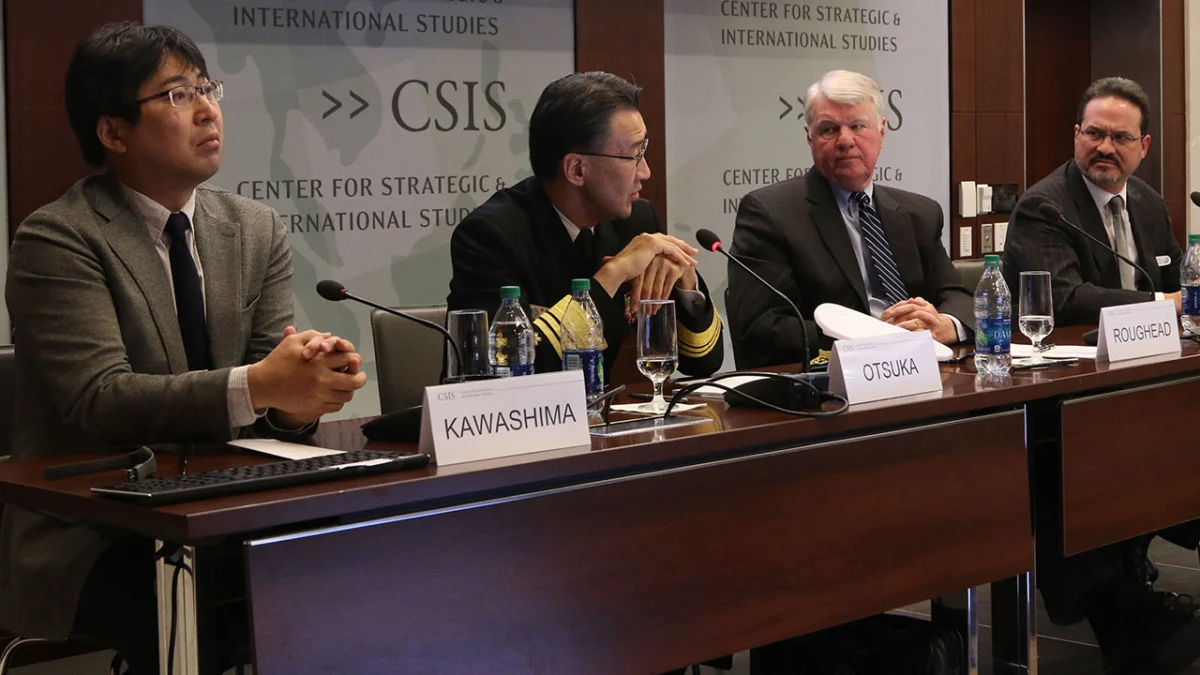
The core of the seminar featured a panel discussion titled "The U.S.-Japan Alliance and Maritime Security in the Asia-Pacific Region." The panel included notable figures such as Vice Admiral Umio Otsuka, then-President of the Japan Maritime Self-Defense Force Command and Staff College; Professor Shin Kawashima of the University of Tokyo; and Admiral Gary Roughead, USN (Ret.), a former Chief of Naval Operations.
The panel analyzed the "gray zone" tactics—actions that fall short of conventional war but challenge sovereign control—that were increasingly prevalent in the region. Admiral Roughead emphasized the necessity of persistent presence and the importance of interoperability between the U.S. Navy and the Japan Maritime Self-Defense Force. He argued that the alliance’s strength was predicated on its ability to project power and maintain freedom of navigation, which were the cornerstones of maritime stability. Professor Kawashima provided a historical and academic lens, detailing how the maritime environment was being redefined by the intersection of domestic nationalist sentiments and international legal frameworks, particularly regarding the United Nations Convention on the Law of the Sea (UNCLOS).
Data and Geopolitical Realities
The discussions were grounded in the reality of the 2016 security landscape. Data from the period indicated that the number of maritime incursions in the East China Sea had reached record highs. For instance, reports from the Japan Coast Guard highlighted a consistent increase in the presence of foreign government vessels near the Senkaku Islands. These incidents underscored the urgency of the dialogue; the alliance needed to move beyond conceptual alignment toward actionable contingency planning.

Furthermore, the economic interdependence of the region provided a stark contrast to the security friction. In 2016, Japan and the United States were heavily engaged in the negotiations for the Trans-Pacific Partnership (TPP), an economic agreement that was viewed by many strategists as the commercial counterpart to the security alliance. The seminar participants noted that economic stability was inseparable from maritime security, as the vast majority of global trade traversed these contested waters.
Chronology of the 2016 Seminar
The afternoon’s schedule reflected the technical and high-level nature of the discussions:
- 3:00 p.m. – 3:15 p.m.: Welcoming remarks delivered by Michael J. Green and Yoshi Nogami, setting the stage for the bilateral cooperation agenda.
- 3:15 p.m. – 4:30 p.m.: A deep-dive session on maritime security, featuring insights from Vice Admiral Umio Otsuka, Professor Shin Kawashima, and Admiral Gary Roughead. The discussion explored the role of technology, such as undersea surveillance and satellite monitoring, in mitigating regional risks.
- 4:30 p.m. – 5:00 p.m.: A comprehensive Q&A session where audience members—comprising policymakers, defense analysts, and members of the press—interrogated the panelists on the future of the alliance under shifting domestic political pressures in both Washington and Tokyo.
- 5:00 p.m.: Formal adjournment followed by a reception, allowing for off-the-record networking and the continuation of high-level discourse.
Implications and Lasting Impact
The 2016 U.S.-Japan Security Seminar proved to be a harbinger of the defense policies that would define the latter half of the decade. The emphasis on "integrated deterrence"—a concept that would later become a formal pillar of U.S. defense strategy—was clearly visible in the rhetoric of the participants. By advocating for closer operational ties, the seminar helped shape the intellectual consensus that the U.S.-Japan alliance must be the bedrock of security in the Indo-Pacific.
The analysis presented during the event suggested that the primary challenge for the alliance was not necessarily a lack of political will, but the technical and legal complexities of modern maritime warfare. The discussion on "gray zone" operations was particularly prophetic, as the techniques discussed—such as the use of maritime militias and the construction of artificial features in disputed waters—became dominant features of regional instability in the years that followed.
The Role of Diplomatic Support
The event was made possible through the support of the Ministry of Foreign Affairs of Japan. This underscores the importance Japan placed on public diplomacy and track-two dialogue as a means of bolstering its security objectives. By supporting venues like CSIS, the Japanese government sought to socialize its security concerns within the Washington policy community, ensuring that the U.S. foreign policy establishment remained focused on the Asia-Pacific despite competing crises in the Middle East and Europe at the time.
Michael J. Green, through his role as the Henry A. Kissinger Chair and his extensive experience in the National Security Council, played a crucial role in framing these discussions as vital to the broader American national interest. His leadership in these seminars has historically ensured that the U.S.-Japan alliance is treated not as a static arrangement, but as an evolving, adaptive partnership that responds to the changing realities of global power.
Conclusion
The 2016 U.S.-Japan Security Seminar serves as a historical document that captures the anxieties and strategic foresight of a critical era. By convening the brightest minds in maritime strategy and diplomatic history, the seminar provided a roadmap for how two sovereign nations could navigate the complexities of a changing maritime order. As the world continues to grapple with the issues of sovereignty, freedom of navigation, and regional stability, the insights shared at the 2016 seminar remain highly relevant. The enduring takeaway from the event is the recognition that the U.S.-Japan alliance is not merely a regional security pact, but a foundational pillar of the global architecture that enables peace and prosperity in the twenty-first century. The collaboration between organizations like CSIS and JIIA continues to be a vital exercise in ensuring that the democratic principles governing international waters remain secure for all nations.