The 2016 U.S.-Japan Security Seminar, hosted at the Center for Strategic and International Studies (CSIS) on March 4, 2016, served as a pivotal forum for examining the evolving strategic landscape of the Asia-Pacific region. As maritime disputes intensified and the geopolitical weight of the Indo-Pacific grew, the seminar brought together senior officials, military leaders, and academic experts to address the durability and necessity of the U.S.-Japan alliance. The event, supported by the Ministry of Foreign Affairs of Japan, underscored the critical role of naval cooperation, policy alignment, and diplomatic engagement in maintaining regional stability.
The Strategic Context of the 2016 Seminar
The seminar took place during a period of significant regional volatility. In 2016, the Asia-Pacific was marked by increasing assertiveness in the South China Sea, where land reclamation projects were transforming disputed features into military outposts. Simultaneously, the U.S.-Japan security relationship was undergoing a transformation, following the 2015 passage of new security legislation in Japan that allowed for a more expansive interpretation of collective self-defense.
The dialogue was led by Michael J. Green, then Senior Vice President for Asia and Japan Chair at CSIS, and featured a keynote conversation with Yoshiji Nogami, President of the Japan Institute of International Affairs (JIIA). The discourse was designed to bridge the gap between academic theory and operational reality, focusing on how the two nations could synchronize their responses to potential maritime contingencies.
Chronology of the Proceedings
The seminar commenced at 3:00 p.m. EST with opening remarks by Michael J. Green and Yoshiji Nogami. Both speakers emphasized the indispensable nature of the alliance, noting that the partnership was no longer merely a bilateral arrangement but a cornerstone of regional order.
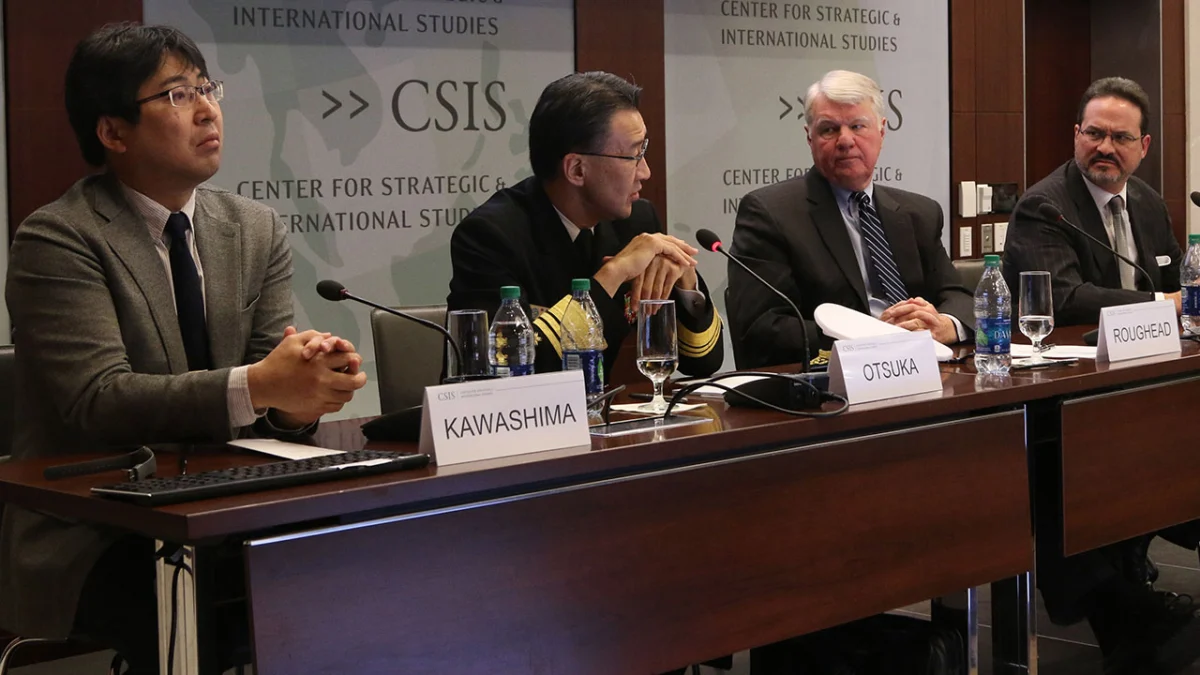
Following the opening, the primary session, titled "The U.S.-Japan Alliance and Maritime Security in the Asia-Pacific Region," convened at 3:15 p.m. The panel featured high-level strategic thinkers, including Vice Admiral Umio Otsuka, President of the Japan Maritime Self-Defense Force (JMSDF) Command and Staff College; Professor Shin Kawashima of the University of Tokyo; and Admiral Gary Roughead, USN (Ret.), the former Chief of Naval Operations.
The discussion focused on three primary pillars:
- Interoperability: The technical and procedural requirements for the U.S. Navy and the JMSDF to operate as a singular, cohesive maritime force.
- Domain Awareness: The importance of real-time intelligence sharing regarding submarine activity and surface vessel movements in the East and South China Seas.
- Legal Frameworks: A discussion of how the 2015 security reforms would manifest in practical maritime operations, particularly concerning gray-zone tactics that fall short of traditional warfare.
At 4:30 p.m., the seminar transitioned to an open Q&A session, where attendees addressed the challenges posed by North Korean ballistic missile testing and the potential for unintended escalations in the maritime domain. The event concluded at 5:00 p.m. with a reception, fostering continued dialogue between policymakers and regional analysts.
Supporting Data and Strategic Considerations
The 2016 seminar was rooted in several stark realities facing the maritime domain. According to reports from the period, the U.S. and Japan were managing a complex balance of power. The U.S. Pacific Command (now Indo-Pacific Command) was tasked with maintaining a "free and open" maritime environment, while the JMSDF was expanding its capacity to project power beyond the Japanese archipelago.

Statistical indicators highlighted during the period emphasized the reliance of global trade on the South China Sea—a waterway through which approximately one-third of the world’s shipping passes. The economic implications of maritime instability were paramount. By 2016, Japan remained the largest foreign investor in the ASEAN region, with significant assets tied to the security of these shipping lanes. This economic interdependence was a primary driver for the increased focus on maritime security cooperation highlighted during the CSIS proceedings.
Official Perspectives and Expert Analysis
During the seminar, Admiral Gary Roughead (Ret.) emphasized that the alliance’s strength lay not just in the hardware of the ships, but in the trust between the crews and the commanders. His perspective was echoed by Vice Admiral Umio Otsuka, who highlighted the JMSDF’s transition toward a more proactive role in international maritime security, moving away from a strictly defensive stance to one of active regional guardianship.
Professor Shin Kawashima provided the academic framework, analyzing how domestic political shifts in Tokyo and Washington were influencing foreign policy. He noted that despite the political polarization in both capitals, the consensus on the necessity of the U.S.-Japan alliance remained remarkably robust, acting as a "stabilizing anchor" amidst regional political fluctuations.
Broader Implications and Long-term Impact
The 2016 U.S.-Japan Security Seminar was more than a academic gathering; it was a manifestation of the "pivot" to Asia, a U.S. foreign policy priority that sought to emphasize the region’s long-term strategic importance. The implications of the seminar were felt in several key areas:
1. Institutionalization of Cooperation: The event accelerated the frequency of high-level consultations between the U.S. Navy and the JMSDF. It helped standardize the terminology and protocols for joint maritime patrols, which would become more frequent in the years that followed.
2. Gray-Zone Strategy: The seminar helped clarify the concept of "gray-zone" conflict—activities that are coercive but do not trigger formal military conflict. By discussing these threats openly, the participants helped create a common lexicon that allowed for more nuanced policy development in the years after 2016.
3. Regional Assurance: The public nature of the seminar served as a signal to regional actors that the U.S.-Japan alliance was not in decline but was instead modernizing to meet 21st-century threats. This served as a deterrent, reinforcing the idea that any attempt to unilaterally alter the status quo in the maritime domain would be met with a coordinated, alliance-based response.
Conclusion: The Lasting Value of the Dialogue
The 2016 U.S.-Japan Security Seminar remains a touchstone for understanding the trajectory of Pacific security. By focusing on the intersection of maritime technology, legal frameworks, and geopolitical strategy, the seminar provided a roadmap for how the two nations would manage the rise of new maritime powers and the complexities of regional security.
The support provided by the Ministry of Foreign Affairs of Japan for this event underscored the importance of transparency in security cooperation. As the world moves further into the 21st century, the themes discussed in this 2016 session—interoperability, domain awareness, and the maintenance of a rules-based order—continue to serve as the pillars upon which the U.S.-Japan relationship is built. The seminar demonstrated that in an era of rapid technological and geopolitical change, the durability of an alliance is found in the continued commitment to dialogue, shared interests, and a common vision for a stable and secure Asia-Pacific region. Through the contributions of experts like Michael J. Green and Admiral Gary Roughead, the seminar succeeded in grounding the abstract concepts of geopolitics in the tangible realities of maritime security, leaving a lasting impact on how both nations approach the challenges of the Pacific theater.