The 2016 U.S.-Japan Security Seminar, hosted by the Center for Strategic and International Studies (CSIS) on March 4, 2016, served as a pivotal forum for evaluating the evolving nature of the bilateral security partnership between Washington and Tokyo. Held at a time of heightened regional anxiety, the seminar focused on the structural challenges of maritime security, the modernization of defense guidelines, and the deepening integration of the U.S.-Japan alliance in the face of shifting geopolitical dynamics in the Indo-Pacific.
The Geopolitical Landscape of 2016
The 2016 seminar took place during a period of significant transition for both nations. Japan, under the administration of Prime Minister Shinzo Abe, had recently pushed forward with controversial security legislation that expanded the role of the Japan Self-Defense Forces (JSDF), allowing for a more proactive defense posture. Meanwhile, the United States was navigating the complexities of its "Pivot to Asia" (or Rebalance) policy, seeking to reaffirm its commitments to regional allies while managing the rise of Chinese maritime assertiveness in the East and South China Seas.
The event featured a high-level dialogue between key strategic thinkers, including Michael J. Green, the Senior Vice President for Asia and Japan Chair at CSIS, and Yoshiji Nogami, President of The Japan Institute of International Affairs (JIIA). The discussions were framed by the necessity of maintaining a "Free and Open Indo-Pacific," a concept that was beginning to take center stage in the foreign policy rhetoric of both the Obama and Abe administrations.
Chronology of the Seminar Proceedings
The seminar commenced with welcoming remarks from Michael J. Green and Yoshi Nogami, setting the stage for a critical examination of the alliance’s future. The opening session emphasized that the U.S.-Japan relationship was no longer merely a regional security arrangement but a global partnership aimed at upholding international law and freedom of navigation.
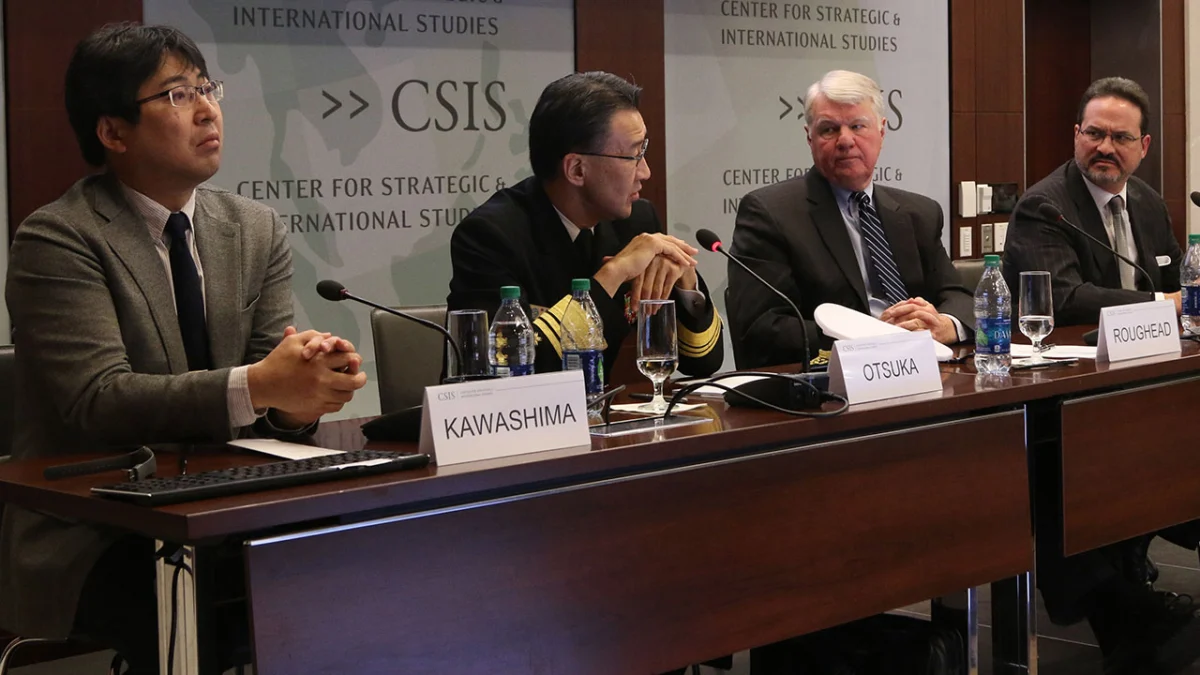
Following the opening, the keynote panel, titled "The U.S.-Japan Alliance and Maritime Security in the Asia-Pacific Region," explored the technical and strategic dimensions of naval cooperation. The panel included Vice Admiral Umio Otsuka, President of the Japan Maritime Self Defense Force Command and Staff College; Professor Shin Kawashima of the University of Tokyo; and Admiral Gary Roughead, USN (Ret.).
The session addressed several core issues:
- 3:15 p.m. – 4:30 p.m.: Strategic discussions regarding the implementation of the 2015 Guidelines for U.S.-Japan Defense Cooperation. These guidelines were fundamental in allowing for seamless cooperation between the U.S. Navy and the Japan Maritime Self-Defense Force (JMSDF) beyond the immediate defense of Japan.
- 4:30 p.m. – 5:00 p.m.: The Q&A segment allowed for an exploration of the domestic political hurdles faced by the Abe administration, particularly regarding the constitutional interpretation of collective self-defense.
- 5:00 p.m.: The event concluded with a reception, fostering deeper networking between defense officials, academic researchers, and policy analysts.
Supporting Data and Strategic Context
To understand the gravity of the 2016 seminar, one must look at the data governing the maritime domain at the time. In 2016, China’s defense budget was estimated by international observers to have grown by approximately 7.6 percent over the previous year, continuing a multi-decade trend of double-digit or high-single-digit expansion. This rapid modernization of the People’s Liberation Army Navy (PLAN) placed immense pressure on the JMSDF and the U.S. Seventh Fleet.
The seminar participants discussed the "A2/AD" (Anti-Access/Area Denial) capabilities being developed by regional powers, which threatened to undermine the conventional naval superiority the U.S. and Japan had enjoyed since the end of the Cold War. Admiral Gary Roughead, drawing on his extensive career, highlighted that the efficacy of the alliance relied not just on hardware—such as destroyers, submarines, and aircraft carriers—but on the interoperability of command structures. The seminar underscored the need for enhanced intelligence, surveillance, and reconnaissance (ISR) sharing to maintain maritime domain awareness in the volatile waters surrounding the Senkaku Islands and the broader South China Sea.

Official Perspectives and Policy Implications
The involvement of the Ministry of Foreign Affairs of Japan in sponsoring the event underscored the official nature of the dialogue. For Tokyo, the seminar was an opportunity to socialize the necessity of its new security laws to a skeptical domestic audience and a cautious regional neighbor.
Professor Shin Kawashima provided the academic perspective on the regional reaction to Japan’s policy shifts. He noted that while countries in Southeast Asia were generally receptive to a stronger Japanese security footprint, the reaction from Beijing remained consistently hostile. The seminar participants largely agreed that the U.S.-Japan alliance served as the "anchor" of regional stability, but cautioned that it must be accompanied by robust diplomatic engagement to avoid unnecessary escalation.
The implications of the 2016 seminar were far-reaching. It highlighted that the alliance was moving toward a more horizontal structure. Rather than a "hub-and-spoke" model where the U.S. dictated the security agenda, the 2016 era signaled the rise of a more equitable burden-sharing arrangement. This was seen as a necessary evolution to ensure the longevity of the alliance amid the fiscal constraints of the U.S. defense budget and the demographic challenges facing the Japanese military.
Analysis of the Alliance’s Trajectory
Retrospectively, the 2016 U.S.-Japan Security Seminar acted as a barometer for the shift from a post-Cold War peace to a period of "Great Power Competition." The seminar effectively identified that the maritime security environment was the primary theater where the rules-based international order would be tested.
By prioritizing the "maritime security" theme, CSIS and the JIIA anticipated the core pillars of the subsequent Indo-Pacific strategies adopted by later U.S. administrations. The integration of the JMSDF and the U.S. Navy described during the event paved the way for the later emergence of the "Quad" (the Quadrilateral Security Dialogue involving the U.S., Japan, Australia, and India).
Broader Impact and Legacy
The legacy of this event remains significant in the annals of U.S.-Japan relations. The seminar did not merely produce a list of recommendations; it solidified a consensus among the foreign policy elite that the alliance needed to be proactive rather than reactive.
The emphasis on maritime domain awareness and the necessity of seamless interoperability served as a roadmap for the subsequent years of defense planning. As the world moved further into the 21st century, the collaborative framework established at the 2016 seminar provided the necessary institutional trust to navigate the complexities of maritime disputes, technological competition, and the preservation of global commons.
In conclusion, the 2016 U.S.-Japan Security Seminar stands as a foundational moment in the mid-decade security architecture of the Asia-Pacific. By bringing together military leadership, academic rigor, and diplomatic support, the event reinforced the enduring necessity of the bilateral alliance. It confirmed that in an era of rapid change, the commitment of the United States and Japan to one another, and to the principles of freedom of navigation and the rule of law, would remain the defining feature of Pacific security. The insights shared during those two hours in March 2016 continue to inform the strategic calculations of policymakers in both Washington and Tokyo today, reminding the international community that security is a dynamic, ongoing process of adaptation, dialogue, and mutual commitment.