The enduring strength of the bilateral partnership between Washington and Tokyo took center stage as defense experts, geopolitical scholars, and retired military leadership converged for the 2016 U.S.-Japan Security Seminar. Held on March 4, 2016, from 3:00 to 5:00 p.m. EST, the high-level symposium provided a comprehensive platform to dissect the shifting balance of power in the Indo-Pacific, with a sharp focus on maritime security, regional deterrence, and the evolving operational scope of the U.S.-Japan alliance. Hosted by the Center for Strategic and International Studies (CSIS)—a premier foreign policy think tank based in Washington, D.C.—the event drew significant attention from policymakers, international relations scholars, and defense attachés tracking stability in East Asia.
The seminar arrived at a critical juncture in modern geopolitical history. Throughout the mid-2010s, the Asia-Pacific region experienced escalating territorial disputes, particularly in the South and East China Seas, alongside a dramatic modernization of regional naval fleets and an increasingly assertive military posture by the People’s Republic of China. Against this tense backdrop, the discussions at CSIS served not merely as an academic exercise, but as a timely evaluation of how allied capabilities could effectively maintain a free, open, and rules-based international maritime order. Generously supported by the Ministry of Foreign Affairs of Japan, the proceedings underscored the shared strategic calculus of both nations in addressing transnational security challenges, protecting vital sea lanes of communication, and reinforcing deterrence mechanisms across the maritime commons.
Chronology and Agenda of the Proceedings
The afternoon seminar followed a meticulously structured agenda designed to transition from high-level diplomatic assessments down to granular operational and strategic challenges.
The event commenced at 3:00 p.m. with welcoming remarks delivered by prominent figures in U.S.-Japan relations. Michael J. Green, who served in dual capacities as the Senior Vice President for Asia and Japan Chair at CSIS as well as the Chair in Modern and Contemporary Japanese Politics and Foreign Policy at Georgetown University, opened the floor alongside Yoshiji Nogami, President of the Japan Institute of International Affairs (JIIA). Both leaders emphasized the indispensable nature of the alliance in an era of growing strategic uncertainty, framing bilateral cooperation as the cornerstone of regional stability.
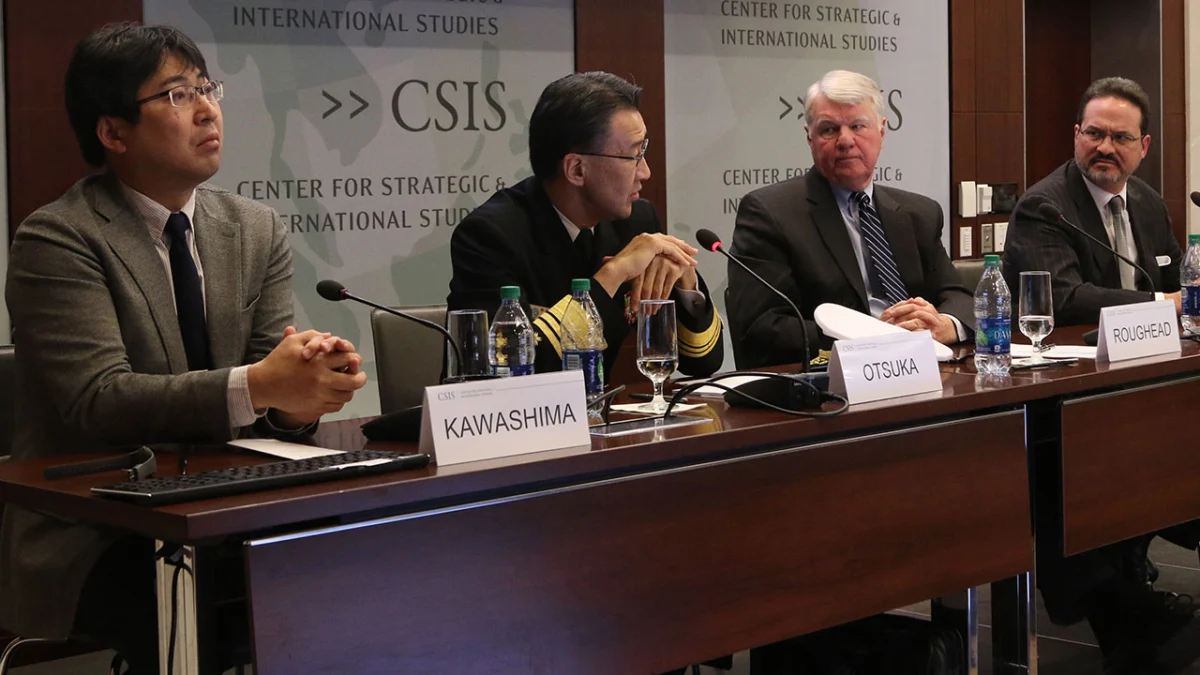
At 3:15 p.m., the core panel discussion commenced under the title "The U.S.-Japan Alliance and Maritime Security in the Asia-Pacific Region." Moderated by Michael J. Green, the panel featured an elite assembly of military and academic minds: Vice Admiral Umio Otsuka, President of the Japan Maritime Self-Defense Force (JMSDF) Command and Staff College; Professor Shin Kawashima of the Graduate School of Arts and Sciences at the University of Tokyo; and Admiral Gary Roughead, a retired four-star admiral who served as the Chief of Naval Operations for the United States Navy.
The panelists engaged in a rigorous debate regarding naval interoperability, gray-zone conflicts, maritime domain awareness, and the legal frameworks governing freedom of navigation. The dialogue directly addressed how both nations could synchronize their defense assets to deter coercive tactics in disputed waters without triggering outright military escalation.
Following the panel presentations, the floor opened at 4:30 p.m. for a dynamic Q&A session. Attendees, including journalists, defense analysts, and government officials, pressed the speakers on topics ranging from hardware procurement and intelligence sharing to alliance burden-sharing and the practical implementation of Japan’s 2015 legislation for peace and security. The formal seminar concluded promptly at 5:00 p.m., transitioning into a networking reception that allowed participants to continue private discussions regarding the future of trans-Pacific defense cooperation.
Background Context: The Geopolitical Landscape of 2016
To fully understand the significance of the 2016 U.S.-Japan Security Seminar, one must examine the complex geopolitical environment that defined the era. The mid-2010s were marked by profound transformations in the security architecture of East Asia. China’s rapid artificial island-building campaign in the Spratly Islands of the South China Sea, coupled with regular incursions by Chinese government vessels around the Senkaku Islands in the East China Sea, created acute anxieties in Tokyo and Washington regarding Beijing’s long-term regional ambitions.
Concurrently, Japan was undergoing a historic evolution in its national security policy under Prime Minister Shinzō Abe. For decades, Article 9 of Japan’s postwar constitution strictly limited the nation’s military capabilities to strictly defensive measures, precluding the exercise of collective self-defense. However, in July 2014, the Japanese Cabinet approved a reinterpretation of the constitution, culminating in the passage of landmark security legislation in September 2015. These laws permitted the Japan Self-Defense Forces (JSDF) to defend allies under specific, highly restricted conditions when an armed attack against a foreign country closely linked to Japan threatened Japan’s own survival.
This legislative shift fundamentally expanded the potential scope of bilateral operations between Washington and Tokyo. The 2016 CSIS seminar thus provided an essential public forum to discuss how the newly revised U.S.-Japan Guidelines for Defense Cooperation—updated in April 2015—would be operationalized in real-world maritime scenarios. The guidelines sought to remove geographical restrictions on JSDF operations, enhance joint intelligence, surveillance, and reconnaissance (ISR), and ensure seamless coordination across ballistic missile defense, cyber, and outer space domains.

Key Insights from Distinguished Participants
The caliber of the speakers ensured that the discussions combined high-level strategic vision with practical naval expertise.
Michael J. Green set the analytical tone for the afternoon, drawing upon decades of government and academic experience—including his service as the Senior Director for Asian Affairs on the National Security Council staff during the George W. Bush administration. Green consistently highlighted that the U.S.-Japan alliance is not merely a bilateral defense pact, but a global partnership critical to upholding the post-World War II liberal international order.
Yoshiji Nogami brought a vital diplomatic perspective from the Japan Institute of International Affairs. Having served as Japan’s Vice Minister for Foreign Affairs and Ambassador to the United Kingdom, Nogami emphasized the diplomatic imperatives underpinning security cooperation. He noted that robust defense deterrence must run parallel to proactive diplomacy, reassuring regional partners that the U.S. security umbrella remains credible and enduring.
From the operational perspective, Vice Admiral Umio Otsuka of the JMSDF Command and Staff College offered invaluable insights into maritime doctrine and operational readiness. Otsuka analyzed the evolving missions of the JMSDF, emphasizing the necessity of maintaining technological superiority in anti-submarine warfare (ASW) and mine countermeasures, areas where the JMSDF has historically maintained world-class proficiency. His remarks illuminated how the JMSDF and the U.S. Seventh Fleet could optimize joint patrols and training exercises to secure vital maritime choke points.
Professor Shin Kawashima of the University of Tokyo provided essential historical and regional context, examining how neighboring Asian nations perceive the shifting balance of power. Kawashima noted that while Southeast Asian nations welcome a strong U.S. and Japanese presence to balance against unilateral assertiveness, they also seek diplomatic engagement rather than outright bloc confrontation. His academic analysis underscored the delicate diplomatic balancing act required of Tokyo and Washington as they seek to strengthen alliances without alienating regional middle powers.
Admiral Gary Roughead, drawing on his extensive command experience within the U.S. Navy—including stints as Commander of U.S. Fleet Forces Command and Commander of the U.S. Pacific Fleet—focused heavily on naval integration and the practicalities of coalition operations. Roughead stressed that maritime security is fundamentally about presence, readiness, and interoperability. He argued that joint training, standardized communications protocols, and integrated command structures are irreplaceable assets when responding to fast-moving maritime crises.
Supporting Data and Strategic Implications
The discussions at the seminar were underpinned by sobering quantitative and qualitative realities regarding defense expenditures and naval force structures in the Indo-Pacific. Throughout the 2010s, defense spending by regional powers diverged sharply:
- Defense Budget Trends: While the United States faced budgetary constraints due to the Budget Control Act of 2011 and sequestration, and Japan maintained a longstanding defense spending ceiling historically hovering around 1% of its Gross Domestic Product, China’s official defense budget experienced double-digit percentage growth rates for much of the preceding two decades, enabling a massive naval modernization program.
- Naval Fleet Expansion: By 2016, the People’s Liberation Army Navy (PLAN) had surpassed the U.S. Navy in total hull counts for certain classes of surface combatants, commissioning advanced destroyers, frigates, and nuclear-powered submarines at an unprecedented pace. This quantitative shift placed a premium on the qualitative edge maintained by the U.S. Navy and the JMSDF.
- Strategic Choke Points: The seminar heavily emphasized the vulnerability of critical maritime choke points in the Indo-Pacific—such as the Malacca, Sunda, and Lombok Straits—through which a significant percentage of global commerce and energy supplies transit daily.
The strategic implications of these data points were stark. Panelists agreed that neither the United States nor Japan could effectively manage regional security challenges in isolation. The maintenance of deterrence required a deeply integrated alliance capable of projecting credible combat power across vast ocean expanses. Furthermore, the seminar highlighted the growing importance of minilateralism—expanding security cooperation to include third-party nations such as Australia, India, and members of the Association of Southeast Asian Nations (ASEAN).
Broader Impact and Long-Term Legacy of the Seminar
Looking back, the 2016 U.S.-Japan Security Seminar accurately anticipated the trajectory of Indo-Pacific geopolitics for the remainder of the decade and into the 2020s. The concepts debated on the stage at CSIS—such as the Free and Open Indo-Pacific (FOIP) vision, the necessity of gray-zone deterrence, and the operationalization of collective self-defense—subsequently became foundational pillars of U.S. and Japanese foreign policy.
The dialogue reinforced the institutional bonds between Washington’s premier foreign policy think tanks and Tokyo’s leading research institutes, facilitating a continuous exchange of ideas that informed legislative and executive branch decisions in both capitals. By providing an open, rigorous forum for defense intellectuals and retired military commanders, the event helped solidify a bipartisan consensus in the United States and a broad public understanding in Japan regarding the indispensable role of the bilateral alliance.
Ultimately, the 2016 seminar demonstrated that the U.S.-Japan security partnership remains far more than a historical relic of the Cold War. It stands as a dynamic, evolving alliance uniquely positioned to adapt to the complexities of twenty-first-century maritime competition, ensuring that the maritime commons of the Asia-Pacific remain open, secure, and governed by international law rather than the unilateral assertion of might.