On March 4, 2016, the Center for Strategic and International Studies (CSIS) hosted the U.S.-Japan Security Seminar, a pivotal gathering of policymakers, naval strategists, and academic experts aimed at addressing the evolving security architecture of the Asia-Pacific. Held in Washington, D.C., the event served as a high-level forum to examine the deepening bilateral cooperation between the United States and Japan amidst rising regional tensions and shifting geopolitical realities. The seminar, supported by the Ministry of Foreign Affairs of Japan, highlighted the critical necessity of a modernized alliance capable of responding to both traditional military threats and non-traditional security challenges.
The event featured a series of expert panels, including a significant opening discussion between Michael J. Green, then Senior Vice President for Asia and Japan Chair at CSIS, and Yoshiji Nogami, President of the Japan Institute of International Affairs (JIIA). Their dialogue set the stage for a broader examination of maritime security, a cornerstone of the U.S.-Japan defense relationship that has grown increasingly complex due to territorial disputes and the modernization of regional navies.
The Historical Context of the 2016 Strategic Environment
To understand the weight of the discussions held at the 2016 seminar, one must look at the broader context of the era. The year 2016 represented a critical juncture for the U.S.-Japan alliance. Following the 2015 revisions to the Guidelines for U.S.-Japan Defense Cooperation, the two nations were actively working to implement a "seamless" security integration. These revised guidelines expanded the scope of Japanese military activity, allowing the Self-Defense Forces (JSDF) to provide greater logistical support to U.S. forces and to engage in collective self-defense under specific, restricted conditions.
By the time of the March seminar, the Asia-Pacific region was experiencing heightened friction. The South China Sea had become a focal point of concern, with various nations asserting expansive maritime claims that challenged the international rules-based order. For Japan, the security of the East China Sea—particularly around the Senkaku Islands—remained a primary preoccupation. The seminar provided a platform for experts to analyze how these local flashpoints necessitated a more robust and coordinated maritime strategy between Washington and Tokyo.
Chronology of the Seminar Proceedings
The seminar was structured to move from foundational diplomatic objectives to technical maritime strategy. The program began at 3:00 p.m. EST with welcoming remarks from Michael J. Green and Yoshi Nogami. The discussion emphasized the transition of the U.S.-Japan relationship from a post-World War II defensive structure to a proactive, global partnership.
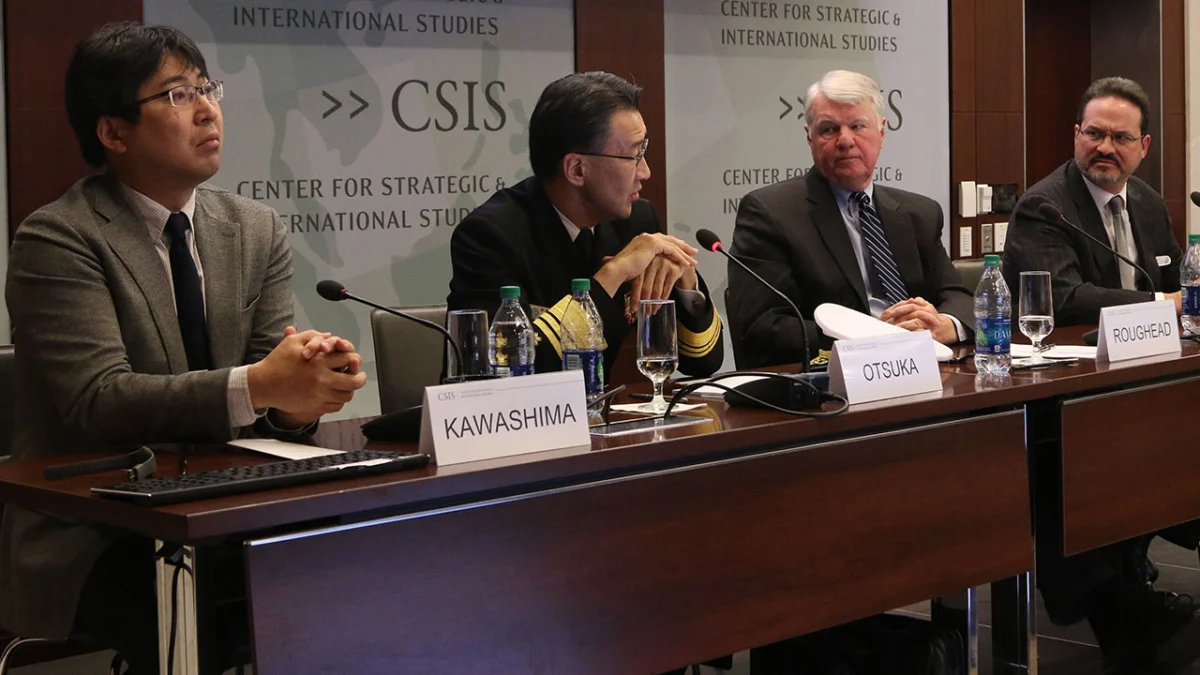
At 3:15 p.m., the seminar transitioned to its core focus: "The U.S.-Japan Alliance and Maritime Security in the Asia-Pacific Region." This session featured distinguished voices, including Vice Admiral Umio Otsuka, then President of the Japan Maritime Self-Defense Force Command and Staff College; Professor Shin Kawashima of the University of Tokyo; and Admiral Gary Roughead, USN (Ret.), a former Chief of Naval Operations.
The panel examined the operational realities of the "pivot" or "rebalance" to Asia, a strategy that had been at the heart of U.S. foreign policy since the Obama administration. The participants debated the efficacy of current deterrent strategies and the potential for increased interoperability between the U.S. Navy and the Japan Maritime Self-Defense Force (JMSDF). Following the expert panel, a dedicated Q&A session at 4:30 p.m. allowed for a rigorous exchange between the panelists and a select audience of policy analysts, journalists, and government officials, before the event adjourned at 5:00 p.m. for a formal reception.
Maritime Security: Data and Strategic Imperatives
The discussions centered on the strategic importance of the First Island Chain and the maintenance of freedom of navigation. Data from 2016 indicated that the region was seeing an unprecedented increase in maritime traffic, coupled with a surge in military activity. The South China Sea, through which over $5 trillion in trade passes annually, had become a theater where naval presence directly correlated with regional stability.

Admiral Gary Roughead, drawing on his extensive experience as a former top-ranking U.S. naval officer, emphasized that the maritime domain was not merely about individual ship movements but about the integration of information, surveillance, and reconnaissance (ISR) capabilities. The panel noted that the JMSDF had evolved into one of the most sophisticated navies in the world, with advanced anti-submarine warfare (ASW) capabilities that were vital to the U.S. strategy of maintaining regional dominance.
Professor Shin Kawashima brought an academic perspective to the discussion, noting that the political discourse in Tokyo had shifted significantly. Public and legislative support for a more assertive security role for the JSDF had grown, influenced by the realization that diplomatic solutions alone were insufficient to address gray-zone coercion—activities that fall below the threshold of traditional armed conflict but are designed to alter the status quo.
Official Responses and Diplomatic Alignment
The event was underpinned by the support of the Ministry of Foreign Affairs of Japan, signaling a clear alignment between the Japanese government’s strategic priorities and the research output of think tanks like CSIS. Throughout the seminar, the speakers reinforced the message that the U.S.-Japan alliance was not directed against any single nation, but rather functioned as a "public good" for the entire Asia-Pacific region.
In the aftermath of the seminar, observers noted that the event effectively summarized the "new normal" for bilateral relations. The participants agreed that while the U.S.-Japan relationship remained the bedrock of regional stability, it required constant maintenance through high-level dialogues. The emphasis on "maritime security" was particularly telling, as it signaled a transition from land-based defense paradigms to a focus on the vast, contested waters of the Pacific.
Broader Impact and Long-term Implications
The 2016 U.S.-Japan Security Seminar left a lasting impact on the trajectory of bilateral policy. By convening experts from the academic, military, and policy spheres, the event helped solidify the intellectual consensus required for the implementation of the 2015 Guidelines. The focus on maritime security served as a precursor to the "Free and Open Indo-Pacific" (FOIP) vision, which would eventually become the dominant strategic framework for both the U.S. and Japan in the years that followed.
Furthermore, the seminar highlighted the growing role of non-traditional security threats, such as cyber warfare and the weaponization of economic dependencies. These issues, while nascent in 2016, were identified by the panelists as critical areas where the alliance would eventually need to expand its cooperation.
The analysis presented by participants like Michael J. Green—who has long been a leading voice on Japanese foreign policy—underscored that the alliance’s strength lies in its ability to adapt. As the security environment in the Asia-Pacific continues to evolve, the themes addressed at the 2016 seminar remain relevant. The need for clear communication, interoperability, and a shared vision of regional order continues to drive the U.S.-Japan strategic dialogue.
In conclusion, the 2016 U.S.-Japan Security Seminar at CSIS was more than a routine policy gathering. It was a strategic assessment of a relationship undergoing a significant transformation. Through the rigorous analysis of maritime threats and the commitment to deeper defense integration, the seminar provided the necessary groundwork for the alliance to navigate the challenges of an increasingly complex and contested Asia-Pacific region. The event served as a testament to the enduring importance of the U.S.-Japan partnership in upholding the principles of sovereignty, international law, and regional stability in the 21st century.