The 2016 U.S.-Japan Security Seminar, hosted by the Center for Strategic and International Studies (CSIS) on March 4, 2016, served as a pivotal forum for evaluating the evolving dynamics of the U.S.-Japan alliance amidst rising maritime tensions and shifting regional power structures in the Asia-Pacific. The event, supported by the Ministry of Foreign Affairs of Japan, brought together leading policy experts, military strategists, and academic voices to discuss the critical intersection of defense, maritime security, and diplomatic cooperation between Tokyo and Washington.
The Strategic Context of the 2016 Security Landscape
In early 2016, the geopolitical environment of the Asia-Pacific was undergoing significant transformation. Japan, under the administration of Prime Minister Shinzo Abe, was actively pursuing a more proactive security policy, seeking to reinterpret its pacifist constitution to allow for a broader exercise of the right to collective self-defense. Simultaneously, the United States was in the midst of its "Pivot to Asia" strategy, an effort to rebalance American foreign policy toward the Pacific region to counter the rapid modernization of the Chinese People’s Liberation Army (PLA) and growing territorial disputes in the South and East China Seas.
The seminar provided a high-level platform to analyze these shifts. The discussions were framed by the necessity of enhancing interoperability between the Japan Self-Defense Forces (JSDF) and the U.S. Armed Forces, a requirement underscored by the 2015 Guidelines for U.S.-Japan Defense Cooperation. These guidelines fundamentally altered the alliance by allowing for seamless cooperation during both peacetime and contingency operations, marking the most significant update to the security partnership since the 1990s.
Chronology of the Seminar Proceedings
The proceedings began at 3:00 p.m. EST with welcoming remarks from Michael J. Green, then Senior Vice President for Asia and Japan Chair at CSIS, and Yoshiji Nogami, President of The Japan Institute of International Affairs (JIIA). Their opening statements emphasized that the alliance was no longer merely a bilateral security pact, but a foundational pillar of regional stability.
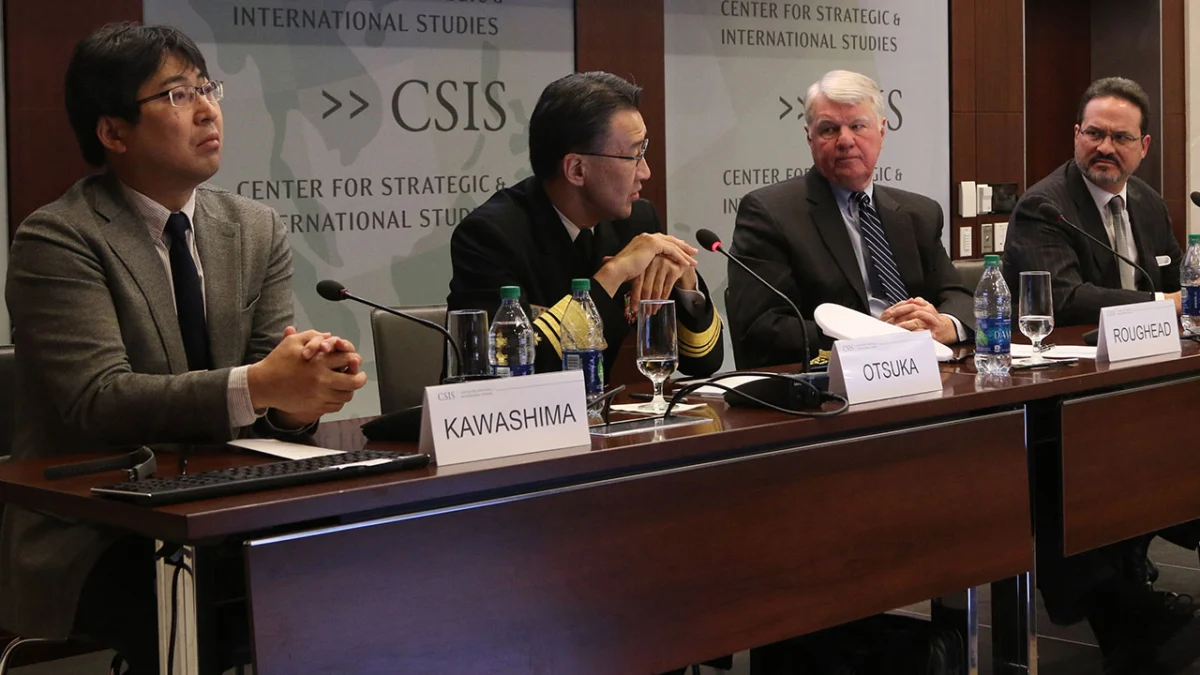
The core of the seminar, held at 3:15 p.m., focused on "The U.S.-Japan Alliance and Maritime Security in the Asia-Pacific Region." This session featured a distinguished panel of experts, including Vice Admiral Umio Otsuka, President of the Japan Maritime Self Defense Force (JMSDF) Command and Staff College; Professor Shin Kawashima of the University of Tokyo; and Admiral Gary Roughead, USN (Ret.), a former Chief of Naval Operations.
The panel scrutinized the challenges posed by "gray zone" activities—situations that fall short of full-scale armed conflict but threaten regional status quos. The discussion moved through the technical requirements of maritime domain awareness to the diplomatic complexities of managing interactions between the JMSDF and the Chinese Coast Guard. The event concluded with an intensive Q&A session at 4:30 p.m., where participants debated the long-term sustainability of the alliance against the backdrop of potential future budgetary constraints in both nations and the unpredictable nature of regional maritime flashpoints.
Supporting Data and Strategic Considerations
Data presented and discussed during the seminar highlighted the growing disparity in naval capabilities in the region. By 2016, the Chinese Navy had significantly expanded its blue-water fleet, commissioning multiple destroyers and frigates annually. In response, the U.S. and Japan emphasized "Integrated Deterrence," a concept that relied heavily on the technical superiority of the U.S. Navy and the increasing capacity of the JMSDF.

One of the key metrics cited by participants was the increasing frequency of incursions by foreign vessels into the territorial waters surrounding the Senkaku Islands. These incidents forced a re-evaluation of the U.S. commitment under Article 5 of the U.S.-Japan Security Treaty. Panelists argued that the strength of the alliance relied on the credibility of this commitment, necessitating more frequent joint training exercises and shared intelligence protocols.
Furthermore, the economic interdependence of the region was noted as a mitigating factor against conflict, yet the seminar speakers cautioned that economic ties were no longer a sufficient guarantor of security. The integration of economic and security policies became a recurring theme, with experts suggesting that the U.S.-Japan partnership needed to be as robust in the realms of trade and technology standards as it was in military hardware.
Institutional Perspectives and Responses
The involvement of the Japan Institute of International Affairs (JIIA) and the support of the Ministry of Foreign Affairs of Japan signaled a concerted effort by Tokyo to communicate its security priorities to the Washington policy establishment. Yoshiji Nogami’s participation highlighted the importance of track-1.5 diplomacy—where government officials and policy experts engage in informal, high-level discussions—to build trust and alignment between the two nations.
For the United States, the presence of figures like Admiral Gary Roughead provided a pragmatic military assessment. Roughead’s insights into the logistical and strategic requirements of maintaining a forward-deployed force underscored the necessity for Japan’s continued investment in base infrastructure and the host-nation support program. The seminar effectively showcased a consensus: the alliance was essential not only for Japan’s self-defense but for maintaining a rules-based order in the Indo-Pacific.
Broader Impact and Long-term Implications
The 2016 U.S.-Japan Security Seminar had lasting implications for the development of security policy in the latter half of the decade. First, it helped solidify the shift toward a more integrated alliance structure. The discussions regarding maritime security directly informed the ongoing development of the Free and Open Indo-Pacific (FOIP) vision, which would later become the cornerstone of regional security policy for the United States, Japan, Australia, and India (the Quadrilateral Security Dialogue).
Second, the seminar identified the necessity of addressing the "gray zone" dilemma. The insights shared by Professor Shin Kawashima regarding the legal and political dimensions of regional disputes helped policymakers in Washington understand the nuanced constraints under which the Japanese government operates. This understanding was vital in ensuring that U.S. policy did not inadvertently push Japan into a diplomatic corner or escalate tensions unnecessarily.
Finally, the seminar served as a precursor to the increased focus on maritime domain awareness (MDA) technology. The exchange of ideas between the JMSDF and U.S. naval experts fostered a culture of deeper cooperation that has since seen Japan take a more active role in maritime capacity building for Southeast Asian nations, such as the Philippines and Vietnam.
Conclusion
The 2016 CSIS seminar stood as a critical juncture in the history of the U.S.-Japan security relationship. By facilitating a rigorous examination of maritime security, the event helped align the strategic visions of Tokyo and Washington at a time of profound regional uncertainty. The discussions held during those two hours in March 2016 not only addressed the immediate threats of the era but also established a framework for cooperation that continues to influence the security architecture of the Asia-Pacific today. As the region faces new challenges, the lessons from this seminar regarding the necessity of shared strategic vision, integrated capabilities, and diplomatic agility remain as relevant as ever. The success of the event, made possible by the Ministry of Foreign Affairs of Japan, underscored the enduring strength of the partnership between the two nations and their shared commitment to maintaining peace and prosperity across the Pacific.