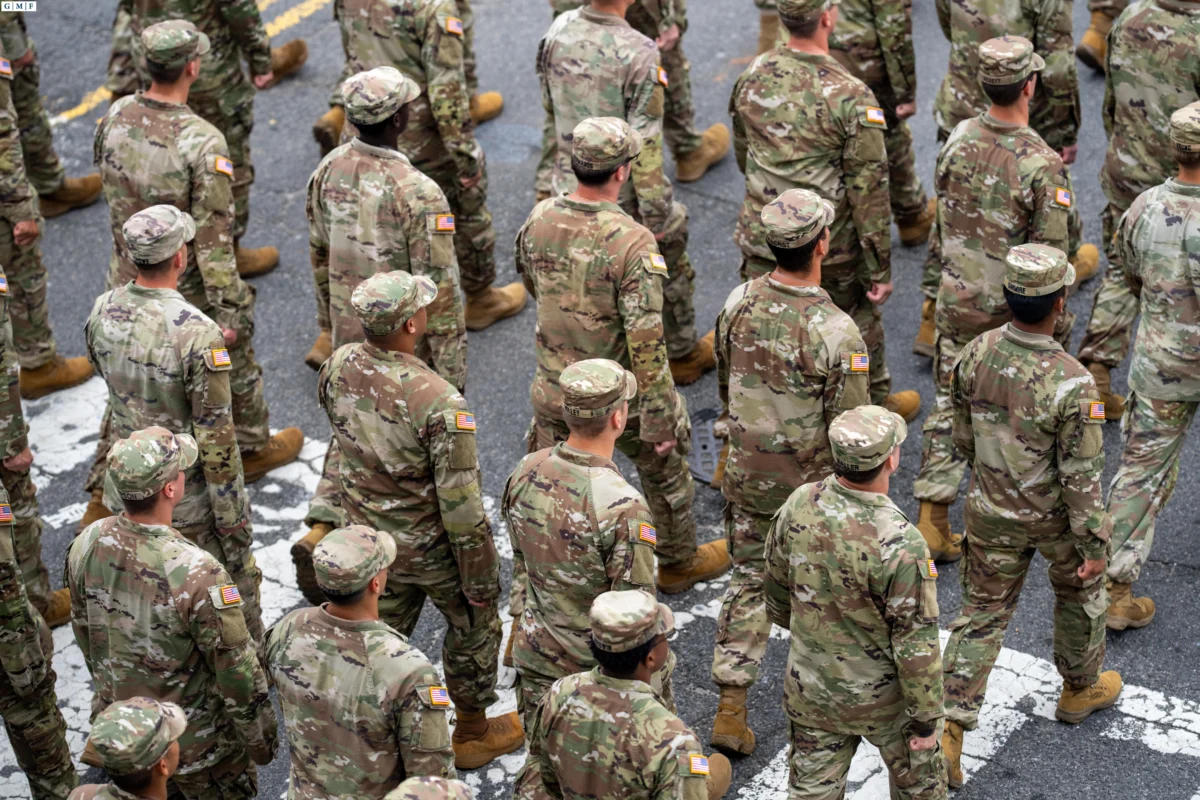
The United States faces a burgeoning constitutional and institutional crisis as the prospect of deploying federal military forces to manage domestic elections moves from the fringes of political rhetoric to the center of national debate. Recent suggestions by President Donald Trump and his administration regarding the potential use of military forces to ensure election security have reignited a century-old debate over the role of the armed forces in American civic life. This shift, which evokes historical precedents not seen since the Reconstruction era, threatens to inflict irreparable harm on the perceived legitimacy of the democratic process and the public’s confidence in the military as an apolitical institution.
A comprehensive new survey conducted by the Democracy and Security Network at the German Marshall Fund of the United States, in partnership with NORC at the University of Chicago, provides a stark warning regarding these trends. Surveying 2,800 Americans—with a specific over-sampling of veterans to capture the nuanced perspectives of those who have served—the research underscores a profound public anxiety regarding the intersection of military power and electoral administration.
A Historical and Political Context
The historical precedent for keeping the military away from the ballot box is robust. Following the Civil War, the Posse Comitatus Act of 1878 was enacted specifically to limit the powers of the federal government in using federal military personnel to enforce domestic policies within the United States. This legal framework was designed to prevent the military from becoming a tool of executive overreach in civilian governance.
President Trump’s recent public admission—that he regrets not deploying the National Guard to seize ballot boxes during the 2020 election—represents a departure from the norms that have governed the American transition of power for over 150 years. This rhetoric is accompanied by increasing domestic use of the military, such as the deployment of National Guard troops in Washington, D.C., and the expansion of federal jurisdiction along the southern border. While the administration frames these moves as necessary security measures, legal scholars and military experts warn that the presence of armed, uniformed personnel at polling sites is not only prohibited by federal law but serves to intimidate voters and undermine the foundational concept of a civilian-led democracy.
The Survey Data: Public Perception and Knowledge Gaps
The findings from the Democracy and Security Network survey reveal that while the American public remains deeply committed to the rule of law, they are simultaneously worried about the military’s ability to remain neutral when deployed domestically.
The data indicates that Americans possess a strong, intuitive sense of accountability:
- 85% of respondents believe it is vital for the U.S. military to obey the laws of war.
- 76% agree that senior military leaders should refuse an order they know to be unlawful.
- 75% maintain that the President must halt any military action if a federal court rules it illegal.
However, these ethical expectations are tempered by a significant knowledge gap. While 79% of respondents are familiar with the general principles of the Posse Comitatus Act, only 30% understand that the law does not restrict a state governor’s authority to deploy their own National Guard. Even more concerning is the public’s awareness of specific election-related statutes: only 64% of Americans know that federal law explicitly prohibits the presence of troops at polling places. This lack of legal literacy creates a vulnerability that can be exploited by political actors seeking to normalize the presence of armed forces in civilian spaces.
The Trust Deficit: A Deepening Institutional Divide
The survey highlights a "trust deficit" that permeates all levels of the military structure. Confidence in the Department of Defense’s politically appointed leaders sits at a dismal 29%, whereas trust in the National Guard and senior military leadership remains higher, at 57% and 56% respectively.
Perhaps most alarming is the impact that hypothetical scenarios of military intervention have on institutional trust. When respondents were asked to consider a scenario where the military was deployed to address perceived election threats following civil unrest, confidence in the military plummeted from 58% to 37%. This 21-percentage-point decline suggests that the mere act of associating the military with election security is toxic to the institution’s reputation. Even among veterans, who generally hold higher levels of confidence in the military than the general public, the trust in senior leaders to reject unlawful orders remains below 50%.
The Role of Congress as a Check on Executive Power
When faced with the prospect of unlawful executive orders, the public looks to Congress as the primary bulwark against abuse. The survey reveals that 72% of respondents, including 65% of Republicans, support Congressional intervention—specifically the power of the purse—to defund illegal operations.
This reliance on Congress is a significant finding in an era of intense political polarization. Americans are signaling that they prefer institutional friction over executive unilateralism. The data shows that confidence in Congress actually rises when the institution is viewed as actively checking potential military overreach. This provides a clear roadmap for lawmakers: the public expects Congress to hold hearings, exercise oversight, and ensure that the military remains an instrument of the state, not an extension of the executive branch’s political will.
Implications for Military Preparedness and Recruitment
The push to utilize the military for domestic law enforcement and election monitoring carries risks that extend far beyond public opinion polls. Military experts argue that these deployments distract from the core mission of the armed forces—national defense and deterrence—and strain the military’s relationship with the civilian population.
Furthermore, there is the risk of "mission creep." When service members are tasked with policing their own fellow citizens, the traditional training and doctrine that prioritize de-escalation and mission-specific objectives may be tested. The survey found that less than 40% of the public believes the U.S. military is well-prepared to conduct domestic law enforcement missions. Veterans, who have the most experience with military capabilities, were the most skeptical of this preparedness.
Recommendations: Education and Accountability
To preserve the integrity of the military and the safety of the electoral process, the report outlines three critical pillars of action:
- Public and Institutional Education: There is an urgent need to close the knowledge gap regarding the laws that govern domestic deployments. Veterans’ organizations and civil society must lead efforts to educate the public on the Posse Comitatus Act and the 18 U.S.C. Section 592 prohibition against troops at the polls.
- Strengthened Accountability Mechanisms: Military commanders must be empowered and encouraged to consult with Judge Advocate General (JAG) officers when faced with ambiguous or potentially illegal orders. Creating a formal, transparent paper trail for these concerns is essential for both the protection of the service member and the maintenance of constitutional order.
- Proactive Risk Assessment: Before any domestic mission is authorized, military and civilian leaders must conduct a thorough risk assessment regarding the impact on public trust. If a deployment is deemed necessary, it must be characterized by strict coordination with local law enforcement and a commitment to transparency that minimizes the risk of political escalation.
Conclusion: The Cost of Politicization
The findings of the Democracy and Security Network serve as a stark reminder that the strength of the U.S. military is inextricably linked to its standing in the eyes of the public. When the military is thrust into the center of the "culture wars" or used as a tool for election management, it risks losing the very support that sustains its funding, recruitment, and effectiveness.
As the nation approaches future election cycles, the message from the American people is clear: they desire a military that is governed by the rule of law, checked by the courts and Congress, and sequestered from the volatile nature of domestic electoral politics. The preservation of this boundary is not merely a legal requirement; it is a vital necessity for the health and longevity of the American democratic experiment. If military leaders fail to maintain this distance, the resulting decline in public confidence may prove to be a damage that no amount of military might can repair.