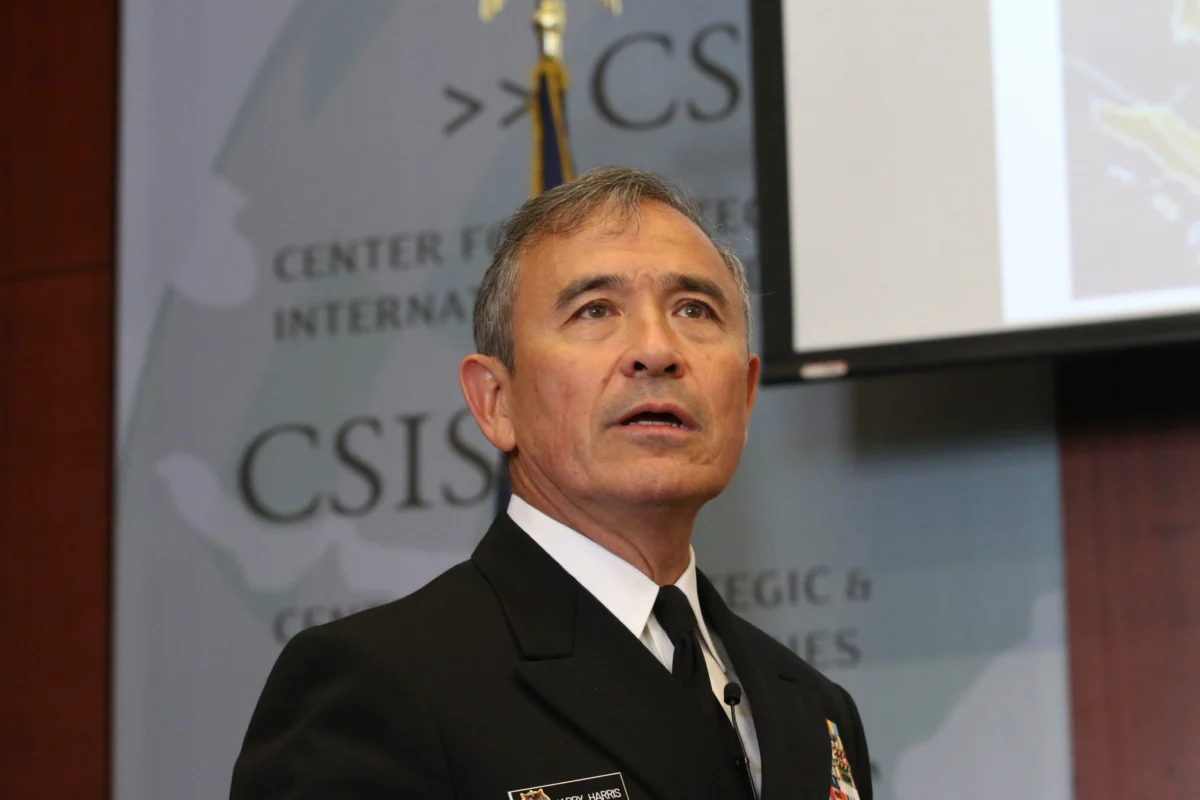
The Center for Strategic and International Studies (CSIS) hosted a high-profile Military Strategy Forum event on January 27, 2016, featuring Admiral Harry B. Harris, then-Commander of the U.S. Pacific Command (PACOM). The evening discussion, held from 6:00 to 7:00 PM EST in Washington, D.C., focused heavily on the evolving geopolitical dynamics, defense capabilities, and strategic opportunities across the vast Indo-Asia-Pacific region. Dr. John J. Hamre, President and CEO of CSIS, provided the opening remarks, while Dr. Kathleen H. Hicks, Senior Vice President, Henry A. Kissinger Chair, and Director of the International Security Program at CSIS, moderated the conversation. The event, made possible with the generous support of Rolls-Royce North America, drew defense experts, policymakers, and military analysts to examine how the United States and its allies could navigate mounting maritime tensions, technological advancements, and shifting regional alliances.
Background Context of the Indo-Asia-Pacific Security Environment
During the mid-2010s, the Indo-Asia-Pacific region emerged as the primary theater for global geopolitical competition. The strategic weight of international commerce, military deployment, and diplomatic maneuvering increasingly shifted toward the maritime domains of East and South Asia. For decades, the United States Pacific Command—subsequently renamed the U.S. Indo-Pacific Command (INDOPACOM)—served as the core security anchor for maintaining stability, protecting open sea lanes, and upholding international norms in a region encompassing more than half of the earth’s population and several of the world’s largest economies.
In 2016, the security landscape was heavily defined by rapid military modernization programs across multiple nations, ongoing territorial disputes in the South and East China Seas, and the persistent challenge posed by North Korea’s nuclear and ballistic missile programs. Against this backdrop, U.S. military strategy required a delicate balance between reassuring regional partners, deterring potential adversaries, and fostering multilateral cooperation. Admiral Harris’s address at CSIS provided a vital window into how the U.S. military command viewed these compounding challenges not merely as risks, but as strategic opportunities to reinforce alliances and modernize defense capabilities for the twenty-first century.
Chronology of the Event and Key Proceedings
The one-hour forum commenced at 6:00 PM EST with an introduction by Dr. John J. Hamre, who emphasized the critical importance of strong leadership and strategic foresight in managing America’s defense posture in the Pacific. Dr. Hamre highlighted the unique complexities facing military commanders who must balance immediate tactical readiness with long-term strategic alignment alongside regional partners.

Following the introduction, Admiral Harry B. Harris took the floor to deliver keynote remarks. Known for his direct communication style and extensive operational background, Admiral Harris outlined the foundational pillars of U.S. strategy in the Indo-Asia-Pacific. He underscored the necessity of robust forward-posture military forces, advanced technological integration, and deepened interoperability with key allies such as Japan, South Korea, Australia, India, and various nations within Southeast Asia.
The address seamlessly transitioned into a moderated Q&A session led by Dr. Kathleen H. Hicks. The dialogue probed deeper into specific regional friction points, examining how the U.S. military planned to safeguard freedom of navigation, respond to gray-zone tactics, and adapt its force posture to counter asymmetric threats. The session concluded shortly after 7:00 PM EST, leaving attendees with a comprehensive overview of the strategic calculus guiding U.S. operations in the Pacific theater.
Supporting Data and Regional Dynamics
To fully understand the gravity of the discussions held at CSIS, one must examine the quantitative and geographic realities that define the Indo-Asia-Pacific theater. Spanning from the waters off the western coast of the United States to the western shores of India, and from the Arctic down to Antarctica, the area of responsibility covers roughly half of the Earth’s surface.
Key statistical indicators highlighting the region’s global significance during this period included:
- Economic Output: The Indo-Asia-Pacific produced more than 60 percent of global gross domestic product (GDP) and accounted for nearly half of global trade volume.
- Maritime Trade Routes: Approximately one-third of all global maritime shipping passed through the South China Sea alone, making freedom of navigation through these choke points an existential priority for international commerce.
- Military Personnel: PACOM directed operations involving roughly 375,000 U.S. military and civilian personnel, integrated across service branches stationed throughout the region or operating on rotational deployments.
- Allied Partnerships: The U.S. maintained critical mutual defense treaties with nations such as Japan, South Korea, Australia, the Philippines, and Thailand, alongside expanding strategic partnerships with India and Vietnam.
These figures underscored why military strategists like Admiral Harris viewed the region not just as a geographic zone of operations, but as the geopolitical epicenter determining the future international order.

Official Responses and Strategic Implications
The insights shared by Admiral Harris and moderated by Dr. Hicks resonated deeply within defense circles, generating prompt analysis across international capitals and policy institutes. Allied nations, particularly in East and Southeast Asia, closely monitored the discussions for signals regarding the steadfastness of U.S. security commitments.
From a defense strategy perspective, the forum highlighted several crucial implications:
- Technological Superiority and Modernization: Maintaining a qualitative edge required accelerated investments in cutting-edge military technology, ranging from advanced stealth platforms and electronic warfare systems to cyber defense and networked command-and-control infrastructure.
- Allied Interoperability: Bilateral and multilateral exercises—such as Malabar with India, Japan, and the U.S., and bilateral drills with South Korea and Australia—were identified as indispensable mechanisms for ensuring coalition forces could operate seamlessly under unified objectives.
- Rules-Based International Order: U.S. leadership consistently stressed that maritime disputes must be resolved peacefully in accordance with international law, particularly the United Nations Convention on the Law of the Sea (UNCLOS), rejecting unilateral attempts to alter the status quo through coercion or land reclamation efforts.
Broader Impact on Geopolitics and International Security
The dialogue at CSIS served as a bellwether for American grand strategy in the years that followed. As geopolitical competition intensified throughout the late 2010s and into the 2020s, the concepts articulated during the Military Strategy Forum—such as the transition from a traditional "Asia-Pacific" framework to the broader "Indo-Pacific" construct—became foundational to U.S. national security policy.
By integrating democratic partners across the Indian Ocean basin with those in East Asia and the Pacific, defense planners successfully fostered a more cohesive, interconnected security architecture. The emphasis on collaborative defense, technological innovation, and steadfast deterrence championed by military leaders like Admiral Harris laid the groundwork for enduring regional stability amidst unprecedented geopolitical shifts. The event at CSIS remains a notable milestone in the ongoing public discourse concerning America’s enduring commitment to peace, security, and prosperity in the world’s most dynamic theater.