
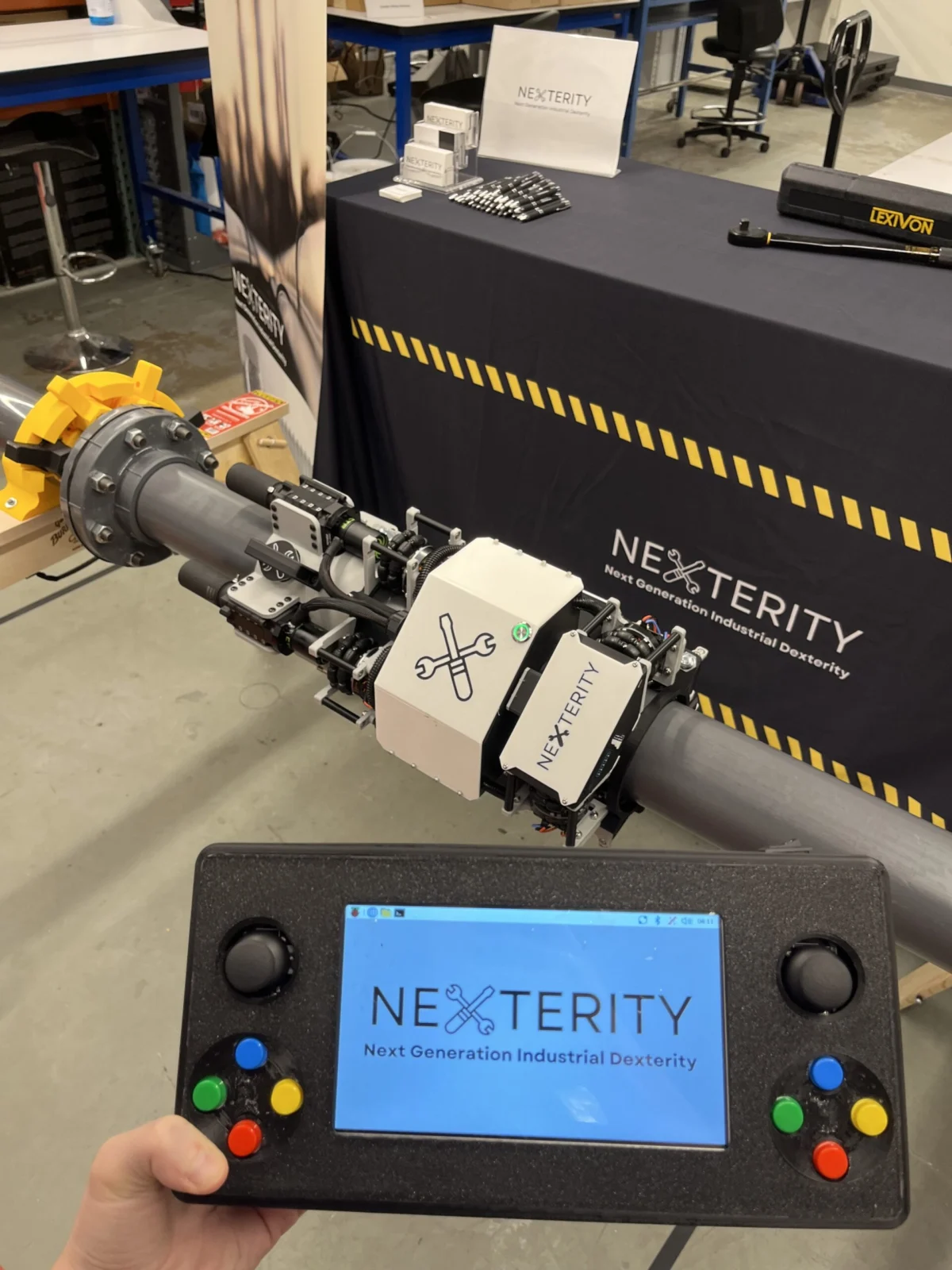
Industrial infrastructure relies heavily on networks of pipes, valves, and mechanical fasteners that span millions of miles globally, transporting critical resources such as oil, gas, petrochemicals, water, and chemicals. Despite the critical nature of these pipelines, maintenance and assembly processes have remained largely unchanged for decades. Connecting and securing industrial pipes involves physically demanding labor, specifically the manual tightening and loosening of bolted flange joints. This labor-intensive process has historically contributed to high rates of physical injury among trade workers, exacerbated by chronic labor shortages across the North American manufacturing, energy, and construction sectors.
Addressing these systemic challenges, startup Nexterity has developed a remote-controlled robotic solution designed to take over the repetitive and physically punishing task of bolting industrial pipes. Founded by former ExxonMobil engineer and planner Lindsey Elliott, Nexterity represents a growing wave of technological innovation aiming to modernize blue-collar trades. Selected as one of the Startup Battlefield 200 companies to participate in TechCrunch Disrupt, Nexterity is positioning itself at the intersection of robotics, industrial safety, and labor efficiency.
The Genesis of Nexterity and the Problem with Traditional Pipefitting
The inspiration for Nexterity’s flagship technology originated from years of observation within the energy sector. During her tenure at ExxonMobil, Elliott spent considerable time analyzing the operational inefficiencies and safety hazards associated with maintaining fluid transport infrastructure. A recurring bottleneck in pipeline maintenance is the bolted flange joint, the critical junction where two sections of pipe meet and are sealed together using multiple high-strength bolts.
In standard industrial settings, pipefitters must manually apply significant physical torque to loosen and tighten these fasteners. This work is often performed in cramped, hazardous, or ergonomically unfavorable environments. Workers frequently endure grueling shifts, sometimes spanning 12 hours a day for months at a time during facility turnarounds and maintenance outages.
According to industry feedback gathered by Elliott from trade professionals across the United States and Canada, North American pipefitting productivity has remained notoriously low relative to capital investment, primarily driven by physical fatigue, workforce turnover, and acute labor shortages. Skilled trades are facing an aging workforce, and younger generations are increasingly hesitant to enter physically punishing manual labor roles. By introducing automation to the most repetitive aspects of pipefitting, Nexterity aims to preserve human labor for higher-value diagnostic and supervisory tasks while mitigating the risk of repetitive strain injuries and acute musculoskeletal trauma.
Engineering the Solution: From Bolting Symposia to Robotic Innovation
Elliott’s journey toward the final product design involved extensive collaboration with industry specialists, mechanical engineers, and academic researchers. Regular attendance at technical gatherings, including the annual Bolting Symposium and engagements with the Pressure Vessels and Piping Division of the American Society of Mechanical Engineers (ASME), provided vital data regarding standard piping configurations.
Discussions with industry veterans—affectionately self-identified as "torque dorks"—revealed a striking uniformity in industrial piping systems. Data collected across multiple sectors indicated that approximately 80% of all industrial piping falls between two and eight inches in diameter, designated technically as NPS2 (Nominal Pipe Size 2) to NPS8.
This high degree of standardization provided an ideal foundation for industrial automation. Because the vast majority of pipelines utilize standardized diameters and bolt patterns, a modular robotic system could be engineered to service a massive segment of the global market without requiring customized engineering for every deployment.
How the Nexterity Robot Operates
Nexterity’s automated system is engineered for maximum portability and ease of use in the field. The hardware architecture is divided into two primary modular components designed to securely clasp around standard cylindrical pipe sections.
Powered by onboard, high-capacity rechargeable batteries, the robotic unit features an integrated sliding mechanism that enables it to traverse along the exterior of the pipe once attached. Rather than addressing fasteners one by one, the robot is capable of simultaneously loosening or tightening four bolts in a single operation, significantly reducing the time required to service a flange joint.
To accommodate the range of standard pipe sizes identified through industry research, Nexterity has engineered multiple interchangeable configurations of the robotic assembly. Crucially, despite their mechanical complexity, all variants are compact enough to fit inside a standard Pelican protective case. A single field technician can easily transport, deploy, and operate the equipment, eliminating the need for heavy lifting equipment or multi-person crews during routine maintenance procedures.
Business Model and Equipment-as-a-Service Strategy
Nexterity has aligned its go-to-market strategy with the operational realities of the construction, oil and gas, and manufacturing sectors. Rather than selling the robotic systems outright as capital expenditure assets, the company utilizes a rental model akin to heavy construction equipment leasing.
This approach lowers the barrier to entry for industrial contractors and facility operators who may be hesitant to commit large sums to unproven technologies. By treating the robots as flexible, deployable rental units, Nexterity enables companies to scale their automation usage up or down depending on maintenance schedules, plant shutdowns, and project-based labor demands.
The flexibility of the hardware ensures that field crews can quickly integrate the devices into existing workflows without extensive retraining or specialized engineering certifications. The intuitive control interface allows operators to manage the bolting process remotely, keeping workers clear of potential pinch points, heavy tool kickbacks, and hazardous atmospheric zones.
Market Scope and Cross-Industry Applications
While initial use cases frequently center around the oil, gas, and petrochemical sectors—where pipeline integrity is paramount to environmental safety and regulatory compliance—the addressable market for Nexterity’s technology extends far beyond fossil fuels.
Industrial piping infrastructure is a universal requirement across modern manufacturing and processing economies. Water treatment plants, municipal wastewater facilities, food and beverage production lines, mining operations, nuclear power plants, and emerging sustainable manufacturing facilities all rely on identical piping configurations and flanged joints.
The sheer ubiquity of standard-diameter piping means that the market potential for automated bolting solutions is substantially larger than public perception might suggest. In facilities where downtime translates directly into millions of dollars in lost revenue, accelerating routine maintenance cycles while enhancing worker safety offers a compelling economic value proposition.
Implications for the Future of Industrial Automation
The introduction of specialized field robotics into traditional trades highlights a broader economic and technological shift. For decades, automation was primarily concentrated inside stationary factory environments, such as automotive assembly lines and semiconductor manufacturing cleanrooms. However, advances in battery technology, wireless remote control, and lightweight materials are enabling robotics to venture out into unstructured, dynamic field environments like construction sites, refineries, and utility plants.
For the pipefitting profession, technologies like Nexterity do not necessarily represent total job displacement, but rather an evolution of the role. By offloading physically grueling, high-torque repetitive tasks to robotic assistants, companies can improve worker retention, reduce lost-time injuries, and combat the ongoing labor shortage in skilled trades.
As startups like Nexterity transition from prototype validation phases—such as the TechCrunch Disrupt Startup Battlefield 200—to commercial scale, the adoption of field robotics in heavy industry is poised to accelerate. By combining deep domain expertise from traditional energy sectors with modern hardware engineering, companies in this space are demonstrating how targeted automation can modernize some of the world’s oldest and most essential technical professions.