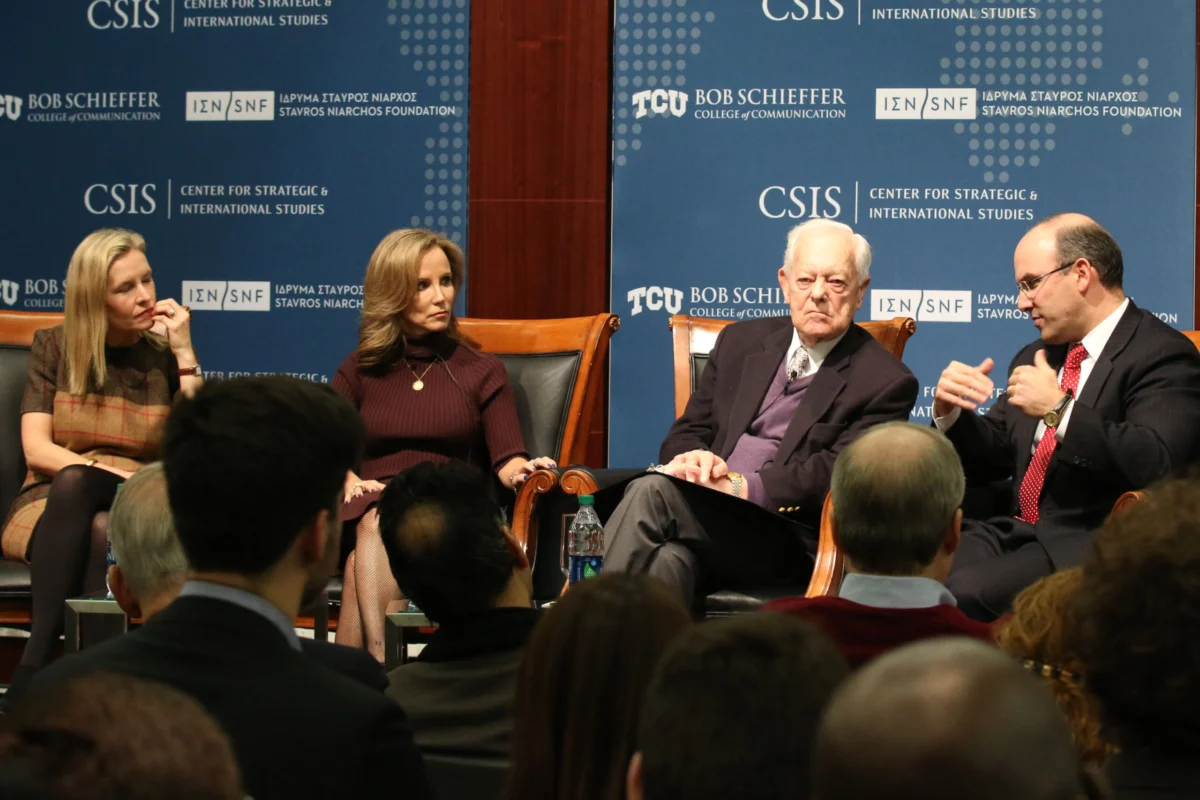
The evolving threat of global terrorism has long demanded nuanced strategic responses, robust intelligence-sharing frameworks, and critical public discourse. On January 29, 2016, the Center for Strategic and International Studies (CSIS), in collaboration with the TCU Bob Schieffer College of Communication, hosted a high-level dialogue addressing the complex security challenges confronting the international community. Moderated by veteran broadcast journalist and former CBS News Chief Washington Correspondent Bob Schieffer, the event brought together prominent national security experts, intelligence veterans, and investigative journalists to analyze the shifting paradigms of domestic and foreign terror threats.
The panel featured Frances Townsend, former Assistant to the President for Homeland Security and Counterterrorism and CSIS Trustee; Mary Louise Kelly, National Security Correspondent for NPR; and Juan Zarate, former Deputy National Security Adviser for Combating Terrorism and Senior Adviser at CSIS. Through a structured exploration of counterterrorism policy, the conversation illuminated the profound geopolitical shifts of the mid-2010s, providing critical insight into the structural vulnerabilities exploited by non-state actors and extremist networks.
Background Context: The Global Security Milieu in 2016
To fully understand the urgency of the discussions held during the January 2016 Schieffer Series dialogue, one must examine the broader geopolitical environment of the era. By 2016, the international counterterrorism architecture was grappling with a dual threat paradigm: the resilient remnants of traditional hierarchical terrorist organizations like al-Qaeda and the rapid, unprecedented rise of the Islamic State of Iraq and Syria (ISIS).
The mid-2010s marked a distinct transitional phase in modern warfare and asymmetric threats. Unlike previous decades defined by centralized terror command structures, the emergence of ISIS demonstrated a chilling mastery of digital recruitment, encrypted communications, and localized radicalization. Through sophisticated social media campaigns, extremist groups successfully appealed to disaffected individuals across Western democracies, giving rise to the phenomenon of "lone-wolf" actors and self-activating cells. This decentralized model fundamentally strained traditional intelligence agencies, which were historically structured to intercept macro-level conspiracies rather than preempt autonomous, internet-radicalized actors.

Concurrently, the Syrian civil war had precipitated a massive humanitarian and security crisis, serving as a magnet for foreign fighters from Europe, North America, and across the Middle East. The porous borders, sectarian conflict zones, and governance vacuums of the region provided terrorist organizations with operational safe havens, financial resources, and tactical battle-hardening. Against this volatile backdrop, policymakers in Washington and allied capitals faced mounting pressure to reassess their counterintelligence strategies, border security protocols, and military engagements abroad without compromising civil liberties at home.
Panel Insights and Key Contributions
The discussion, recorded at CSIS headquarters in Washington, D.C., served as an intellectual crucible where policy theory met operational reality. Bob Schieffer opened the dialogue by framing the overarching security dilemmas facing the United States, emphasizing the difficulty of balancing open society principles with the imperatives of national defense.
Frances Townsend brought decades of executive-branch experience to the conversation, drawing directly from her tenure under President George W. Bush. Townsend emphasized the institutional evolution of the U.S. homeland security apparatus following the September 11 attacks, noting that inter-agency cooperation and intelligence integration had improved exponentially. However, she cautioned that the proliferation of online extremist propaganda presented a fundamentally new frontier. Townsend argued that legacy counterterrorism tools—such as financial sanctions, military kinetic strikes, and physical border controls—were insufficient on their own to combat ideological radicalization propagated via digital platforms. She underscored the necessity of forging resilient partnerships between technology corporations and government security agencies to disrupt extremist networks online while preserving privacy rights.
Mary Louise Kelly provided an essential journalistic perspective, shedding light on the complexities of reporting on national security and intelligence matters. Kelly discussed the inherent friction between government transparency and operational security, observing that the public often struggles to comprehend the invisible successes of intelligence agencies—specifically, the numerous plots intercepted before reaching execution. Furthermore, Kelly highlighted the psychological impact of terrorism on Western populations, noting that high-profile attacks in major global cities were deliberately designed to provoke disproportionate policy reactions, stoke societal polarization, and undermine trust in democratic institutions.
Juan Zarate, leveraging his extensive background in combating terrorist financing and financial crime, focused heavily on the economic dimensions of modern counterterrorism. Zarate explained how modern extremist groups diversified their funding streams, moving away from reliance on wealthy state sponsors or traditional charitable fronts toward self-funding mechanisms, illicit trafficking, kidnapping for ransom, and control of local economies and oil assets in conflict zones. He emphasized that financial intelligence remains one of the most potent weapons in the counterterrorism arsenal, arguing that choking off access to the international banking system severely degrades a terrorist organization’s operational capacity, recruitment allure, and sustainability.

Chronology of the Event and Procedural Framework
The structured dialogue followed a rigorous academic and policy-oriented format characteristic of the CSIS-Schieffer Series, which is made possible through the generous philanthropic support of the Stavros Niarchos Foundation:
- 4:00 AM – 5:00 AM EST: The formal panel discussion and broadcast recording commenced, featuring opening remarks by Bob Schieffer and in-depth analyses delivered by Townsend, Kelly, and Zarate. The conversation systematically traversed key security vectors, including threat identification, intelligence sharing, digital radicalization, and international coalition building.
- 5:00 PM – 6:00 PM EST: A pre-event and post-event networking reception convened policymakers, academic researchers, journalists, and defense analysts to continue the dialogue in an informal setting, fostering collaborative exchanges across diverse sectors of the national security community.
This monthly collaborative series between TCU and CSIS has historically served as an indispensable platform for bridging the gap between academic research, journalistic inquiry, and practical policymaking, ensuring that critical national security debates remain accessible to the public and rigorously scrutinized by experts.
Analytical Implications for Future Security Architecture
The insights articulated during the January 2016 Schieffer Series dialogue carry profound, enduring implications for the future architecture of global security. The challenges discussed by the panel laid bare the reality that contemporary terrorism cannot be defeated through military force alone; rather, it requires a whole-of-society approach that integrates intelligence, diplomacy, economic statecraft, and counter-ideological messaging.
First, the conversation highlighted the urgent requirement for public-private cooperation in the digital age. As extremist organizations increasingly migrated their operational planning and recruitment to encrypted messaging applications and decentralized social networks, traditional intelligence collection faced acute blind spots. The imperative for tech companies to proactively identify and mitigate the dissemination of violent extremist content—without crossing into censorship or infringing upon fundamental civil liberties—remained a central policy debate.
Second, the panelists’ focus on terrorist financing underscores the enduring efficacy of following the money. While the tactical manifestation of terrorism continually evolves, the underlying requirement for capital, logistical support, and resource distribution remains constant. Strengthening international regulatory standards, combating illicit trade, and enforcing rigorous anti-money laundering (AML) and counter-terrorist financing (CTF) protocols continue to serve as indispensable pillars of global stability.

Finally, the dialogue underscored the psychological dimension of asymmetric conflict. Terrorist networks rely heavily on inducing fear and compelling adversary states to overextend themselves strategically, financially, and morally. Maintaining societal resilience, safeguarding democratic norms against reactionary erosion, and fostering robust international alliances remain the most effective deterrents against the destabilizing ambitions of extremist movements.
Conclusion
The January 29, 2016 installment of the CSIS-Schieffer Series provided a masterclass in strategic analysis during a pivotal juncture in modern counterterrorism history. By convening leading voices from government, intelligence, and journalism, the forum transcended partisan rhetoric to deliver a clear-eyed assessment of the structural threats facing the global community. As security landscapes continue to evolve in complexity, the foundational dialogues established by platforms such as the Schieffer Series remain vital for educating policymakers, informing the public, and charting effective paths toward enduring international peace and security.