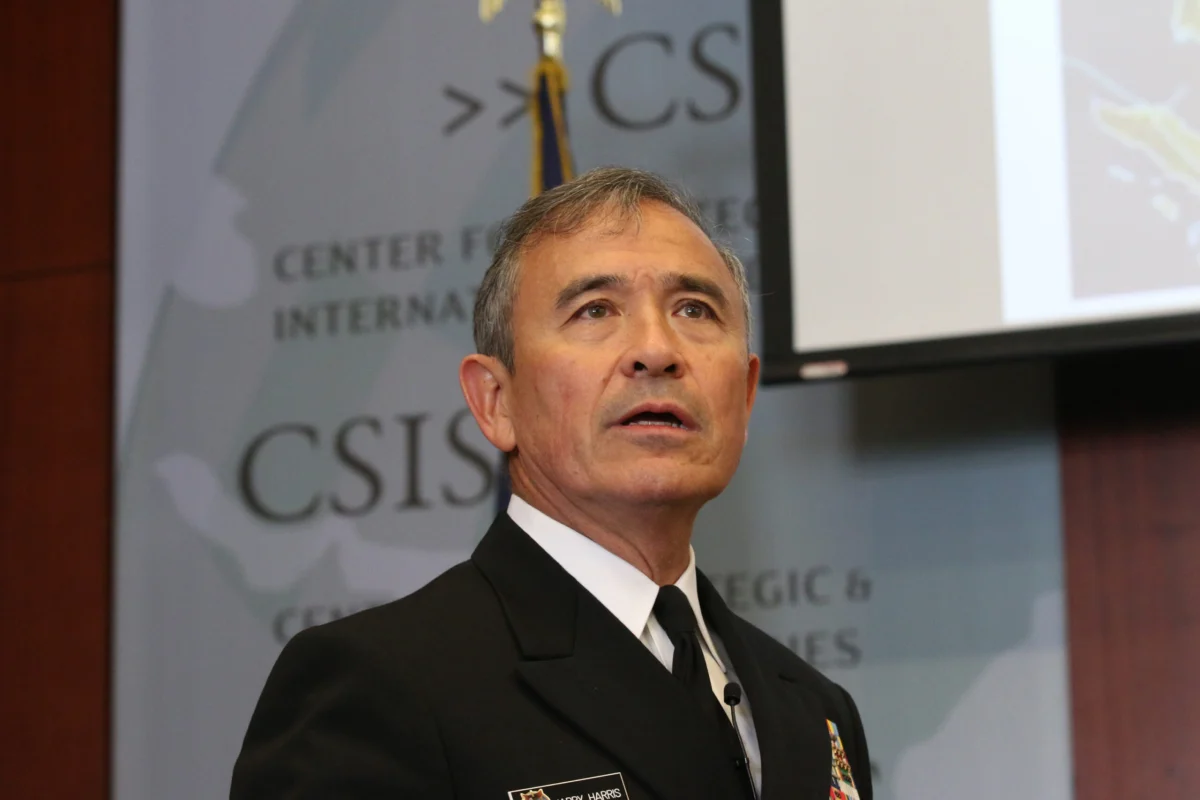
The Center for Strategic and International Studies (CSIS) hosted a high-profile Military Strategy Forum event featuring Admiral Harry B. Harris, then-Commander of the U.S. Pacific Command (PACOM), who delivered a comprehensive address on the strategic opportunities, geopolitical shifts, and defense challenges defining the Indo-Asia-Pacific region. Held on January 27, 2016, in Washington, D.C., the event drew defense analysts, policymakers, and military officials to discuss the evolving security architecture of one of the world’s most economically and strategically vital zones.
The discussion was introduced by Dr. John J. Hamre, CSIS President and CEO, and moderated by Dr. Kathleen H. Hicks, then-Senior Vice President, Henry A. Kissinger Chair, and Director of the International Security Program at CSIS. Made possible with support from Rolls-Royce North America, the forum served as a critical platform for evaluating the operational priorities of the United States military as it navigated complex maritime disputes, shifting alliances, and rapid technological modernization across Asia and the Pacific.
Background Context and Regional Significance
During the mid-2010s, the Indo-Asia-Pacific region was undergoing a profound geopolitical transformation. Long recognized as the engine of global economic growth, the region also represented a primary theater of strategic competition. Territorial and maritime disputes—particularly in the South China Sea and the East China Sea—had intensified, raising concerns regarding freedom of navigation, international law, and regional stability.
Concurrently, major powers in the region, including China, India, Japan, and South Korea, were undergoing substantial military modernization programs. China’s rapid expansion of its naval capabilities, combined with its assertion of expansive maritime claims, challenged the post-World War II rules-based international order. In response, the United States sought to rebalance its strategic focus toward the Asia-Pacific, reinforcing bilateral alliances with nations like Japan, Australia, and South Korea, while deepening strategic partnerships with emerging democracies such as India and various members of the Association of Southeast Asian Nations (ASEAN).

Admiral Harris’s address at CSIS came at a crucial juncture in this strategic rebalance. As the head of PACOM—which has since been renamed the U.S. Indo-Pacific Command (INDOPACOM) to underscore the critical linkage between the Indian and Pacific Oceans—Harris was responsible for overseeing all U.S. military operations across an area spanning 36 nations, 50 percentage of the earth’s surface, and more than half of the global population.
Event Chronology and Key Proceedings
The one-hour forum, scheduled from 6:00 PM to 7:00 PM EST, followed a structured format designed to maximize analytical depth on military strategy and international security.
The evening commenced with introductory remarks by Dr. John J. Hamre, who emphasized the enduring importance of transatlantic and transpacific security cooperation. Hamre highlighted the unique operational challenges faced by the U.S. military in the Pacific, noting that distance, geography, and diverse political landscapes required a sophisticated and adaptable strategic approach.
Following the introduction, Admiral Harry B. Harris took the floor. Known for his candid and direct communication style, Harris focused his remarks on the concept of "strategic opportunities" within the Indo-Asia-Pacific. Rather than framing the region solely through the lens of friction or potential conflict, Harris underscored the potential for constructive engagement, technological innovation, and alliance-building to maintain stability. He detailed how U.S. forces were actively working alongside regional partners to enhance maritime domain awareness, conduct joint exercises, and uphold the rules-based international order that had facilitated decades of regional prosperity.
Dr. Kathleen H. Hicks then led a moderated discussion and question-and-answer session with Admiral Harris. The dialogue explored a wide range of defense topics, including the implementation of the U.S. defense rebalance, the technological edge required to deter potential adversaries, and the delicate balance between diplomatic engagement and military deterrence. The conversation also touched upon the complexities of managing relations with major regional actors while simultaneously reassuring smaller partner nations committed to sovereignty and international maritime laws.

Supporting Data and Strategic Priorities
The discussions at the CSIS forum were underpinned by significant data regarding defense expenditures, force postures, and trade dynamics in the Indo-Asia-Pacific:
- Geographic Scope: PACOM’s area of responsibility encompassed roughly 100 million square miles, stretching from the waters off the west coast of the United States to the western border of India, and from the Arctic to the Antarctic.
- Economic Stakes: By 2016, the Indo-Asia-Pacific accounted for nearly 60 percent of global gross domestic product (GDP) and generated over half of global trade. Approximately $5.3 trillion in trade passed through the South China Sea alone annually, underscoring the critical economic necessity of keeping maritime communication lines open.
- Military Modernization Trends: Defense spending across Asia had been on a consistent upward trajectory for over a decade. According to global defense institutes, Asian military expenditure surpassed that of Europe in the early 2010s, driven largely by acquisitions of advanced submarines, surface combatants, multi-role aircraft, and sophisticated anti-access/area-denial (A2/AD) weapon systems.
- Alliance Network: The U.S. maintained formal mutual defense treaties with five nations in the region—Japan, South Korea, Australia, the Philippines, and Thailand—while cultivating robust security partnerships with Singapore, India, Indonesia, Vietnam, and Malaysia.
Official Responses and Stakeholder Perspectives
While the forum itself served primarily as a platform for military leadership to articulate strategic vision, the themes addressed by Admiral Harris reflected broader consensus across Washington and allied capitals during the Obama administration:
- Department of Defense Perspective: Pentagon leadership consistently emphasized that the rebalance to the Asia-Pacific was not merely a military repositioning, but a comprehensive diplomatic, economic, and security strategy. The goal was to ensure that no single power could dominate the region through coercion.
- Allied and Partner Reactions: Nations bordering the South and East China Seas expressed growing anxiety over unilateral assertions of maritime sovereignty. Regional partners frequently welcomed U.S. freedom of navigation operations (FONOPs) as a vital deterrent against creeping militarization and a tangible demonstration of American commitment to regional security.
- Counter-Perspectives: Major regional competitors, particularly Beijing, viewed the U.S. strategic rebalance and increased military presence with skepticism, frequently characterizing such maneuvers as attempts to contain China’s legitimate rise and interfere in regional territorial disputes. Beijing maintained that its activities in the South China Sea were defensive and aimed at protecting its sovereignty and economic interests.
Broader Impact and Long-Term Implications
The issues examined during the January 2016 Military Strategy Forum laid foundational pillars for U.S. national security policy that extended well beyond the Obama administration. The insights shared by Admiral Harris and moderated by Dr. Hicks highlighted several enduring implications for defense strategy and geopolitics:
- The Indivisibility of the Indian and Pacific Oceans: Harris’s emphasis on the "Indo-Asia-Pacific" nomenclature solidified a strategic shift that viewed the two oceanic basins as a single, continuous security environment. This conceptual evolution directly influenced subsequent U.S. defense strategies, culminating in the formal adoption of the "Free and Open Indo-Pacific" (FOIP) framework by later administrations.
- Technological Adaptation and Innovation: To maintain its competitive edge in a vast theater, the U.S. military recognized the imperative of investing in advanced military technologies. Forum discussions on defense capabilities underscored the need for innovation in cyber defense, electronic warfare, long-range precision strike systems, and unmanned maritime vehicles.
- Multilateral Security Architecture: The forum underscored that bilateral alliances alone were insufficient to address modern transnational security challenges. Consequently, U.S. strategy increasingly pivoted toward minilateral and multilateral frameworks, laying the groundwork for deepened cooperation structures such as the Quadrilateral Security Dialogue (the Quad) involving the United States, Japan, Australia, and India.
Through events like the Military Strategy Forum, CSIS continued to provide a vital bridge between military practitioners and policy analysts, fostering rigorous dialogue on the strategic imperatives necessary to preserve peace, security, and economic vitality in the world’s most dynamic region.