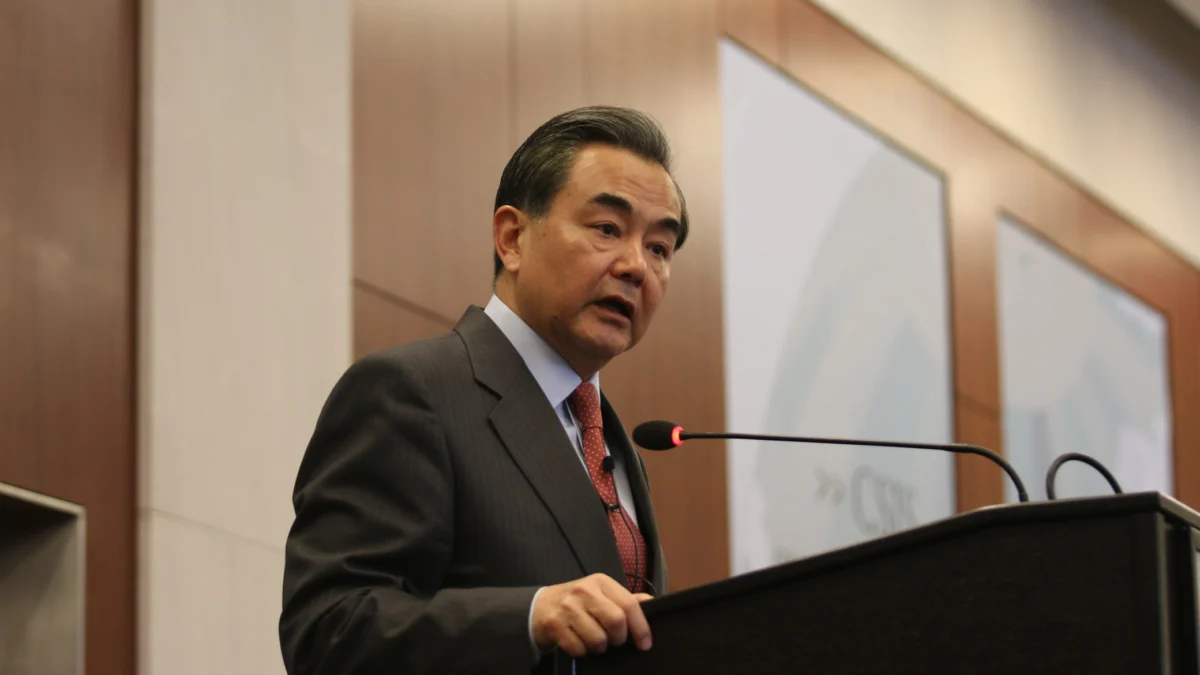
On February 25, 2016, the Center for Strategic and International Studies (CSIS) hosted a high-profile Statesmen’s Forum in Washington, D.C., featuring Wang Yi, the Minister of Foreign Affairs of the People’s Republic of China. The evening event, which ran from 7:30 to 9:00 PM EST, served as a critical platform for addressing the multifaceted dimensions of contemporary Chinese foreign policy and the intricate bilateral dynamics shaping U.S.–China relations during a period of significant strategic transition. The discussion was opened with welcoming remarks by John Hamre, President and CEO of CSIS, and was expertly moderated by Christopher Johnson, who at the time served as the Freeman Chair in China Studies at the organization.
The geopolitical landscape of early 2016 was characterized by heightened anxieties over maritime security in the Asia-Pacific, complex economic transformations within China, and ongoing strategic competition between Washington and Beijing. Against this backdrop, Minister Wang’s address offered international observers, policymakers, and scholars a direct window into Beijing’s official diplomatic posture, security doctrine, and economic objectives. The forum drew intense global interest, underscoring the enduring reality that the relationship between the world’s two largest economies remains the most consequential bilateral tie of the twenty-first century.
Historical and Geopolitical Background of the 2016 Forum
To understand the weight of Minister Wang Yi’s 2016 remarks at CSIS, it is necessary to examine the prevailing diplomatic climate of the era. The year 2016 marked a pivotal juncture in international relations. In the South China Sea, territorial disputes involving China, the Philippines, Vietnam, and other regional actors were reaching a boiling point. Legal challenges, notably the arbitration case brought by the Philippines under the United Nations Convention on the Law of the Sea (UNCLOS) at the Permanent Court of Arbitration in The Hague, were moving toward a definitive ruling, which Beijing fiercely opposed.
Simultaneously, the United States was executing its strategic "Pivot to Asia" (or rebalance), a policy initiative aimed at reallocating diplomatic, economic, and military resources toward the Asia-Pacific region. Beijing viewed this rebalance with deep suspicion, frequently interpreting it as a containment strategy designed to curb China’s legitimate rise. Conversely, Washington and its regional allies expressed growing alarm over China’s rapid militarization of artificial islands in the South China Sea and its assertive enforcement of maritime claims.

Economically, China was navigating a critical structural transition. Having enjoyed decades of export-led, double-digit growth, the Chinese economy was slowing down as Beijing attempted to pivot toward a "New Normal"—a consumption-driven and innovation-based growth model. Concerns regarding overcapacity in heavy industries such as steel and aluminum, alongside capital flight and currency fluctuations, were generating jitters in global financial markets. It was within this matrix of maritime friction, strategic rivalry, and economic realignment that Minister Wang took the stage at CSIS to articulate Beijing’s perspective.
Forum Proceedings and Key Deliverables
The event commenced with introductory remarks by Dr. John Hamre, President and CEO of CSIS, who emphasized the indispensable nature of open dialogue between the United States and China. Dr. Hamre noted that while strategic mistrust had accumulated across various domains, institutional channels and forums like the one hosted by CSIS were vital for preventing misunderstandings from escalating into open conflict.
Following the opening remarks, Minister Wang Yi delivered a comprehensive address detailing Beijing’s foreign policy principles. Emphasizing the core tenets of China’s peaceful development, Wang argued that China’s growing global footprint was a natural outcome of its economic modernization and that its foreign policy remained anchored in the principle of non-interference in the internal affairs of other sovereign states. He underscored Beijing’s commitment to building a "new model of major-country relationship" with the United States—a concept championed by Beijing that sought to foster non-conflict, non-confrontation, mutual respect, and win-win cooperation.
However, the core of the tension lay in the differing interpretations of these diplomatic platitudes. During the moderated discussion led by Christopher Johnson—a former CIA senior analyst on China and a preeminent scholar in the field—tough questions were posed regarding Beijing’s actions in the South China Sea, cybersecurity, and human rights.
Wang reiterated China’s historical sovereignty over the islands in the South China Sea, asserting that China’s construction activities on the disputed reefs and islets were lawful, justified, and aimed at providing public goods such as navigation safety, search and rescue, and environmental monitoring. He maintained that Beijing remained committed to resolving disputes peacefully through direct negotiations with the parties directly concerned, while implicitly warning external powers—an indirect reference to the United States—against militarizing the region or intervening in localized territorial disputes.

Chronology of U.S.–China High-Level Diplomacy Surrounding the Event
The CSIS forum did not occur in a vacuum; it was part of a dense calendar of diplomatic engagements between Washington and Beijing throughout 2016. A chronological review highlights the cadence of dialogue and friction during this period:
- September 2015: Chinese President Xi Jinping undertook a historic state visit to the United States, culminating in a summit with President Barack Obama where the two leaders reached a landmark agreement on curbing commercial cyber espionage, alongside commitments to cooperate on climate change.
- February 12–13, 2016: Minister Wang Yi attended the Munich Security Conference, where he outlined China’s vision for global security governance and engaged in high-level diplomatic exchanges with Western counterparts.
- February 25, 2016: Wang Yi delivered his keynote address at CSIS in Washington, D.C., following bilateral meetings with U.S. Secretary of State John Kerry, where topics ranged from North Korea’s nuclear provocations to the South China Sea.
- March–April 2016: International focus intensified on the impending ruling by the Permanent Court of Arbitration regarding the South China Sea, leading to increased diplomatic posturing between Beijing and Washington.
- March 31–April 1, 2016: President Obama and President Xi held a bilateral meeting on the margins of the Nuclear Security Summit in Washington, D.C., reaffirming their commitment to managing differences constructively.
- June 6–7, 2016: The eighth round of the U.S.–China Strategic and Economic Dialogue (S&ED) was convened in Beijing, addressing macroeconomic policies, climate initiatives, and bilateral trade hurdles.
- July 12, 2016: The Permanent Court of Arbitration issued its unanimous ruling in favor of the Philippines, invalidating China’s expansive "nine-dash line" claims—a decision that Beijing immediately rejected as null and void.
Analysis of Implications and Strategic Outcomes
The 2016 Statesmen’s Forum featuring Wang Yi provided lasting insights into the structural divergence between U.S. and Chinese strategic objectives. From Washington’s perspective, Beijing’s assurances of peaceful development appeared increasingly incongruent with its assertive enforcement of maritime claims and its refusal to abide by international legal mechanisms like the UNCLOS arbitration tribunal. American policymakers argued that international rules-based order was non-negotiable and that unilateral changes to the status quo in the South China Sea threatened global commerce and stability.
Conversely, from Beijing’s vantage point, the United States’ continued freedom of navigation operations (FONOPs) and military alliances in the Asia-Pacific were viewed as provocative attempts to encircle and contain China’s rightful rise. Chinese leadership consistently framed their maritime activities as defensive measures necessary to protect their sovereign rights and maritime supply lines.
The implications of the positions articulated by Wang Yi at CSIS reverberated well beyond 2016. The inability of both nations to forge a mutually acceptable modus vivendi in the maritime domain laid the groundwork for the more overt strategic decoupling and trade wars that characterized the late 2010s and early 2020s. As great power competition institutionalized into the primary framework of international relations, public forums like the CSIS Statesmen’s Forum became even more critical as rare conduits for signaling intentions, testing diplomatic boundaries, and preserving channels of communication amidst rising geopolitical headwinds.
Ultimately, the event underscored the delicate balancing act required of diplomats and scholars alike. While institutional dialogue could not eliminate the fundamental clashes of interest between a reigning superpower and a rising revisionist power, platforms like CSIS ensured that the terms of the strategic debate remained transparent, rigorous, and accessible to the global public.