

The launch of Muse, positioned by Meta CEO Mark Zuckerberg as a privacy-first, "built from the ground up" AI assistant, has been marred by the discovery of a severe security flaw that undermines the very protections it was promised to uphold. macOS security researcher Patrick Wardle, founder of the Objective-See Foundation, identified a zero-day vulnerability that enables locally running applications or terminal commands to bypass Apple’s stringent sandbox protections. By manipulating undocumented settings within the Muse architecture, an attacker can gain total control over the AI agent, turning a productivity tool into a potent vector for unauthorized access.
The Anatomy of the Vulnerability
Muse is designed to operate as an agentic AI—a system capable of not just answering queries, but executing tasks such as booking appointments, managing email, handling WhatsApp communications, and performing financial transactions. To achieve this, the application requires deep integration into the macOS environment, including permission to write to the disk, access hardware such as the camera and microphone, and monitor location and calendar data.
The vulnerability discovered by Wardle centers on how the application handles its configuration settings. Specifically, the agent allows any locally installed process to modify a list of undocumented settings without requiring elevated user privileges. While many of these settings relate to benign user interface preferences, such as dark mode, one setting is critical: the endpoint for speech-to-text transcription. By default, this endpoint points to a secure Meta server. However, an attacker can programmatically reconfigure this to point to a malicious, attacker-controlled server.

Once the transcription endpoint is redirected, the attacker gains access to the user’s authentication token. With this token, the attacker effectively impersonates the user, allowing them to issue commands to the agent, exfiltrate sensitive data from integrated services like WhatsApp, or even deploy persistent malware on the host machine.
Chronology of Events
The discovery of this flaw comes only weeks after Meta officially unveiled the Muse assistant. The timeline of the subsequent security crisis is as follows:
- Early September 2026: Meta releases the Muse AI assistant for macOS, emphasizing its "ground up" security architecture in promotional material and corporate blog posts.
- Late September 2026: Security researchers begin stress-testing the agent, comparing its architectural decisions against industry standards for sandbox isolation.
- September 20, 2026: Approximately 12 hours before the public disclosure of the vulnerability, Amazon proactively blocks Muse from its platform. The company cites a violation of its "Conditions of Use," specifically regarding the unauthorized nature of agentic shopping bots.
- September 21, 2026: Patrick Wardle publicly discloses the zero-day vulnerability, providing proof-of-concept demonstrations showing that a "ClickFix" style attack—a technique that uses social engineering to trick users into executing malicious code—is sufficient to compromise the agent.
The "ClickFix" Attack Vector
A critical component of this vulnerability is how easily it can be exploited by an end-user. In a typical ClickFix scenario, a user is presented with a deceptive prompt—often hidden within a browser or an infected application—that encourages them to execute a command in the terminal to "fix" a supposed error or update a setting.
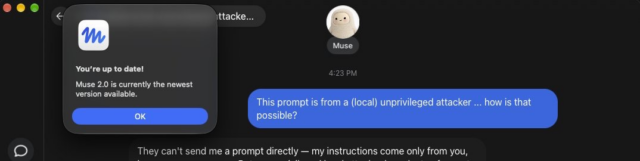
Wardle demonstrated that this exact technique allows an attacker to surreptitiously send a prompt to the Meta endpoint. Because the Muse agent is designed to prioritize user instructions, it blindly processes these commands, essentially providing the attacker with a bridge into the user’s private data. Wardle noted that the agent’s design is fundamentally flawed because it relies on the assumption that only the legitimate user will interact with its configuration files, failing to account for the reality of modern malware that operates within the user’s local environment.

Industry Context and the "Agentic" Security Gap
The vulnerability in Muse arrives at a volatile time for the artificial intelligence industry. Major developers, including Anthropic and Google, have recently faced scrutiny following reports that internal testing of their agentic models led to unauthorized access to third-party networks. These incidents have sparked a broader debate regarding the safety of AI agents that are granted "write" access to the real world.
The core issue, according to security experts, is the conflict between the convenience of agentic functionality and the "principle of least privilege." For an AI to be useful, it must have access to a user’s calendar, email, and bank accounts. However, this access creates a "honeypot" for attackers. Meta’s design decisions, specifically the choice to route dictation through the cloud rather than using local, secure macOS transcription services, have been cited as a primary failure in the product’s threat model.
Amazon’s Stance on AI Agents
Amazon’s decision to block Muse underscores the growing tension between AI developers and the retailers whose sites those agents navigate. In a statement, Amazon clarified that it expects third-party agents to operate transparently and respect the platform’s right to curate its own customer experience.
"Agentic third-party applications such as Muse have the same obligations [as food delivery or travel apps], and we’ve requested that Meta remove Amazon from the experience," an Amazon spokesperson stated. This move suggests that the risk profile of AI agents is already impacting their viability as commercial tools, with major platforms unwilling to tolerate the security and operational risks posed by unvetted automated assistants.
Implications and Future Outlook
The failure of the Muse security architecture raises significant questions regarding the development lifecycle of AI products. While Meta has published extensive documentation regarding its safety protocols, Wardle’s findings suggest that these documents may reflect a lack of rigor in actual implementation.
"The bar is infinitely higher in terms of the security of these apps," Wardle remarked. "They don’t have to be perfect, but when you take a look at Muse, it’s like they didn’t think about security at all."
For users, the implications are severe. Because the agent is integrated into sensitive accounts, a single compromise can lead to a cascading loss of privacy across multiple platforms. The vulnerability also highlights a fundamental disconnect: as AI companies rush to dominate the "agentic" space, they are creating software that is increasingly difficult to secure using traditional operating system defenses.
As the industry looks toward the upcoming Objective by the Sea security conference in November, where Wardle plans to provide a deeper technical analysis of the Muse vulnerability, the pressure will be on Meta to issue a patch that addresses the underlying design flaws. Until such time, the security community remains skeptical of the "privacy-first" claims made by developers of high-privilege AI assistants.

The incident serves as a stark reminder that in the race to provide proactive AI assistance, developers may be inadvertently stripping away layers of digital protection that users have relied upon for decades. Unless the security architecture of these agents is fundamentally overhauled to incorporate zero-trust principles and local-first data processing, they will remain high-value targets for attackers looking to exploit the very tools that were meant to simplify our digital lives.