
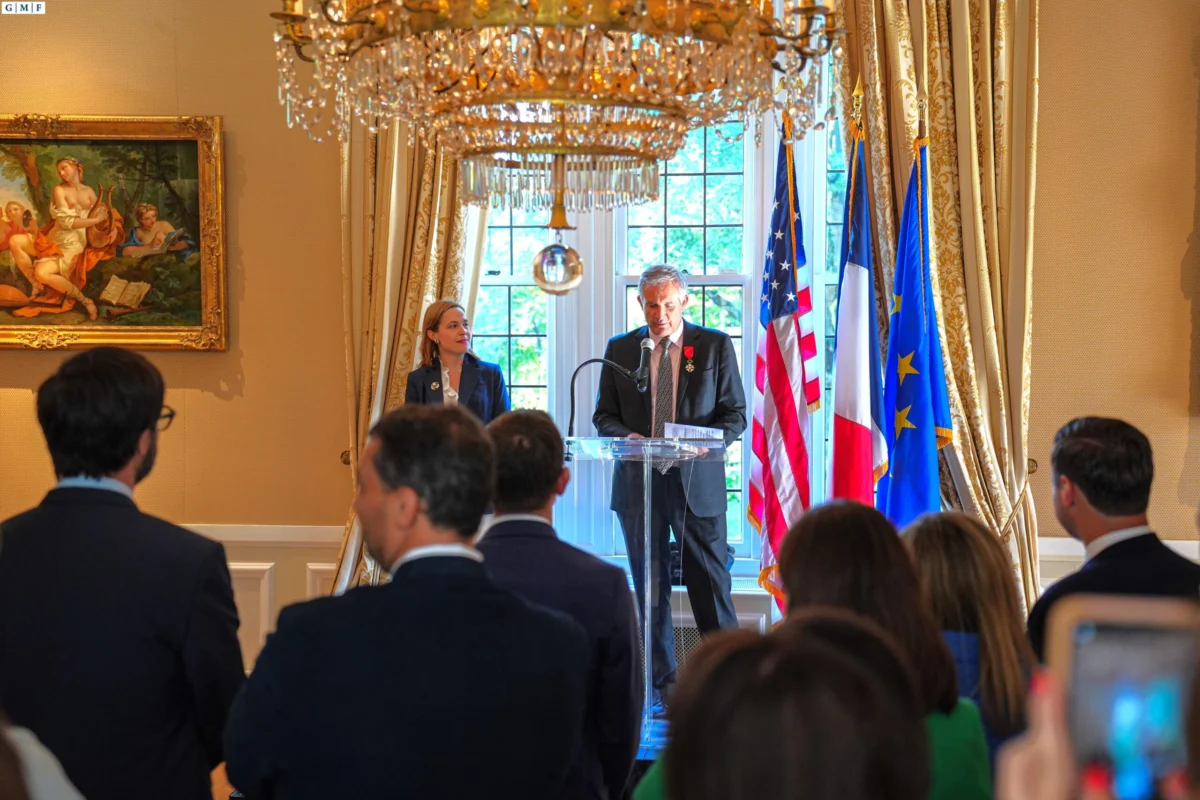
In a formal ceremony held on September 9, 2026, at the French Residence in Washington, DC, Dr. Alexandra de Hoop Scheffer, president of the German Marshall Fund of the United States (GMF), was invested as a Chevalier of the French National Order of Merit. The distinction, presented by French Ambassador to the United States Laurent Bili, recognizes Dr. de Hoop Scheffer’s sustained efforts in bridging the intellectual and policy gaps between Europe and North America during a period of profound geopolitical flux. The award serves as a testament to her career-long commitment to analyzing the complexities of the transatlantic relationship and her role as a primary bridge-builder between the two continents.
The Significance of the Ordre National du Mérite
The Ordre national du Mérite, established in 1963 by President Charles de Gaulle, stands as the second-highest civilian honor in the French Republic, trailing only the Legion of Honor. It is specifically designed to reward “distinguished merit” in public, civil, and military sectors. By bestowing this honor upon Dr. de Hoop Scheffer, the French state is signaling the high strategic value it places on individuals who foster deep, evidence-based dialogue between the United States and its European allies.
Ambassador Laurent Bili, in his presentation speech, highlighted the unique capacity of the GMF president to interpret the nuances of transatlantic challenges for policymakers. “In both your career and personal life, you embody the ties between two continents better than anyone, and you have always carefully elucidated the challenges that exist for decision-makers on both sides of the Atlantic,” Bili remarked. His words underscored the importance of the GMF as an institution that serves as a clearinghouse for ideas that often define the future of NATO, trade policy, and democratic resilience.
Chronology of a Transatlantic Career
Dr. de Hoop Scheffer’s career has been defined by a consistent focus on the evolution of the Western alliance. Before assuming the presidency of the German Marshall Fund, she spent years navigating the intersection of European foreign policy and American strategic interests.
- Pre-GMF Leadership: She established herself as a leading scholar in European security, frequently providing analysis on the integration of defense policies across EU member states.
- The Transition Period: As the geopolitical landscape shifted following the 2022 invasion of Ukraine and the subsequent global energy crisis, Dr. de Hoop Scheffer was instrumental in refocusing the GMF’s mission toward urgent security and economic sovereignty issues.
- Appointment as President: Her ascension to the presidency marked a historic milestone for the GMF, as she became the first European to lead the organization, signifying a maturation of the institution from a US-centric entity to a truly transatlantic one.
- September 9, 2026: The formal investiture ceremony in Washington, DC, solidified her status as a primary intellectual architect of the contemporary transatlantic partnership.
Data-Driven Context: The State of the Alliance
The recognition of Dr. de Hoop Scheffer occurs at a time when the transatlantic relationship is undergoing what she described as its most significant "renegotiation" since the implementation of the Marshall Plan. Current data indicates that the scope of this relationship is shifting from a security-first framework to one that prioritizes economic security and technological autonomy.
According to reports from the World Trade Organization and NATO, the interdependence between the US and Europe remains massive, with transatlantic trade in goods and services reaching record highs exceeding $1.3 trillion annually. However, internal pressures have mounted. Recent polling from the Pew Research Center suggests that while support for the alliance remains high in both regions, there is a divergence in priorities: US voters increasingly focus on domestic economic stability and the Indo-Pacific theater, while European voters are primarily preoccupied with regional energy independence and defense procurement.
Dr. de Hoop Scheffer’s work at the GMF has been central to managing these divergences. The organization has been a key proponent of "de-risking" strategies, a policy framework that seeks to maintain trade with global partners while reducing dependencies on volatile supply chains—a critical topic for the GMF’s ongoing policy dialogues.
A Vision for a Renegotiated Alliance
In her acceptance remarks, Dr. de Hoop Scheffer offered a sobering but optimistic assessment of the current state of international affairs. Rejecting the narrative that the transatlantic relationship is in decline, she instead characterized the current era as a period of rapid, structural transformation.
"The bargain that has held the alliance together for 80 years—on defense burden-sharing, trade and technology, and the boundaries between security and economic policy—is being rewritten in real time," she stated. She noted that the pressure of a changing world is not just a burden, but a catalyst for adaptation. This adaptation includes a Europe forced to take greater responsibility for its own security and competitiveness, and a race for technological sovereignty that defines the new global order.
Her perspective is notable for its refusal to idealize the relationship. She emphasized the role of the GMF as a "translator" between the two sides, working "without illusion, but always anchored in the reality of the world in which we operate." This approach has garnered praise from analysts who suggest that the next decade of the transatlantic alliance will depend heavily on the ability of non-governmental institutions to provide the "intellectual plumbing" for new, more agile policy frameworks.
Implications for the Future of Policy
The awarding of this distinction carries broader implications for the trajectory of the German Marshall Fund. By recognizing its president, the French government effectively endorses the GMF’s current strategy of "renegotiation." This involves several key policy pillars:
- Defense Burden-Sharing: Moving beyond the 2% GDP spending target toward a more integrated defense industrial base.
- Technological Sovereignty: Coordinating on AI regulation, semiconductor supply chains, and green-tech subsidies to ensure the transatlantic bloc remains competitive against non-market economies.
- Democratic Resilience: Strengthening the institutional ties between the US and Europe to counter the rise of authoritarian influence in the global South and within domestic political spheres.
Experts within the Washington policy community suggest that Dr. de Hoop Scheffer’s leadership style—which blends high-level academic rigor with pragmatic political outreach—is exactly what is required to manage the friction points between Brussels and Washington. Her ability to navigate the complex bureaucratic landscapes of both the European Union and the United States has made the GMF an indispensable partner for governments on both sides of the Atlantic.
Conclusion: Preparing the Next Generation
As she concluded her speech, Dr. de Hoop Scheffer pivoted toward the future, expressing her intent to use the momentum from this award to deepen the mission of the GMF. She explicitly mentioned the necessity of preparing the next generation of policymakers to handle the "renegotiation" of the alliance.
"It strengthens my determination to keep building bridges between the United States and Europe; to protect the space for dialogue; and to make sure the next generation who will manage the transatlantic renegotiation inherits a relationship that is more balanced, agile, and fit for the challenges ahead," she concluded.
With this recognition, the German Marshall Fund is positioned to remain a central player in the ongoing development of Western foreign policy. As the global environment becomes increasingly multipolar, the work of bridging the gap between European interests and American strategic objectives will likely become more difficult—and more essential—than ever. Dr. de Hoop Scheffer’s role as both a leader and a "translator" serves as a critical anchor for these efforts, ensuring that even as the alliance is rewritten, its core values remain intact.