

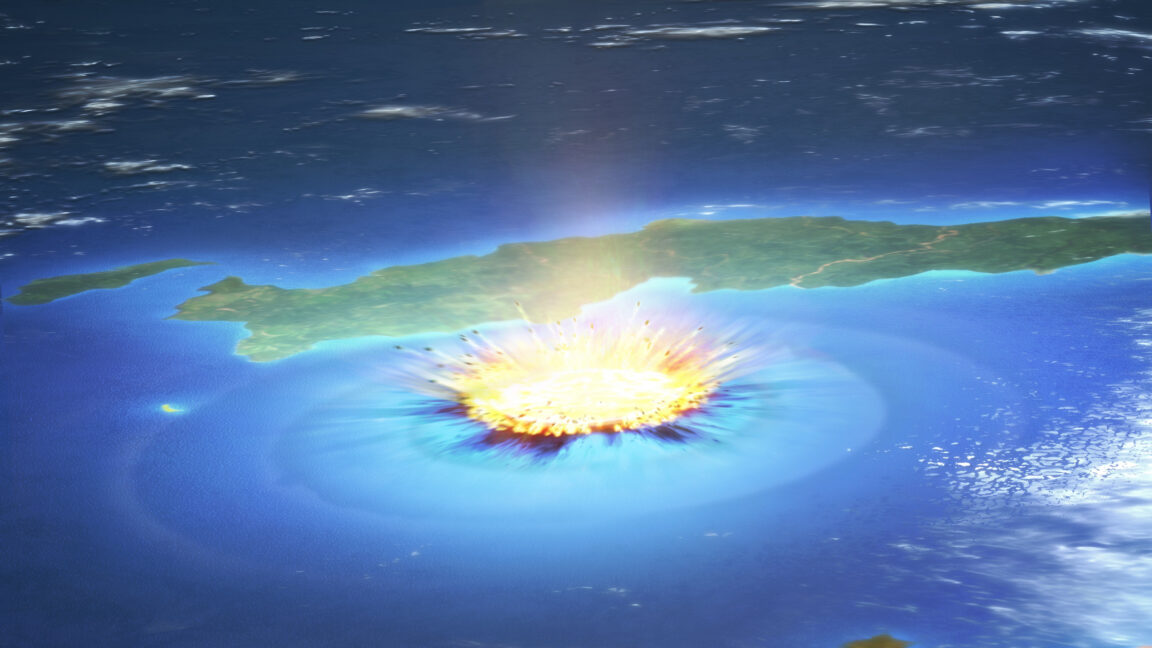
The collision that effectively ended the Cretaceous period 66 million years ago was not merely a cataclysmic finale for the non-avian dinosaurs; it was also a profound geological architect. While the Chicxulub asteroid impact is famously remembered for the global devastation it wrought—triggering tsunamis, wildfires, and an "impact winter" that collapsed terrestrial ecosystems—new research suggests that the site of the impact itself became an unlikely oasis. According to a study published in Communications Earth & Environment, the massive crater in the Yucatan Peninsula hosted a long-lived hydrothermal system that persisted for at least 8 million years, potentially providing a sheltered environment for microbial life to flourish in the aftermath of the extinction event.
The Anatomy of a Planetary Catastrophe
The Chicxulub impact was an event of unparalleled violence. When a 10-to-15-kilometer-wide asteroid slammed into the Yucatan Peninsula at tens of thousands of miles per hour, it deposited a staggering amount of energy, equivalent to billions of atomic bombs. This force pulverized the Earth’s crust, sending shockwaves as deep as 35 kilometers into the subsurface.
The immediate consequences were horrific: the vaporization of carbonate and sulfate rocks released massive quantities of sulfur and carbon dioxide into the atmosphere, leading to rapid global cooling. However, the subterranean reality was quite different. The intense heat generated by the collision melted immense volumes of rock, creating a complex, porous network of fractures deep beneath the seabed. As seawater flooded into these fractured, superheated zones, it initiated a sustained hydrothermal circulation system—a phenomenon akin to the deep-sea vents found today at mid-ocean ridges, where nutrient-rich, heated water sustains diverse communities of chemosynthetic organisms.
Challenging Previous Assumptions
For years, the scientific consensus regarding the longevity of this hydrothermal system was relatively conservative. Initial models and limited sampling suggested that the thermal energy dissipated relatively quickly, likely within 2 million years of the strike. However, a research team led by geologist and planetary scientist Annemarie Pickersgill of the University of Glasgow’s SUERC Center for Isotope Sciences sought to refine this timeline.
By conducting a high-resolution analysis of rock core samples recovered from a depth of one kilometer within the impact zone, the team employed advanced radioisotopic dating techniques. Specifically, the researchers focused on feldspar crystals found within the brecciated rocks of the crater. By measuring the decay of potassium-40 into argon-40, the scientists were able to determine the precise cooling history of the rocks. Because argon gas escapes from molten material, the concentration of argon trapped within these crystals serves as a "geological clock," marking the exact moment the rocks solidified and the hydrothermal flow began to taper off.
The results of this analysis were striking. The data indicated that the hydrothermal system remained active for at least 8 million years, roughly four times longer than previous estimates had suggested. This extended duration provides a vastly different perspective on the post-impact environment, suggesting that the crater did not simply remain a graveyard, but served as a persistent, stable habitat for millions of years.
A Timeline of Habitability
To contextualize these findings, it is helpful to view the post-impact period through a chronological lens:
- T+0 (66 Million Years Ago): The asteroid strikes, creating an instant basin and vaporizing crustal material. The initial shock causes widespread destruction.
- T+1.5 to 2.3 Million Years: The crater’s interior remains at extreme temperatures. Computer simulations indicate the region cools to approximately 90°C (194°F). At this stage, the environment is likely too hostile for most biological life, serving primarily as a geological engine.
- T+5 Million Years: The system cools further to below 50°C (122°F). This temperature range is well within the physiological limits for many thermophilic (heat-loving) microorganisms. It is during this window that the system likely reached its peak potential for supporting life.
- T+6 Million Years: Fluid flux begins to decline significantly. The hydrothermal circulation slows, and the infusion of nutrients from the deep crust wanes.
- T+8 Million Years: The thermal energy is finally depleted. The hydrothermal system ceases to function, effectively shutting down the artificial "oasis" that had thrived in the shadow of the extinction event.
Implications for Astrobiology and Early Earth
The findings by Pickersgill and her team carry significant weight beyond terrestrial paleontology; they provide a blueprint for understanding the habitability of impact craters on other worlds. Hydrothermal systems are ubiquitous in the solar system, found wherever massive impacts have occurred on water-bearing planets or moons.
"Longer periods of hydrothermal activity will generate extended windows of opportunity for prebiotic chemical reactions to occur, life to develop, and micro-organisms to thrive and propagate beyond their point of origin," Pickersgill noted in the study.
This insight is particularly relevant for the study of early Earth, where bombardment by large asteroids was a much more frequent occurrence. If smaller impacts like Chicxulub can sustain habitable conditions for 8 million years, the larger, more frequent impacts of the Hadean and Archean eons may have played a fundamental role in the emergence and diversification of early life. By acting as "cradles" for biology, these craters may have protected early microbes from the volatile surface conditions of the time.
The Search for Ancient Microbes
While the evidence for the conditions of habitability is now robust, confirming the presence of life remains a challenge. Despite the existence of 70 known underwater impact craters globally that likely hosted hydrothermal activity, evidence of biological colonization has been confirmed in only eight. The search for "biosignatures"—chemical or structural evidence of ancient life—is notoriously difficult in the metamorphic, high-heat environments of an impact site.

However, the Chicxulub study demonstrates that the window for life was much wider than once thought. A longer duration of heat and chemical circulation increases the probability that microbial colonies could have migrated from the surrounding ocean into the porous, nutrient-rich environment of the crater. The researchers emphasize that while their work does not definitively prove that life inhabited this specific system, it establishes that the environmental constraints on life—specifically the availability of thermal energy—were not a limiting factor for millions of years.
Broader Scientific Context
This research highlights the shift in modern paleontology toward a more systems-based approach. By integrating geochronology, computer fluid-dynamics modeling, and microbiology, scientists are moving away from viewing the asteroid impact as a static event of destruction. Instead, they are characterizing it as a dynamic geological process that fundamentally altered the geochemical landscape of the planet.
Furthermore, the study highlights the importance of the 2016 drilling expedition at the Chicxulub site, which remains one of the most successful efforts to access the deep, inner structure of a large impact crater. As scientists continue to analyze these cores, they expect to uncover further details about the chemical evolution of the crater and its potential role as a geochemical reactor.
Conclusion
The Chicxulub impact remains the most famous extinction-level event in Earth’s history, but the narrative is shifting from one of total annihilation to one of complex, long-term environmental transformation. The discovery that the crater supported a hydrothermal system for 8 million years challenges the notion of the impact as a singular, short-lived trauma.
Instead, it suggests that Earth’s own violent geological history may have provided the very conditions necessary to foster the recovery and evolution of life. As researchers turn their attention to larger impact basins on Mars, the Moon, and beyond, the legacy of the Chicxulub crater will serve as a critical model for identifying potential habitats for life elsewhere in the cosmos. For the history of our planet, the asteroid was not just a messenger of death, but a catalyst for a unique, subterranean biological experiment that persisted long after the dust of the extinction had settled.