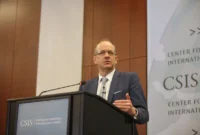

The Center for Strategic and International Studies (CSIS) International Security Program is preparing to convene a high-level, half-day Defense360 conference dedicated to examining the fiscal year 2017 (FY2017) defense budget request and the evolving strategic priorities of the United States Department of Defense. This pivotal event gathers top-tier Pentagon officials, renowned defense economists, and leading national security analysts to dissect the fiscal parameters, force-structure implications, and long-term strategic calculus underpinning the administration’s military spending proposals. As fiscal constraints, legislative caps, and global security challenges continuously intersect, the conference serves as a critical forum for evaluating how effectively the proposed budget aligns with the nation’s overarching defense strategy.
The event, made possible through general operational support provided to CSIS, opens with framing remarks by Dr. John Hamre, President and CEO of CSIS. The core of the morning features a premier panel of senior defense officials—including the Under Secretary of Defense (Comptroller), the Director of Cost Assessment and Program Evaluation (CAPE), and the Assistant Secretary of Defense for Strategy, Plans, and Capabilities—followed by an independent expert panel featuring former government officials and scholars from prominent Washington think tanks. Todd Harrison, Director of Defense Budget Analysis and Senior Fellow with the CSIS International Security Program, is scheduled to moderate the discussions across both sessions.
Background and Context of the FY2017 Defense Budget Request
The release of the FY2017 defense budget request arrived at a particularly complex juncture for United States national security policy. Navigating the lingering statutory framework of the Budget Control Act (BCA) of 2011, Pentagon leadership faced the ongoing challenge of balancing readiness recovery, technological modernization, and force end-strength against rigidly enforced spending caps. Unlike previous fiscal years that were heavily dominated by immediate counterinsurgency operations in the Middle East, the FY2017 blueprint was deliberately crafted to address a shifting global threat environment characterized by the resurgence of great-power competition, particularly involving near-peer adversaries such as Russia and China, alongside persistent asymmetric threats in the Middle East and cyber domains.
Within this context, the strategic calculus of the Department of Defense shifted toward a heavy emphasis on technological superiority, research and development (R&D), and the preservation of a technological edge often referred to as the "Third Offset Strategy." Department leaders stressed the necessity of prioritizing investments in advanced capabilities—including artificial intelligence, unmanned systems, electronic warfare, cyber defense, and long-range precision strike systems—even if it meant making difficult choices regarding legacy platforms and force size. The Defense360 conference was specifically designed to unpack these trade-offs, providing stakeholders, industry leaders, and policymakers with a transparent platform to evaluate whether the requested funding levels and resource allocations were sufficient to meet the ambitious goals outlined in the National Defense Strategy.
Chronology of the Event Program
The morning conference schedule is structured to provide a comprehensive, top-down examination of the budget, moving from official administration justification to independent third-party critique and analysis.
The proceedings commence at 9:00 AM with official opening remarks delivered by Dr. John Hamre, setting the analytical tone for the morning by framing the macroeconomic and geopolitical realities influencing the fiscal debate. Immediately following the opening remarks, the first substantive session runs from 9:00 AM to 10:30 AM, featuring a trio of the Pentagon’s most influential civilian resource and strategy architects: Mike McCord, Under Secretary of Defense (Comptroller) and Chief Financial Officer; Dr. Jamie Morin, Director of Cost Assessment and Program Evaluation (CAPE); and Robert Scher, Assistant Secretary of Defense for Strategy, Plans, and Capabilities. This panel delves directly into the executive branch’s rationale, detailing how the proposed top-line figures were derived and how strategic priorities were translated into specific budget line items.
Following a brief transition, the second session convenes from 10:30 AM to 11:30 AM, shifting the perspective from internal Pentagon management to external expert evaluation. This panel brings together a diverse assembly of defense policy authorities, including former senior government officials and prominent researchers. The participants include Tina Jonas, former Under Secretary of Defense (Comptroller) and Chief Financial Officer and current Senior Adviser at CSIS; Andrew Hunter, Director of the Defense-Industrial Initiatives Group and Senior Fellow in the International Security Program at CSIS; Mark Cancian, Senior Adviser in the International Security Program at CSIS; Shawn Brimley, Executive Vice President and Director of Studies at the Center for a New American Security (CNAS); and Roger Zakheim, Visiting Fellow at the American Enterprise Institute (AEI). Both sessions are moderated by Todd Harrison, ensuring continuity in questioning and thematic focus across the entire program. In tandem with the live discussions, CSIS has launched a public survey on defense reform to gather broader stakeholder input on structural changes required within the defense enterprise.
Key Figures and Panelists
The roster of speakers for the Defense360 conference represents a deep reservoir of expertise spanning federal financial management, military strategy, and defense acquisition policy.
Dr. John Hamre brings decades of institutional memory to his opening remarks, having served as the 26th Deputy Secretary of Defense and Under Secretary of Defense (Comptroller) prior to leading CSIS. His introductory perspective typically bridges the gap between historical defense budgeting trends and contemporary fiscal realities.
Mike McCord, in his capacity as Under Secretary of Defense (Comptroller) and CFO, serves as the chief financial architect of the Department of Defense. Responsible for the execution, formulation, and presentation of the defense budget to Congress, McCord’s insights provide attendees with a direct understanding of the fiscal constraints and legislative compromises inherent in the executive’s proposal.
Dr. Jamie Morin leads the Office of Cost Assessment and Program Evaluation (CAPE), an independent analytic organization within the DoD responsible for providing the Secretary of Defense with objective evaluations of weapon system costs, program trade-offs, and force structure alternatives. Morin’s presence sheds light on the analytical rigor applied to major defense acquisition programs.
Robert Scher, serving as Assistant Secretary of Defense for Strategy, Plans, and Capabilities, offers crucial insight into the policy framework that drives resource allocation. His work directly connects high-level national security strategy with operational planning and force development.
The expert panel introduces critical outside perspectives. Tina Jonas contributes a wealth of former financial management experience combined with current analytical depth from her advisory role at CSIS. Andrew Hunter and Mark Cancian bring extensive research focus on defense-industrial issues, procurement trends, and force structure analysis. Meanwhile, Shawn Brimley of CNAS and Roger Zakheim of AEI represent leading independent viewpoints on how the budget impacts broader U.S. foreign policy, geopolitical deterrence, and legislative viability on Capitol Hill. Todd Harrison, as moderator, guides the dialogue with his recognized expertise in defense budget economics and fiscal trend analysis.
Supporting Data and Fiscal Realities of the FY2017 Request
While the specific dollar figures debated during the conference reflect the unique political and economic environment of 2016, the underlying structural challenges highlighted by the data remain perennial fixtures of American defense economics. The FY2017 budget request was constructed around a base budget and an Overseas Contingency Operations (OCO) funding mechanism, a bifurcation that has historically drawn intense scrutiny from both fiscal hawks and defense advocates.
During the conference discussions, analysts frequently pointed to the tension between rising personnel costs—including healthcare and retirement benefits—and the shrinking capital available for modernization and readiness. Despite concerted efforts by the Pentagon to achieve internal efficiencies, mandated end-strength floors and legislative pushback against compensation reform created persistent upward pressure on non-discretionary overhead. Furthermore, the data underscored a widening gap between the cost of procuring increasingly sophisticated, software-intensive military platforms and the flat or declining purchasing power dictated by BCA spending caps. This fiscal squeeze forced leadership to constantly re-evaluate force readiness metrics, noting that while the active-duty force could maintain high readiness for primary deployment cycles, the depth of the force and the ability to sustain a prolonged multi-theater conflict remained areas of acute vulnerability.
Official Responses and Stakeholder Reactions
The unveiling of the FY2017 defense budget and the subsequent discussions at forums like the CSIS Defense360 conference elicited a wide spectrum of reactions across the Washington defense establishment, Capitol Hill, and the defense-industrial base.
Administration defenders emphasized that the budget represented a pragmatic, strategy-driven compromise that maximized available resources within the strict parameters of the law. Pentagon officials consistently argued that any attempt to unilaterally bust spending caps without bipartisan legislative consensus would trigger destabilizing sequester cuts, thereby inflicting greater harm on military readiness than the proposed fiscal constraints themselves. They highlighted targeted increases in R&D funding as evidence of a forward-leaning posture designed to preserve technological superiority over potential adversaries.
Conversely, congressional critics and independent defense analysts voiced significant apprehension regarding the adequacy of the top-line request. Many lawmakers argued that the budget underfunded critical modernization initiatives and failed to account for the expanding operational demands placed on the armed forces globally. Think-tank experts frequently pointed out that relying heavily on OCO funding to cover enduring baseline requirements created budgetary instability and obscured true long-term costs. The dialogue at the conference reflected these broader institutional tensions, underscoring the ongoing struggle between executive branch resource management and congressional legislative oversight.
Broader Impact and Strategic Implications
The implications of the FY2017 defense budget and the strategic debates highlighted during the CSIS conference extend far beyond immediate fiscal accounting, touching upon the fundamental tenets of American global power projection and national security.
First, the budget choices made during this fiscal cycle directly influenced the trajectory of the Department of Defense’s modernization pipeline. By prioritizing investments in disruptive technologies—such as hypersonics, artificial intelligence, and advanced cyber capabilities—the DoD sought to deter technologically advanced adversaries. However, these choices also necessitated difficult divestments from legacy platforms, sparking contentious debates regarding acceptable levels of risk in traditional warfare domains like armor, surface combatants, and tactical aviation.
Second, the conference underscored the critical linkage between defense strategy and industrial base capacity. As the Pentagon increasingly looked to commercial sectors for technological innovation, traditional defense contractors faced growing pressure to adapt their business models, research and development pipelines, and acquisition practices. The health and responsiveness of the defense-industrial base emerged as a central determinant of whether the United States could successfully execute its strategic pivot toward great-power competition.
Finally, the deliberations at Defense360 served as a barometer for the broader health of American civil-military policymaking. By bringing together civilian leadership, independent researchers, and fiscal analysts, the event reinforced the necessity of transparent, rigorous debate in navigating the nation’s most complex security challenges. As the United States continues to grapple with shifting geopolitical dynamics and fiscal realities, the insights generated through platforms like the CSIS International Security Program remain instrumental in shaping informed, resilient, and effective national defense policies for the future.