On March 4, 2016, the Center for Strategic and International Studies (CSIS) hosted a high-level security seminar that brought together top-tier defense officials, academic experts, and policymakers to evaluate the evolving landscape of the U.S.-Japan alliance. The event, supported by the Japanese Ministry of Foreign Affairs, served as a critical platform for analyzing the shifting maritime security environment in the Asia-Pacific region, a theater marked by increasing territorial tensions and the modernization of regional naval forces. By examining the synergy between Washington and Tokyo, the seminar provided a comprehensive look at how these two nations intended to navigate the complexities of the South and East China Seas during a period of transition in international relations.
The Strategic Context of the 2016 Security Environment
The 2016 seminar was convened against a backdrop of intensifying geopolitical friction. During this period, the Asia-Pacific region was experiencing a rapid transformation in the maritime domain. China’s assertive posturing in the South China Sea—characterized by the construction of artificial islands and the militarization of disputed reefs—had created significant unease among regional actors. Furthermore, the persistent tensions regarding the Senkaku Islands in the East China Sea necessitated a recalibration of how the U.S.-Japan security umbrella functioned in practice.
For the United States and Japan, the 2016 security environment was defined by the need to harmonize domestic policy with the requirements of an integrated defense strategy. The Japanese government, under Prime Minister Shinzo Abe, had recently passed significant security legislation in 2015 that allowed for a more expansive interpretation of "collective self-defense." This marked a historic shift for Japan’s post-war pacifist doctrine, enabling the Japan Self-Defense Forces (JSDF) to provide logistical and operational support to allies under a broader range of circumstances. The CSIS seminar acted as a vital venue for officials to unpack the practical implications of these policy changes.
Chronology of the Seminar Proceedings
The proceedings began at 3:00 p.m. with welcoming remarks delivered by Michael J. Green, the Senior Vice President for Asia and Japan Chair at CSIS, and Yoshiji Nogami, President of The Japan Institute of International Affairs (JIIA). Their opening statements emphasized the endurance of the bilateral partnership, framing it as the cornerstone of regional stability in the face of unpredictable security challenges.
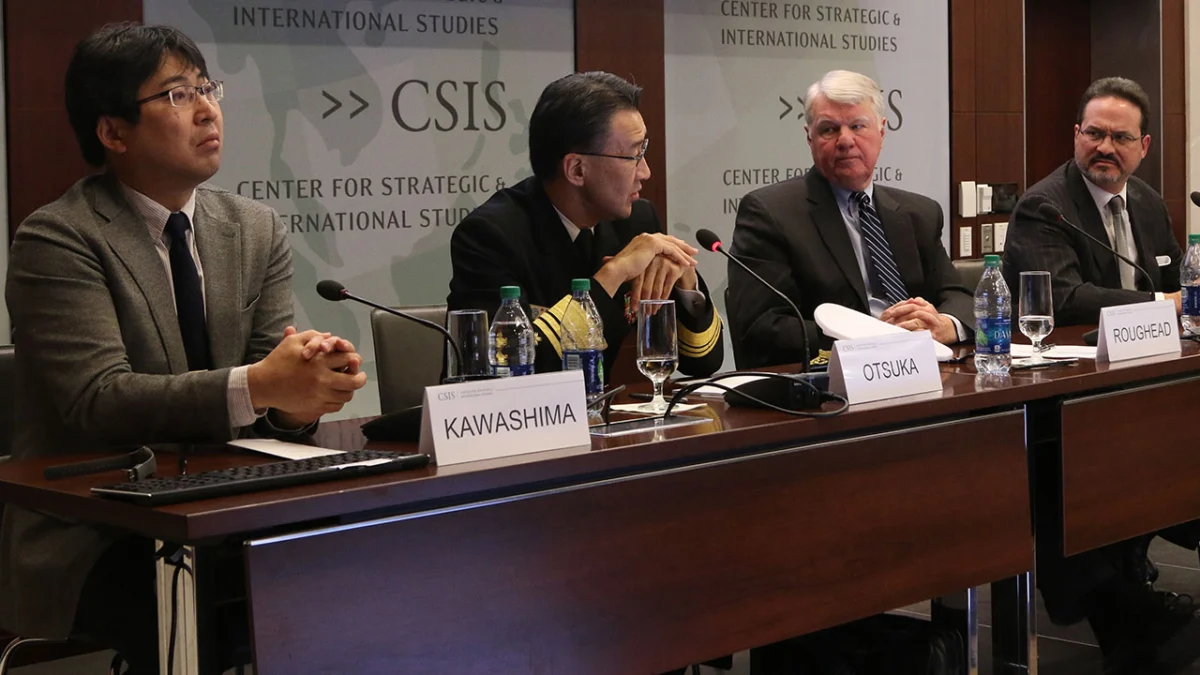
Following the introductions, the core of the seminar—a deep-dive session titled "The U.S.-Japan Alliance and Maritime Security in the Asia-Pacific Region"—commenced at 3:15 p.m. This panel featured a distinguished group of experts: Vice Admiral Umio Otsuka, President of the Japan Maritime Self Defense Force Command and Staff College; Professor Shin Kawashima from the University of Tokyo; and Admiral Gary Roughead (USN, Ret.).
The discussion focused on the operational necessity of interoperability between the U.S. Navy and the Japan Maritime Self-Defense Force (JMSDF). Admiral Roughead, drawing on his extensive career, provided insights into the logistical challenges of maintaining a persistent naval presence in the Western Pacific. Vice Admiral Otsuka highlighted the specific maritime threats facing Japan, focusing on the protection of sea lines of communication (SLOCs) and the importance of maintaining an open, rules-based maritime order. Professor Kawashima provided the academic framework, analyzing how China’s regional maritime strategy influenced the threat perception of the Japanese public and government officials.
The seminar concluded with a robust Q&A session at 4:30 p.m., allowing for a candid exchange between the panelists and a high-level audience of policy analysts and government representatives. The event officially adjourned at 5:00 p.m., transitioning into a private reception.
Supporting Data and Security Metrics
To understand the weight of the issues discussed, one must look at the data available in 2016 regarding military spending and maritime capabilities. Throughout the mid-2010s, China’s defense budget saw double-digit growth, consistently outpacing the defense spending of most other regional powers. By 2016, China had surpassed many neighbors in terms of naval tonnage and the sheer number of coast guard vessels equipped for long-range patrols.

In contrast, Japan’s defense spending, while modest in percentage of GDP, was strategically shifting toward high-tech maritime capabilities. In 2016, the Japanese Ministry of Defense emphasized the acquisition of advanced P-1 maritime patrol aircraft, the construction of additional Sōryū-class submarines, and the deployment of new radar systems along the Nansei Islands. These acquisitions were intended to counter the "gray zone" tactics—activities that stop just short of conventional war—employed by regional rivals. The CSIS seminar served as an analytical bridge, linking these procurement decisions to the overarching goal of maintaining a credible deterrent.
Official Perspectives and Policy Implications
The collaborative nature of the seminar reflected the deepening institutional ties between Washington and Tokyo. Statements from the participants consistently echoed a unified message: the U.S.-Japan alliance was not a static arrangement but a dynamic partnership requiring constant maintenance and adjustment.
Michael J. Green, a central figure in U.S.-Japan relations, consistently argued that the alliance served as a deterrent against unilateral attempts to change the status quo by force. His research and commentary, both at the time of the seminar and in subsequent years, reinforced the idea that maritime security is intrinsically linked to the economic prosperity of the Indo-Pacific.
From the Japanese perspective, the presence of figures like Yoshiji Nogami underscored the importance of think-tank diplomacy. By fostering dialogue between the JIIA and CSIS, the two nations ensured that policy recommendations were based on shared intelligence and synchronized strategic goals. The seminar also served as a signal to other regional powers—particularly those in the Association of Southeast Asian Nations (ASEAN)—that the United States remained committed to the region despite domestic political debates regarding "pivot" or "rebalance" policies.
Broader Impact and Long-term Implications
The 2016 U.S.-Japan Security Seminar stands as a seminal point of reference for researchers studying the evolution of modern alliances. The themes explored—specifically the integration of maritime security strategies and the adaptation to gray-zone warfare—have become even more salient in the years since.
The implications of the 2016 discourse were manifold. First, it cemented the understanding that the U.S.-Japan alliance is as much about legal and administrative frameworks as it is about hardware. The legislative shifts in Japan were successfully communicated to the U.S. defense establishment as a sign of Tokyo’s readiness to bear a greater share of the security burden. Second, it solidified the focus on the "Free and Open Indo-Pacific" (FOIP) vision, a concept that would later be formally adopted and expanded by both the Trump and Biden administrations.
Furthermore, the seminar highlighted the role of non-governmental institutions in shaping foreign policy. By creating a space for transparent dialogue, CSIS and JIIA were able to influence the intellectual consensus regarding China’s rise. This consensus shifted the perspective from viewing China solely as an economic partner to acknowledging the necessity of a sophisticated security response to its growing maritime assertiveness.
Conclusion: A Legacy of Strategic Alignment
The 2016 CSIS security seminar did more than present a series of lectures; it functioned as a strategic barometer for the most important bilateral relationship in the Pacific. By gathering experts who understood the nuances of naval warfare, regional history, and international law, the seminar successfully mapped out the requirements for maintaining peace in the Asia-Pacific region.
The insights shared by Admiral Roughead, Vice Admiral Otsuka, and Professor Kawashima remain relevant as the international community continues to grapple with the complexities of maritime sovereignty and regional hegemony. The seminar reminded its audience that the stability of the global commons—the international waters through which a significant portion of world trade passes—is not a default state, but rather a condition that must be actively defended through diplomacy, robust alliances, and strategic foresight. As the geopolitical landscape of the Indo-Pacific continues to evolve, the framework discussed in this 2016 meeting serves as a foundational element for the ongoing security architecture that links Washington and Tokyo today.