
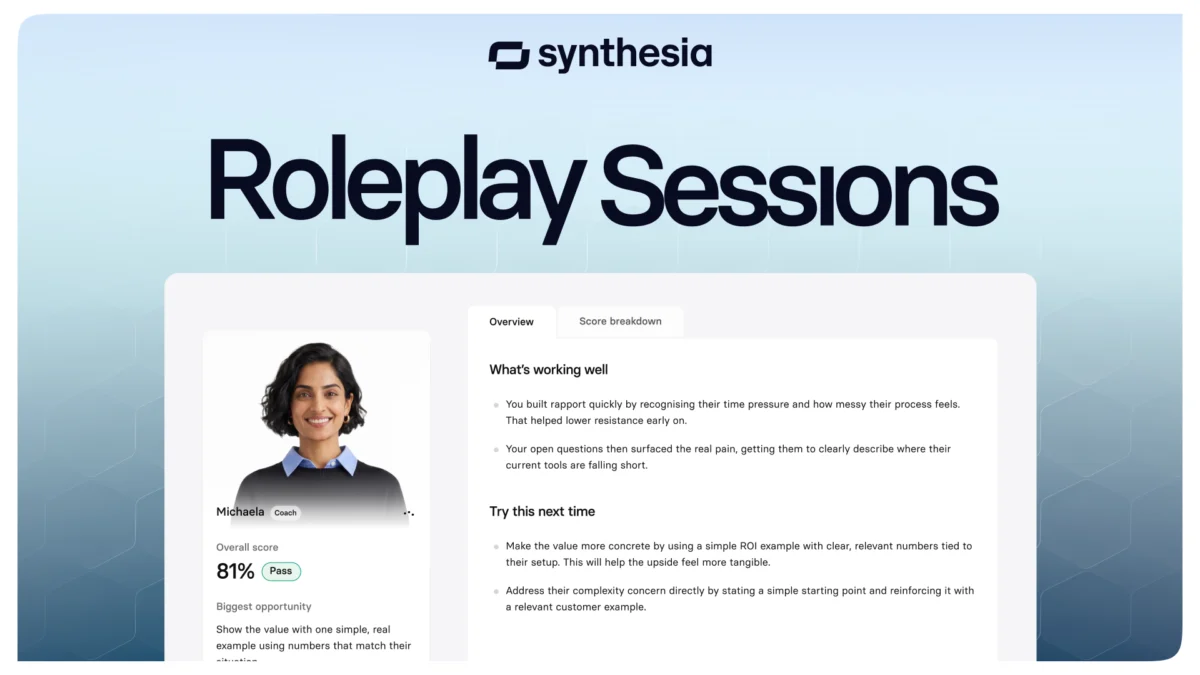
For years, the corporate training sector has been defined by a passive consumption model: employees watch videos, read manuals, and click through slides, hoping that information retention translates into workplace competence. Synthesia, the British AI unicorn currently valued at $4 billion, is now signaling a fundamental shift in that paradigm. By launching Roleplay Sessions, a new interactive platform that enables employees to engage in high-stakes simulations with AI avatars, the company is moving beyond simple content generation to address the long-standing enterprise challenge of measuring behavioral change.
This evolution represents a significant strategic pivot for a company that rose to prominence by automating the production of corporate training videos. While Synthesia’s core product successfully reduced the time and cost associated with creating educational content, the company’s leadership now argues that the true "moat" in enterprise AI is not the ability to generate media, but the capacity to prove that such media—and the training it provides—actually works.
The Shift Toward Active Learning
The launch of Roleplay Sessions on Wednesday marks the beginning of a broader "Sessions" platform architecture. The initial rollout allows employees to practice complex, high-pressure interactions—ranging from intricate sales pitches and performance reviews to navigating difficult customer complaints—with an AI avatar capable of verbal and non-verbal feedback.
The mechanism is sophisticated: the AI does not simply read a script. It is designed to listen, push back, and adapt to the user’s input, ultimately providing a quantitative score based on a pre-defined performance rubric. This shift moves the product from a static "broadcast" model to a dynamic "interactive" model.
According to Victor Riparbelli, CEO and co-founder of Synthesia, the impetus for this development lies in the limitations of traditional learning methods. "Video performs way better than text or sending out a document," Riparbelli noted. "But for most things, we learn the best by actually practicing something rather than just reading it." By integrating a feedback loop that evaluates performance, Synthesia is betting that enterprises will prioritize measurable skill acquisition over mere information distribution.
Chronology and Context: From Avatars to Analytics
Synthesia’s journey reflects the broader maturation of the enterprise AI market. In its early stages, the company focused on the novelty and efficiency of hyper-realistic AI avatars. As the technology matured, so did the demands of its corporate clients.
- Foundation: Synthesia built its reputation on creating cost-effective, scalable video content for global corporations, effectively digitizing the "talking head" lecture format.
- Expansion Phase: As LLMs (Large Language Models) became more powerful, Synthesia began integrating sophisticated natural language processing (NLP) to enable its avatars to interact with content in real-time.
- The Current Pivot: The introduction of the Sessions platform marks the transition from content creation to talent management. The platform is designed to track employee progress, identify skill gaps, and provide managers with aggregate data on team performance.
This timeline reflects a broader industry trend where the initial hype surrounding generative AI—which focused on creative "flash"—is being replaced by a demand for "utility." Enterprises are currently undergoing an audit of their AI expenditures, moving away from experimental pilots and toward solutions that demonstrate a direct impact on the bottom line.
Data-Driven Performance Management
The implications for human resources and sales leadership are substantial. By utilizing Roleplay Sessions, an organization can map the talent distribution of its workforce in ways that were previously cost-prohibitive. For instance, if a Fortune 500 company mandates that its entire sales force practice pitch scenarios with an AI, the resulting data provides management with granular insights into the consistency, strengths, and weaknesses of their team.
Synthesia’s approach relies on a combination of proprietary avatar and voice technology, layered over the reasoning capabilities of OpenAI’s models. By adding a layer of rubrics and analytics, Synthesia is positioning itself not just as a media production tool, but as a critical piece of enterprise infrastructure. This is a move toward "performance management," a lucrative segment that attracts higher budgets and longer contract cycles than standard creative software.
Early adoption appears robust. A company spokesperson confirmed that initial commercial rollouts include one of the top three European companies by market cap, one of the top five Fortune 100 firms, and one of the world’s largest recruitment agencies. These early adopters are primarily utilizing the technology for sales training and leadership development, focusing heavily on soft skills that are notoriously difficult to teach through traditional e-learning.
Addressing the "Action Gap" in Corporate Training
The rationale behind this move is backed by academic research. A meta-analysis of learning design suggests that the "action gap"—the space between consuming information and applying it—is where most corporate training fails. Traditional methods inform and demonstrate, but they rarely force the cognitive engagement required to alter behavior.
By requiring the employee to respond in real-time to an avatar that mimics a difficult client or an underperforming direct report, the training forces the user to apply knowledge under pressure. This is a significant departure from the standard "click-to-advance" training modules that dominate current corporate systems.
Furthermore, the customization options allow for bespoke training programs. Companies can either use the platform to build their own modules or utilize Synthesia’s consultants to integrate proprietary training documents and company-specific context. This creates a high barrier to entry for competitors, as the platform becomes increasingly "sticky" due to the volume of company-specific data and performance history embedded within the system.
Broader Market Implications
As inference costs for AI continue to decline, Synthesia plans to democratize access to Roleplay Sessions. While currently restricted to large enterprise clients, the company expects to expand the offering to small businesses, prosumers, and educational institutions in the coming months.
The success of this pivot could serve as a bellwether for the rest of the enterprise AI sector. If Synthesia can successfully demonstrate that AI-driven roleplay leads to higher conversion rates for sales teams or better retention rates for leadership, other SaaS providers will likely follow suit, integrating "active feedback" loops into their platforms.
However, the transition is not without challenges. The integration of AI into performance management raises concerns regarding privacy, data security, and the ethics of "algorithmic management." As companies collect more granular data on how employees perform in simulated scenarios, they must navigate the delicate balance between coaching for improvement and surveillance for disciplinary action.
Future Outlook: Toward Measurable Outcomes
The move into the "Sessions" platform is more than just a product update; it is an evolution of Synthesia’s business identity. The company is effectively shifting its value proposition from "making it look professional" to "making it work effectively."
Victor Riparbelli’s vision for the next phase of enterprise AI is clear: companies are moving past the "demo phase." The future of the market belongs to tools that can prove they generate measurable business outcomes. Whether it is through improved sales performance, more effective HR interactions, or streamlined candidate screening, the focus has shifted from the aesthetic to the functional.
As Synthesia expands its "Sessions" suite to include job interviews and candidate screening, the company is positioning itself as a central player in the digitized workplace. By bridging the gap between content delivery and performance assessment, Synthesia is betting that the future of enterprise AI lies in its ability to coach, measure, and refine human talent at scale. Whether the market follows this trend remains to be seen, but the initial commercial uptake suggests that large organizations are hungry for tools that move beyond the screen and into the reality of the office environment.