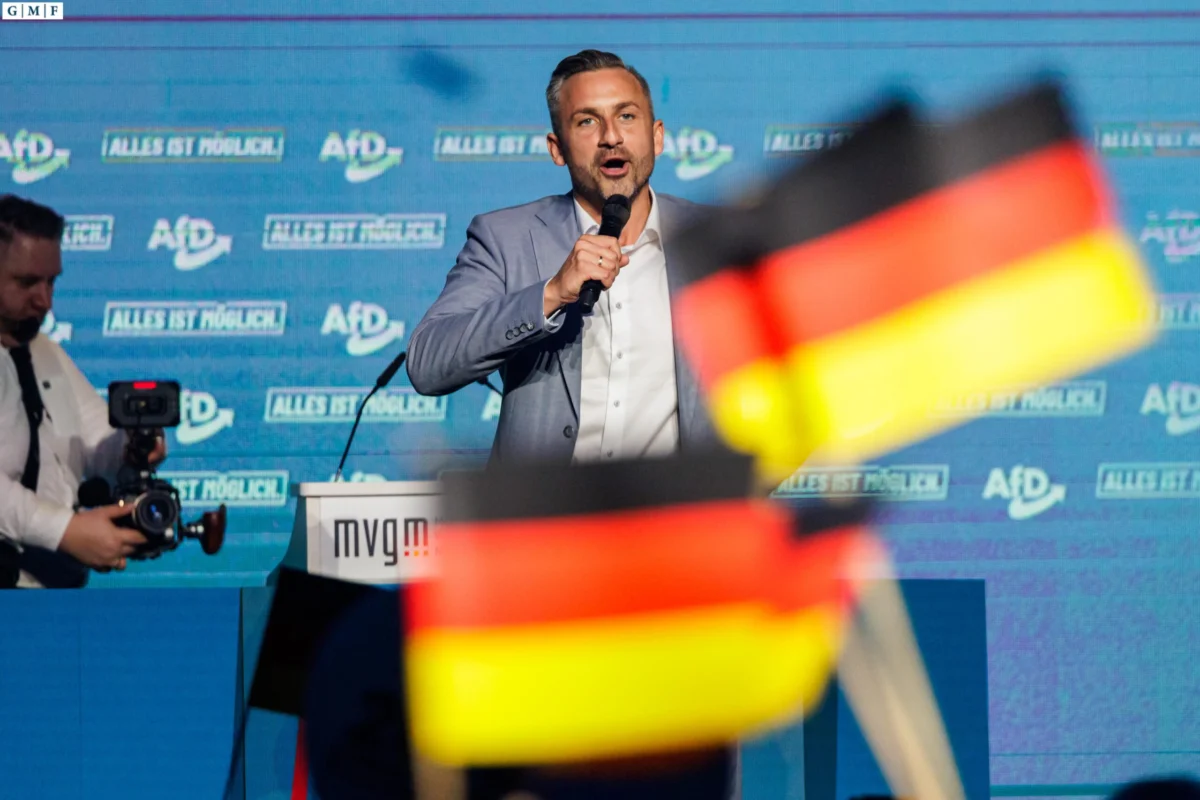
The political landscape of the Federal Republic of Germany underwent a seismic transformation this week as the state of Saxony-Anhalt delivered results that shattered eight decades of post-war political norms. For the first time since the nation’s founding in 1949, a far-right party—the Alternative for Germany (AfD)—has secured a definitive victory in a state-level election. By more than doubling its share of the vote compared to the 2021 election cycle, the AfD has effectively dismantled the long-standing "cordon sanitaire" that mainstream parties relied upon to keep extremist factions from the levers of regional power. Chancellor Friedrich Merz’s Christian Democratic Union (CDU), once the dominant force in the region, saw its support collapse by half, leaving the party’s leadership in Berlin scrambling to address a catastrophic erosion of its electoral base.
This outcome is not merely a regional curiosity; it represents a fundamental fracture in the democratic guardrails that have defined modern Germany. While Saxony-Anhalt comprises only 1.7 million of Germany’s 83 million citizens, the symbolic and structural implications of this victory are immense. Since 2023, the state’s domestic intelligence agency, the Verfassungsschutz, has officially classified the local AfD branch as a confirmed right-wing extremist organization. The agency’s dossiers cite evidence that the party systematically works to undermine the constitutional order, human dignity, and the integrity of democratic institutions. That a political entity operating under such a designation could achieve a clear mandate from the electorate suggests that the traditional barriers separating radical discourse from mainstream governance have not only been breached—they have been rendered obsolete.
A Chronology of the Political Surge
The rise of the AfD in Saxony-Anhalt did not occur in a vacuum; it is the culmination of a decade-long drift in eastern German politics.
- 2013–2015: The AfD is founded, initially as a Euro-skeptic movement, before pivoting toward anti-immigration rhetoric during the 2015 refugee crisis.
- 2016–2021: The party establishes a firm foothold in the former East German states, capitalizing on feelings of "second-class citizenship" and economic stagnation relative to the industrial hubs of the west.
- 2023: The Saxony-Anhalt domestic intelligence agency formally labels the state party a right-wing extremist threat, marking a shift from monitoring to active designation.
- Mid-2024: National polling for Chancellor Friedrich Merz’s CDU hits a historic low of 13%, exacerbated by persistent inflation, energy crises, and a perceived failure to address the grievances of the eastern electorate.
- Election Day: The AfD secures a landslide victory, leaving the CDU and coalition partners scrambling to define a strategy for potential governance—or total opposition.
Economic Disparities and Regional Resentment
The electoral results serve as a harsh indicator of the "wall in the heads" that remains a feature of German society. Despite billions of Euros in federal transfers, the economic disparity between the former East and West remains a defining grievance. In many rural communities across Saxony-Anhalt, the traditional center-left SPD and center-right CDU have seen their organizational presence atrophy.
The AfD has successfully filled this vacuum by adopting a grassroots strategy. Party representatives are frequently seen at local community events, town halls, and festivals where they offer simple, populist solutions to complex problems. By focusing on daily grievances—such as the rising costs of living, the closure of local schools, and the perceived neglect from Berlin—the party has cultivated a base of support that feels ignored by the "metropolitan elite." This is not merely an ideological shift; it is a structural abandonment of the traditional party system by voters who no longer believe the mainstream promises of prosperity and stability.
Implications for Foreign Policy and Security
While state governments in Germany are primarily responsible for education, policing, and local infrastructure, their influence on the national stage cannot be ignored. The AfD’s platform stands in stark contrast to the foreign policy established by the federal government under Friedrich Merz. The party has consistently campaigned for the cessation of military aid to Ukraine and advocates for a restoration of energy and economic ties with the Kremlin.
This puts the AfD in direct opposition to the transatlantic security architecture. As Washington and Brussels push for increased defense spending and a unified front against Russian aggression, the emergence of a German state government committed to isolationism creates a significant internal headache for Berlin. If the AfD successfully forms a coalition—a process that is expected to take weeks or even months of arduous negotiation—they will gain a bully pulpit from which to attack federal policies. This "sovereign isolationism" creates a strategic vulnerability, potentially limiting Germany’s ability to act as a cohesive leader within the European Union.
The Breakdown of the "Firewall"
The most immediate crisis facing Chancellor Merz is the collapse of the "firewall" (Brandmauer) policy, which prohibits any form of cooperation between the CDU and the AfD. Across the eastern states, local CDU politicians are under intense pressure to abandon this policy. They argue that refusing to govern with the strongest party—the AfD—makes the state ungovernable and alienates voters even further.
Merz is now caught in a pincer movement. If he maintains the firewall, he risks a total loss of relevance in the east and the potential fracture of his own party. If he allows for pragmatic cooperation with the AfD, he risks a revolt from the moderate, western wing of the CDU and a potential loss of credibility on the international stage.
Meanwhile, the federal coalition partners, including the SPD and the Greens, are increasingly paralyzed by the fear that their own electoral prospects will follow the same downward trajectory. This internal strife is expected to grind federal legislative progress to a halt, as each party focuses on damage control rather than national governance.
The European Perspective
Beyond Germany’s borders, the shockwaves are palpable. European partners, already anxious about the future of the EU’s defense posture, now view Germany as a country struggling to maintain its own democratic consensus. A chancellor preoccupied with his own political survival is a chancellor unable to steer European policy on issues ranging from the transition to green energy to the coordination of military support for Kyiv.
The fear in Brussels is that the Saxony-Anhalt result is a precursor to a wider trend. With elections in Mecklenburg-Western Pomerania and Berlin on the horizon, the political momentum favors the AfD. If the AfD can successfully export its model of populist, anti-establishment politics to other states, the political center in Berlin may find itself fighting for its existence, rather than merely managing the country.
A New Reality for the Federal Republic
The events in Saxony-Anhalt represent more than a temporary shift in the polls; they mark the end of an era. For nearly 80 years, the Federal Republic’s political identity was built on the premise that the radical right would never again wield influence. That commitment served as a guiding principle for policy, coalition-building, and social discourse.
The collapse of this guardrail suggests that Germany is entering a period of deep instability. While the country is not returning to the era of the 1930s, the mechanisms that once protected the center from the fringes have proven unable to withstand the current political climate. The challenge for Germany’s leadership now is to determine whether it can re-engage the alienated electorate without further undermining the democratic institutions that define the nation. As the fallout from this election continues to ripple through the Bundestag, the future of German governance remains, for the first time in decades, entirely uncertain.