
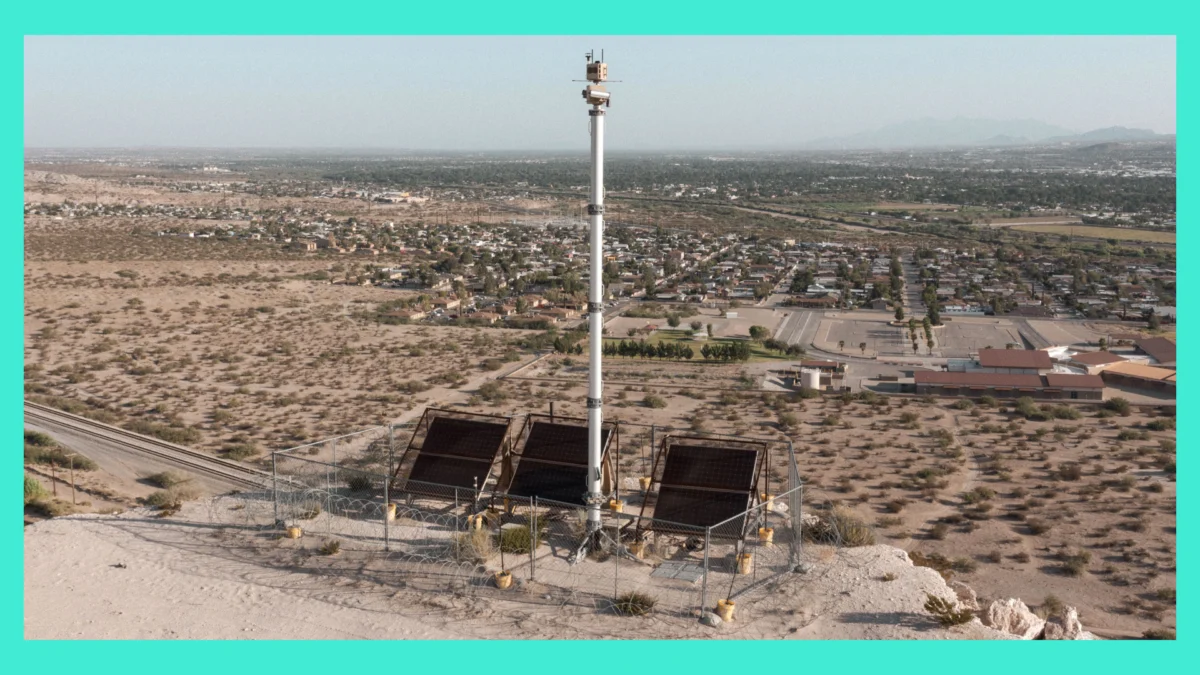
For a quarter of a century, successive United States administrations have invested billions of dollars into a high-tech solution for an age-old challenge: securing the southern border. Promoted as a humane and efficient alternative to physical barriers, the strategy relied on the construction of a so-called virtual wall—an extensive network of surveillance towers, ground sensors, thermal imaging cameras, and, more recently, artificial intelligence-powered detection systems. The foundational promise made to taxpayers, lawmakers, and border communities was twofold: these digital sentinels would dramatically enhance national security by detecting and apprehending unauthorized crossers, and, crucially, they would save lives by enabling rapid rescue operations for individuals in distress.
However, a groundbreaking and exhaustive investigation by MIT Technology Review has shattered that official narrative. The months-long journalistic endeavor documented more than one thousand instances where migrants traversed areas under the direct surveillance of these high-tech towers, only to be left unreached, unapprehended, and ultimately dead in the unforgiving terrain of the borderlands. Even more alarming, the investigation revealed that numerous victims perished directly under the watch of newly deployed, AI-powered towers explicitly engineered to autonomously spot and flag human movement. Far from fulfilling its humanitarian promise, the multi-billion-dollar virtual wall has overseen a staggering humanitarian crisis that unfolded in plain sight of state-of-the-art lenses and algorithms.
The Origins and Evolution of the Virtual Wall
The concept of a technological barrier along the United States-Mexico border is not a recent innovation; it represents the culmination of a twenty-five-year evolution in federal border enforcement strategy. In the late 1990s and early 2000s, United States Customs and Border Protection (CBP) began supplementing boots on the ground with rudimentary remote sensors and stationary cameras. Following the attacks of September 11, 2001, security paradigms shifted dramatically, accelerating federal funding for technological interventions.
The first major milestone in this evolution was the Secure Border Initiative (SBI), launched under the administration of President George W. Bush in 2005. The cornerstone of SBI was the Secure Border Initiative Network, commonly known as SBInet. Envisioned as a comprehensive technological shield, SBInet was contracted out to aerospace giant Boeing. The plan was to deploy a dense network of radar, cameras, and communication equipment across the entire southwest border to stream real-time data to command centers.
However, SBInet was plagued by severe technical failures, massive cost overruns, and persistent delays. By 2011, after spending approximately $1 billion on just a fraction of the intended coverage area in Arizona, the Department of Homeland Security officially canceled the program. Internal evaluations revealed that the technology frequently malfunctioned due to environmental interference—such as blowing brush, extreme desert heat, and wildlife—generating an unsustainable volume of false alarms that overwhelmed Border Patrol agents.
Despite the collapse of SBInet, the underlying ambition persisted. CBP pivoted away from a single, monolithic contractor toward a more modular approach known as the Integrated Fixed Towers (IFT) program and the Remote Video Surveillance System (RVSS) program. Contractors such as Elbit Systems of America were awarded lucrative multi-billion-dollar contracts to erect towering structures equipped with long-range day and night cameras, ground-penetrating radar, and sophisticated tracking software.
Chronology of Technological Expansion and Policy Shifts
To understand how the virtual wall expanded while failing its stated humanitarian objectives, it is necessary to examine the chronological progression of deployment and policy integration over the past two decades:
- 2005–2011 (The SBInet Era): The federal government initiates the Boeing-led Secure Border Initiative Network, attempting to build a comprehensive digital fence. Technical failures and soaring budgets lead to its cancellation, but establish the precedent for reliance on fixed electronic surveillance.
- 2011–2015 (The Transition to Modular Systems): CBP abandons the single-contractor model in favor of regional fixed towers. The Integrated Fixed Towers program is deployed heavily in the Tucson and Yuma sectors of Arizona, prioritizing stationary, long-range observation capabilities over sweeping network integration.
- 2016–2020 (Integration of Advanced Analytics): As commercial software capabilities mature, federal agencies begin experimenting with automated video analytics. Software is introduced to assist human operators in filtering out false positives, though manual monitoring remains the primary operational paradigm.
- 2021–Present (The Artificial Intelligence Era): The Department of Homeland Security accelerates the integration of machine learning and artificial intelligence into the tower network. Collaborating with private tech vendors, CBP deploys autonomous detection algorithms designed to identify human silhouettes, vehicles, and thermal signatures without requiring continuous human oversight, culminating in the current infrastructure analyzed by investigative reports.
Supporting Data and Investigative Findings
The scale of the failure documented by MIT Technology Review challenges the core justifications provided by proponents of border surveillance technology. While government briefings frequently highlight the number of alerts generated or the terabytes of data processed by these systems, the investigation shifted the analytical focus to the downstream human consequences: the intersection of algorithmic detection and mortal peril.
According to geographical data and forensic records cross-referenced during the investigation, more than a thousand individuals who traversed regions monitored by surveillance towers succumbed to the elements—primarily hyperthermia, dehydration, and exposure—without receiving timely intervention. In numerous specific cases highlighted in the report, tower cameras captured the deliberate movements of vulnerable travelers navigating treacherous desert expanses. Yet, the data streams generated by these multi-million-dollar assets failed to trigger the dispatch of search-and-rescue personnel before it was too late.
Compounding this systemic failure is the integration of artificial intelligence. Proponents of AI-driven border towers have long argued that machine learning eliminates human fatigue, ensuring that a migrant in distress is never missed due to an operator looking away from a screen. The reality on the ground, however, demonstrates a profound operational disconnect. Even when AI algorithms successfully classify a human subject moving through remote wilderness, the institutional priorities of enforcement agencies often supersede humanitarian rescue protocols. The primary directive of the technology remains apprehension and interdiction, not medical triage. Consequently, the data collected by automated towers frequently serves to document tragedies rather than avert them, transforming the virtual wall into an automated chronicler of preventable deaths.
Official Responses and Institutional Posture
In response to inquiries regarding the findings of the investigation, representatives from Customs and Border Protection and the Department of Homeland Security have consistently defended the efficacy and necessity of border surveillance technology. Federal officials maintain that fixed towers and advanced camera systems are vital force multipliers that protect frontline personnel, disrupt transnational smuggling cartels, and provide critical situational awareness in hazardous, remote environments.
Agency spokespersons have frequently emphasized that the primary mission of CBP is the enforcement of immigration laws and the securing of national borders, while asserting that agents routinely engage in humanitarian rescue operations when resources and circumstances permit. According to official statistics released by the agency over the years, Border Patrol agents have conducted thousands of search-and-rescue missions, saving the lives of individuals abandoned by smugglers in extreme weather conditions.
However, civil rights organizations, humanitarian groups, and technology ethics watchdogs argue that the official defense misses the central ethical and operational critique. Critics contend that framing border towers as humanitarian tools is a discursive strategy designed to justify astronomical public expenditures on militarized infrastructure. When technology is deployed with the overarching objective of deterring migration—such as pushing crossers into more remote, lethal terrain—the resulting loss of life is not an accidental administrative oversight, but a foreseeable consequence of deterrence-by-design strategies.
Broader Impact and Implications
The revelations surrounding the failure of the virtual wall carry profound implications for the future of domestic surveillance, immigration policy, and the ethics of artificial intelligence deployment by the state.
First, the investigation exposes the limitations of technological solutionism in complex humanitarian and geopolitical crises. Policymakers have repeatedly turned to Silicon Valley contractors and defense manufacturers in search of politically palatable alternatives to physical walls or humane immigration reform. The assumption has been that cleaner, quieter, digital surveillance would mitigate the human costs associated with border enforcement. The data proves the exact opposite: the technological apparatus has scaled up the surveillance of the borderlands without establishing a corresponding institutional obligation to preserve the lives of those observed.
Second, the deployment of AI-powered surveillance towers along the southern border sets a troubling precedent for domestic security applications. The borderlands have long served as a testing ground for surveillance technologies that eventually migrate inward into American cities and towns. The normalization of autonomous, algorithmic tracking of human movement by federal agencies raises critical questions regarding civil liberties, accountability, and the absence of regulatory frameworks governing how artificial intelligence is utilized in life-or-death scenarios.
Finally, the findings force a moral reckoning regarding public transparency and accountability. Billions of dollars in taxpayer funds have been funneled into a technological infrastructure whose operational failures are largely shielded from public scrutiny behind national security designations. By documenting the human toll beneath the lenses of these cameras, investigators have illuminated a dark intersection where advanced engineering meets institutional indifference.
As debates over immigration policy and border security continue to dominate the national political landscape, the legacy of the virtual wall stands as a stark warning. Technology, absent a fundamental commitment to human life and ethical governance, cannot resolve systemic humanitarian challenges; it can only automate their tragic consequences.