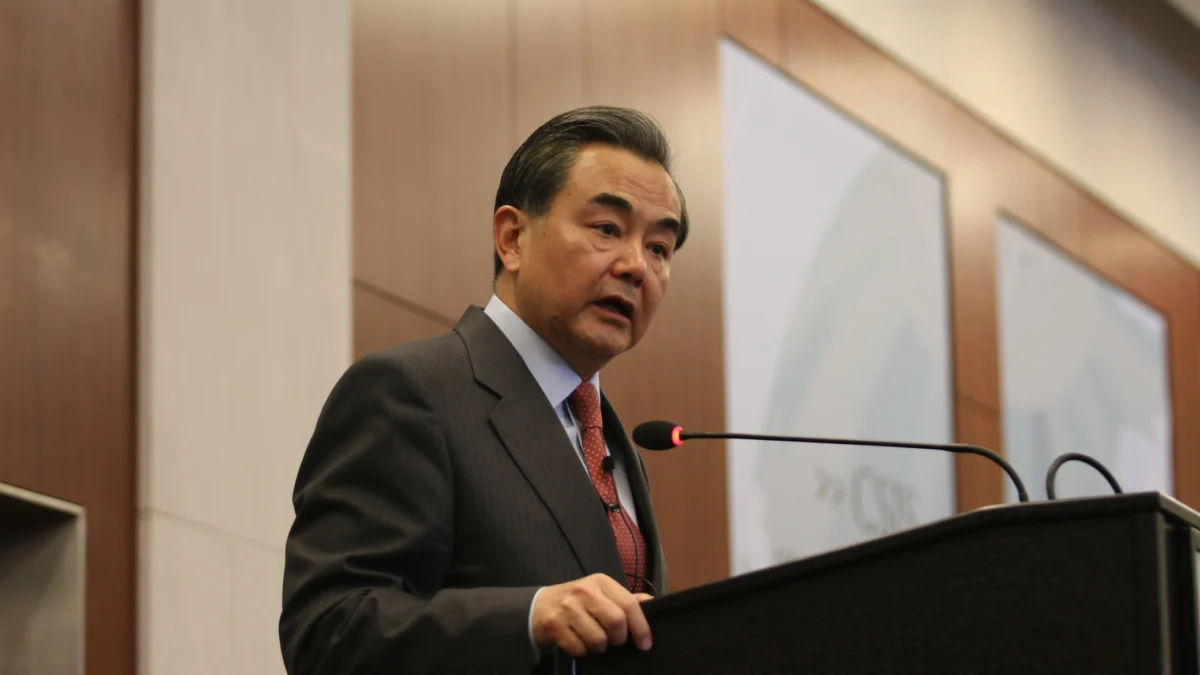
The geopolitical landscape of the twenty-first century is defined by few relationships as critical, complex, and consequential as the one between the United States and the People’s Republic of China. Against the backdrop of escalating maritime disputes in the South China Sea, ongoing debates over cybersecurity, and intertwined global economies, high-level diplomatic engagements serve as crucial barometers for international stability. On February 25, 2016, the Center for Strategic and International Studies (CSIS) hosted a landmark Statesmen’s Forum featuring Wang Yi, the Minister of Foreign Affairs for the People’s Republic of China. The evening event, running from 7:30 to 9:00 PM EST in Washington, D.C., provided a prominent platform for Beijing to articulate its foreign policy doctrines, address bilateral frictions with Washington, and outline its vision for regional and international order.
Welcoming remarks for the high-profile gathering were delivered by John Hamre, President and CEO of CSIS, who emphasized the necessity of open dialogue during periods of strategic friction. The discussion itself was moderated by Christopher Johnson, who at the time served as the Freeman Chair in China Studies at CSIS. The forum was broadcast globally via a live webcast, capturing the attention of policymakers, academics, corporate strategists, and international media outlets eager to decipher Beijing’s diplomatic signals amid a shifting global order.
Background and Context of the 2016 CSIS Statesmen Forum
The timing of Foreign Minister Wang Yi’s visit to Washington in early 2016 was deeply significant. The bilateral relationship between the U.S. and China was navigating a series of acute structural tests. Chief among these was the maritime security architecture of the Asia-Pacific region. Tensions in the South China Sea had intensified significantly throughout 2014 and 2015 as Beijing accelerated its land reclamation activities and military fixture construction on disputed reefs and atolls. Washington had responded by conducting Freedom of Navigation Operations (FONOPs), challenging what the United States and its regional partners viewed as excessive maritime claims by China.
Concurrently, economic anxieties were running high. China’s economy was undergoing a delicate transition from export-led manufacturing toward domestic consumption-driven growth, marked by a notable deceleration in gross domestic product (GDP) growth rates and volatility in Chinese equity markets that sent ripples through global financial exchanges. Issues surrounding intellectual property theft, state-sponsored cyber espionage, and market access for foreign firms operating within China remained major irritants in bilateral commercial diplomacy.
Despite these friction points, the two nations had also recently demonstrated a capacity for pragmatic cooperation. Most notably, the historic Paris Climate Agreement, concluded in December 2015, had been propelled forward by a joint bilateral climate accord struck between Presidents Barack Obama and Xi Jinping. The CSIS Statesmen’s Forum was thus framed as an opportunity to address the contentious elements of the relationship while preserving channels for strategic reassurance.
Chronology of the Event and Core Themes

The evening’s proceedings commenced at 7:30 PM EST with introductory remarks by Dr. John Hamre, who underscored the unique responsibilities shared by the world’s two largest economies in maintaining global economic stability and security. Following the welcome, Minister Wang Yi took the floor to deliver a comprehensive address outlining Beijing’s overarching foreign policy philosophy.
Wang emphasized China’s official diplomatic mantra of "peaceful development," asserting that Beijing’s expanding global footprint was inherently cooperative rather than competitive or zero-sum in nature. He addressed the core concerns of the United States and regional allies, attempting to alleviate fears regarding China’s assertive posture in its near seas. However, he also firmly reiterated Beijing’s red lines, particularly concerning sovereignty claims over Taiwan, Tibet, and the South China Sea.
The address was followed by a moderated conversation led by Christopher Johnson. During this segment, the discussion probed deeper into specific flashpoints:
- Maritime Security and Territorial Disputes: Wang defended China’s infrastructure projects in the South China Sea, arguing that they were built within China’s sovereign territory and were intended to provide public goods such as search-and-rescue facilities, navigational aids, and environmental monitoring to the international community. He criticized U.S. military patrols in the region as a form of "militarization" that needlessly escalated tensions.
- Bilateral Economic Engagement: The Foreign Minister addressed concerns regarding foreign investment climates in China, signaling Beijing’s commitment to ongoing economic reforms, the reduction of market barriers, and the negotiation of a Bilateral Investment Treaty (BIT) with the United States.
- Global Governance and Multilateralism: Wang highlighted China’s growing participation in international institutions, pointing to initiatives such as the Asian Infrastructure Investment Bank (AIIB) and the Belt and Road Initiative (BRI) as complementary frameworks designed to boost global development rather than undermine existing Western-led financial structures.
Supporting Data and Bilateral Metrics
To fully understand the weight of Minister Wang Yi’s statements at CSIS, it is necessary to examine the macroeconomic and diplomatic data defining the U.S.-China relationship during this era. In 2016, bilateral trade in goods and services between the United States and China surpassed $600 billion, cementing an economic interdependence that made complete decoupling virtually unthinkable for policymakers in either capital.
At the same time, security metrics pointed toward increasing operational friction. The U.S. Department of Defense reported a notable uptick in unsafe intercepts between American and Chinese military aircraft and naval vessels in international airspace and waters throughout the Western Pacific. Public opinion polling conducted by the Pew Research Center around this period indicated a steady hardening of public attitudes in the United States toward China, driven primarily by concerns over job losses, cyberattacks, and geopolitical assertiveness, even as academic and business communities continued to advocate for deep engagement.
Official Responses and Diplomatic Reactions
While the forum itself was a platform for Chinese messaging, reactions from Washington policymakers and international observers were swift and multifaceted.

U.S. State Department officials, while welcoming the high-level dialogue as an indispensable mechanism for crisis management, reiterated that Washington remained deeply concerned by Beijing’s unilateral actions in the South China Sea. American diplomats consistently stressed that freedom of commerce, adherence to international maritime law as codified in the United Nations Convention on the Law of the Sea (UNCLOS), and the peaceful resolution of territorial disputes were non-negotiable pillars of U.S. foreign policy in the Indo-Pacific.
Regional allies, particularly Japan, the Philippines, and Vietnam, monitored the proceedings closely. For nations directly involved in overlapping maritime claims with Beijing, Wang Yi’s remarks at CSIS were analyzed for any softening of Beijing’s stance on binding multilateral codes of conduct. Many regional capitals expressed disappointment that China continued to favor bilateral negotiations over multilateral dispute resolution mechanisms, arguing that bilateral talks inherently disadvantaged smaller states dealing with a global economic and military superpower.
Broader Impact and Long-Term Implications
Looking back, the February 2016 CSIS Statesmen’s Forum featuring Wang Yi captured a pivotal transition period in modern international relations. The event occurred near the twilight of the Obama administration’s "pivot to Asia" strategy and preceded the profound structural shifts in U.S. foreign policy that materialized in subsequent years.
The arguments presented by Minister Wang underscored a fundamental divergence in strategic worldviews between Washington and Beijing. While Washington increasingly viewed China through the lens of great power competition and revisionist challenges to the post-World War II liberal international order, Beijing viewed its rise as the natural restoration of a historical status and insisted on a multipolar architecture that accommodated its core national interests.
Ultimately, the dialogue hosted by CSIS served as a microcosm of the broader U.S.-China dynamic: an intricate mix of deep economic reliance, strategic mistrust, and an ongoing diplomatic contest to shape the rules of engagement for the twenty-first century. As global challenges ranging from trade imbalances to regional security continue to evolve, the themes addressed during Wang Yi’s 2016 address remain central to the study and practice of international diplomacy.