
The rapid expansion of artificial intelligence infrastructure has placed unprecedented demands on electrical grids worldwide, exposing fundamental vulnerabilities in how modern data centers manage power. While public discourse frequently focuses on generation capacity—such as the need for more wind, solar, and nuclear power plants—recent catastrophic grid events in major data center hubs like Ashburn, Virginia, reveal that the crisis is fundamentally architectural. As gigawatt-scale AI campuses come online, traditional power protection models are failing to keep pace with the hyper-volatile load profiles of advanced machine learning workloads.
To prevent widespread blackouts and streamline the deployment of future AI facilities, energy engineers are increasingly looking beyond standard indoor low-voltage configurations. By moving power protection upstream to the medium-voltage level, relocating backup infrastructure outside the main data halls, and integrating systems directly into the primary power path, the industry is witnessing a structural transformation. This shift not only protects sensitive computing hardware from sub-millisecond grid transients but also fundamentally alters the economics, density, and permitting timelines of next-generation data centers.
The Anatomy of the Grid Vulnerability: Lessons from Northern Virginia
The fragility of the current data center power stack was starkly illustrated during a series of high-profile grid incidents in Northern Virginia, widely known as "Data Center Alley." On July 22, 2026, a transmission line fault in Ashburn triggered a sudden loss of more than 3 gigawatts of load from the electrical grid within a matter of seconds.
This disruption was not an isolated anomaly. Two years prior, a single failed surge arrester caused approximately 60 Virginia facilities and 1,500 megawatts of load to drop off the grid simultaneously. Grid operators and regional transmission organizations had previously modeled load responses based on historical industrial paradigms—such as steel mills or large manufacturing plants—which draw power smoothly and recover gradually. The simultaneous shedding of gigawatts of digital load, however, caught regional operators off guard.
Investigations into these events revealed that the root cause was not a lack of electricity generation, but rather the automated protection logic embedded within legacy data center infrastructure. Designed decades ago when a "large load" rarely exceeded 50 megawatts, these protection schemes were programmed to monitor voltage dips and automatically disconnect facilities from the grid after a predetermined threshold. When minor transients occurred, dozens of massive data centers interpreted the signals through identical safety logic, disconnecting simultaneously and creating an artificial supply shock for the regional grid.
How AI Workloads Defy Traditional Power Infrastructure
The fundamental mismatch between the electrical grid and modern artificial intelligence facilities lies in the physics of deep learning compute. Unlike traditional enterprise data centers, which maintain relatively flat and predictable power consumption profiles, AI training clusters experience extreme volatility.
During an intensive training run, an AI campus can swing up to 70% of its total load in mere milliseconds. Conversely, at the first sign of an upstream grid disturbance, these facilities can trip offline just as rapidly to protect billions of dollars in specialized graphics processing units (GPUs) and AI accelerators. While this behavior is economically rational for individual data center operators seeking to safeguard high-value hardware, it introduces a severe destabilizing force when aggregated at gigawatt scale.
The traditional power stack—comprising medium-voltage utility feeds, step-down transformers, and low-voltage uninterruptible power supply (UPS) units located deep inside the building—was never engineered for this level of sub-millisecond volatility. Standard UPS batteries function essentially as an undersized spare tire, designed to bridge short-term outages for a few minutes rather than continuously absorb massive, rapid load swings.
Furthermore, to maximize operational efficiency and prevent excessive energy waste from legacy power converters, many operators run their facilities in "eco-mode." In this configuration, static switches feed server racks directly from the utility grid, bypassing filtration mechanisms. Consequently, raw power fluctuations from compute swings travel outward into the grid, while harmful sub-millisecond grid transients pass inward, threatening sensitive IT equipment.
Engineering the Solution: Moving Up, Out, and In-Line
To address these systemic challenges, power systems engineers have proposed a fundamental redesign based on three core architectural shifts: moving the voltage level up, relocating the infrastructure outside, and embedding protection directly into the primary power path.
First, power protection is being elevated from the traditional 480-volt low-voltage environment to medium voltage—typically 13.8 kilovolts and higher—matching the voltage at which large sites draw power directly from utility transmission and distribution networks.
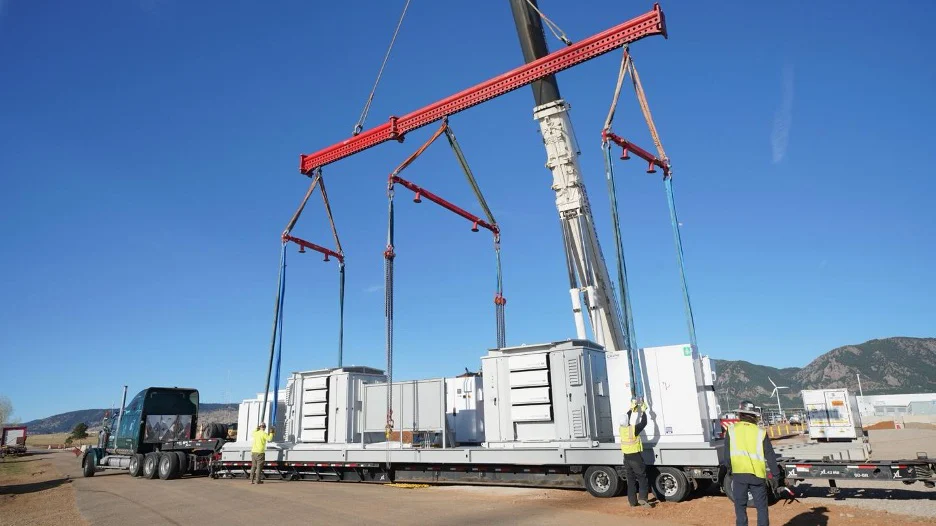
Second, this heavy equipment is being moved out of the data hall and into modular enclosures situated near the outdoor substations. This architectural separation ensures that the main building houses exclusively compute hardware and advanced liquid or air cooling systems, thereby maximizing revenue-generating square footage.
Third, rather than relying on reactive battery systems that monitor and switch during emergencies, modern medium-voltage designs place the energy storage and conditioning equipment directly in the primary power path. Every electron flows through the system continuously. Because the architecture never routes power around the stabilization mechanism, there is no detection delay and no mechanical switching time.
Validating Performance Under Extreme Conditions: Laboratory Testing
The viability of this medium-voltage, in-line architecture moved from theoretical engineering to empirical validation in early 2026, when researchers conducted full-scale system testing at the National Renewable Energy Laboratory (NREL) in Colorado. As a premier U.S. Department of Energy facility, the laboratory offers specialized testing loops capable of replicating real-world grid faults and AI-scale load swings simultaneously.
During the evaluation, the medium-voltage system was subjected to rigorous stress tests from both directions. Realistic, high-frequency AI load profiles were applied to the compute side at full medium voltage, while severe utility-side disturbances—including complete zero-voltage events—were introduced from the grid side.
The results demonstrated that the advanced architecture successfully isolated both domains. The compute infrastructure experienced zero disruption, while the grid-facing side maintained stability without triggering protective disconnects. Furthermore, the system comfortably cleared the stringent large-load voltage ride-through requirements mandated by grid operators such as the Electric Reliability Council of Texas (ERCOT).
Broader Implications: Economics, Permitting, and Grid Resilience
The adoption of medium-voltage, in-line power architectures carries profound implications for the commercial and regulatory landscape of data center development.
From a regulatory standpoint, interconnection processes are significantly streamlined. Rather than requiring utility engineers to evaluate and certify hundreds of disparate transformers, low-voltage UPS units, chillers, and switchgear lineups within a facility, utilities can review and certify a single, standardized medium-voltage enclosure. This simplification can shave months off complex permitting timelines. Additionally, data center operators can upgrade server and chip generations without triggering mandatory, time-consuming re-studies of their grid interconnection agreements.
Economically, the shift transforms the financial calculus of backup power. Equipment operating at medium voltage and sited outdoors frequently qualifies for federal and state clean energy tax credits. Furthermore, by possessing integrated, high-capacity energy storage, data centers can actively participate in grid-support programs such as peak shaving and demand response. Backup power transitions from a pure capital expenditure insurance policy into an active revenue-generating asset.
As the global buildout of artificial intelligence infrastructure accelerates, the choices made by developers and utility providers will dictate whether future data centers act as a severe strain on electrical grids or serve as stabilizing anchors for modern energy networks. By moving power protection upstream and rethinking internal architectures, the industry is laying the groundwork for sustainable, high-density digital infrastructure.