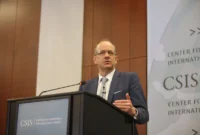

The Center for Strategic and International Studies (CSIS) International Security Program convened a high-level, half-day Defense360 conference in Washington, D.C., bringing together top Pentagon officials, defense economists, and leading national security analysts. The central focus of the gathering was a rigorous examination of the recently released Fiscal Year 2017 (FY2017) defense budget request, alongside an evaluation of the broader strategic calculus guiding current U.S. national security policy. As the geopolitical landscape faces shifting challenges—ranging from great power competition to persistent regional instability—the event served as a critical forum for dissecting how financial resources align with military strategy.
The conference featured opening remarks by Dr. John Hamre, President and Chief Executive Officer of CSIS, setting a tone of analytical depth and strategic urgency. The morning’s agenda was structured into two primary segments: an opening administration discussion featuring senior Department of Defense (DoD) leaders, followed by an expert panel providing independent assessment and critique of the administration’s fiscal and strategic alignment. Todd Harrison, Director of Defense Budget Analysis and Senior Fellow with the CSIS International Security Program, moderated both sessions, guiding the discourse through complex fiscal data and strategic trade-offs.
Main Facts and Event Structure
The event was designed to provide policymakers, defense industry leaders, and the public with a comprehensive breakdown of the FY2017 defense spending blueprint. The initial discussion block, running from 9:00 a.m. to 10:30 a.m., featured three key administration officials responsible for shaping and justifying the defense enterprise: Mike McCord, Under Secretary of Defense (Comptroller) and Chief Financial Officer; Dr. Jamie Morin, Director of Cost Assessment and Program Evaluation (CAPE); and Robert Scher, Assistant Secretary of Defense for Strategy, Plans, and Capabilities. These leaders outlined the administration’s rationale behind the budget request, detailing how fiscal constraints under the Bipartisan Budget Act of 2015 were balanced against urgent modernization and readiness requirements.
Following this administration briefing, a panel discussion convened from 10:30 a.m. to 11:30 a.m., bringing together prominent voices from the defense policy community. The panel included Tina Jonas, former Under Secretary of Defense (Comptroller) and Senior Adviser at CSIS; Andrew Hunter, Director of the Defense-Industrial Initiatives Group and Senior Fellow at CSIS; Mark Cancian, Senior Adviser in the CSIS International Security Program; Shawn Brimley, Executive Vice President and Director of Studies at the Center for a New American Security (CNAS); and Roger Zakheim, Visiting Fellow at the American Enterprise Institute (AEI). This panel scrutinized the linkage between the stated National Security Strategy and the actual funding allocations proposed in the FY2017 request.
Background Context and the FY2017 Budget Environment
To understand the gravity of the discussions at the CSIS Defense360 conference, it is necessary to examine the fiscal and geopolitical backdrop of the FY2017 budget cycle. Released in early 2016, the FY2017 defense budget request totaled approximately $583 billion, encompassing both the base budget and the Overseas Contingency Operations (OCO) funding account. This request was formulated under the shadow of the Budget Control Act (BCA) of 2011, which imposed statutory caps on discretionary spending, forcing the Pentagon to continuously manage a delicate balance between force structure size, technological modernization, and operational readiness.
In the years leading up to the FY2017 request, the Department of Defense faced severe turbulence caused by sequestration, government shutdowns, and continuing resolutions. Military leaders repeatedly warned that unpredictable funding cycles were eroding the readiness of the force, leaving units unprepared for high-end conflicts. While the Bipartisan Budget Act of 2015 temporarily relieved some of the immediate pressure by raising spending caps for FY2016 and FY2017, the long-term fiscal outlook remained constrained. Consequently, the FY2017 budget was framed not as an ideal reflection of all global military requirements, but as a prioritized blueprint constrained by legislative realities.
Compounding these fiscal challenges was a rapidly deteriorating security environment. The Department of Defense was simultaneously executing operations against the Islamic State in Iraq and Syria (ISIS), reinforcing NATO’s eastern flank in response to Russian assertiveness in Eastern Europe, monitoring escalating maritime tensions in the South China Sea, and managing persistent threats from North Korea and Iran. The strategic challenge for officials like Robert Scher and Dr. Jamie Morin was demonstrating how a relatively flat topline budget could adequately address these simultaneous, high-demand operational missions while preserving resources for future research, development, and procurement.
Administration Perspectives: Strategy Meets Fiscal Reality
During the opening session, the administration panel addressed the core tension of the FY2017 request: balancing immediate operational demands with the imperative to innovate for future conflicts. Mike McCord, in his capacity as Comptroller, provided a detailed breakdown of the financial architecture supporting the budget. McCord emphasized that the department had to make difficult choices, prioritizing people, readiness, and technological superiority over force size where necessary. He highlighted the ongoing efforts to rein in overhead costs and find internal efficiencies, noting that congressional willingness to support further Base Realignment and Closure (BRAC) rounds or reform military compensation packages remained vital for long-term fiscal health.
Dr. Jamie Morin focused on the analytical rigor applied by CAPE in shaping the defense program. Morin explained how cost estimation methodologies and independent program assessments ensure that major acquisition programs—ranging from the F-35 Lightning II joint strike fighter to the new B-21 bomber and the Columbia-class ballistic missile submarine—are realistically budgeted. CAPE’s role, Morin noted, is to inject objective fiscal reality into service-level aspirations, preventing cost overruns from cannibalizing other essential accounts within the defense portfolio.
Robert Scher provided the strategic lens, explaining how the budget supports the Defense Department’s strategic priorities, particularly the rebalance to the Asia-Pacific region and the deterrence posture in Europe. Scher discussed how the strategy adapted to emerging threats, emphasizing the concept of "third offset" technologies designed to maintain U.S. military technological dominance against advanced adversaries like Russia and China. According to Scher, the FY2017 request deliberately funneled resources into high-end capabilities such as cyber defense, electronic warfare, autonomous systems, and advanced space architectures, recognizing that future battlegrounds would be defined by speed, connectivity, and technological superiority.
Expert Commentary and Independent Assessment
The transition to the expert panel at 10:30 a.m. introduced external perspectives that both validated and challenged the administration’s assertions. Moderated by Todd Harrison, the panel engaged in a vigorous debate over whether the FY2017 budget adequately closed the gap between strategy and resources.
Tina Jonas, drawing on her extensive experience as a former Pentagon Comptroller and current CSIS senior adviser, offered a seasoned financial critique. Jonas noted the persistent structural challenges within the defense budget, particularly the tension between personnel costs, operations and maintenance (O&M), and procurement. She underscored that while O&M funding had seen boosts to address readiness shortfalls, the long-term sustainability of force readiness remains vulnerable if structural reform does not accompany funding increases.
Andrew Hunter and Mark Cancian brought specialized insights into defense-industrial initiatives and force structure. Hunter discussed the health of the defense-industrial base, noting that predictability in budgeting is essential for contractors investing in advanced manufacturing and research facilities. He questioned whether the OCO funding mechanism—increasingly used to backfill base budget requirements—created a dangerous dependency that obscures long-term fiscal planning. Cancian analyzed force structure implications, pointing out that while the strategy demanded global presence, the active-duty end-strengths proposed in the budget left the force stretched thin across multiple theaters.
Representing perspectives from other prominent Washington think tanks, Shawn Brimley of CNAS and Roger Zakheim of AEI provided further nuance. Brimley focused on the conceptual framework of the defense strategy, arguing that while the Pentagon correctly identified key peer competitors, the implementation pace of innovation initiatives needed acceleration. Zakheim offered a more critical assessment of the budget’s topline limitations, arguing that statutory budget caps were fundamentally inadequate for meeting the full spectrum of global threats identified by military commanders. Zakheim emphasized that Congress would likely seek opportunities to augment defense spending beyond the administration’s request, particularly in shipbuilding, aviation, and munitions inventories.
Fact-Based Analysis of Implications
The discussions at the CSIS Defense360 conference underscored several critical takeaways regarding the trajectory of U.S. defense policy and fiscal management:
-
The Readiness vs. Modernization Dilemma: The FY2017 budget highlighted the perpetual trade-off the Pentagon faces. Pouring resources into immediate readiness—such as flight hours, steaming days, and equipment maintenance—often starves long-term modernization programs. Conversely, cutting readiness to pay for future weapon systems risks immediate operational vulnerabilities. The conference revealed that while the administration attempted a balanced approach, independent analysts remained skeptical that flat budgets could successfully sustain both over the long term.
-
The OCO Debate: The reliance on Overseas Contingency Operations funding to cover baseline operational and readiness costs emerged as a recurring point of contention. Originally conceived as a temporary, emergency funding mechanism for wartime operations in Iraq and Afghanistan, OCO has evolved into a budgetary relief valve. Analysts at the conference noted that using OCO to fund enduring baseline requirements circumvents BCA spending caps but introduces fiscal instability and undermines transparent budget accounting.
-
Technological Innovation and the Third Offset: There was broad consensus that the strategic pivot toward high-end technological competition is necessary. However, translating concepts like the "third offset strategy" into fielded capabilities requires sustained, predictable funding. Experts discussed the challenges the Department of Defense faces in bridging the "valley of death" between technological research and large-scale procurement, particularly given traditional bureaucratic inertia within military acquisition systems.
-
Legislative Dynamics and Defense Reform: The conference underscored that the executive branch’s budget request is merely the starting point in a complex legislative process. Congressional action—driven by committee priorities, parochial interests, and overarching national security debates—frequently reshapes the final appropriations. Furthermore, the emphasis placed by speakers on defense reform, acquisition streamlining, and overhead reduction highlighted that structural inefficiencies continue to siphon vital dollars away from the warfighter.
Conclusion and Broader Impact
The CSIS Defense360 half-day conference on the FY2017 defense budget request provided an invaluable public platform for transparent dialogue between defense leaders and independent analysts. By examining the intersection of fiscal constraints and strategic imperatives, the event illuminated the difficult choices confronting U.S. national security architects. As the defense community continues to navigate evolving geopolitical threats and domestic fiscal realities, the insights generated during the conference remain central to ongoing debates surrounding military readiness, technological superiority, and the stewardship of taxpayer dollars in defense of the nation.