
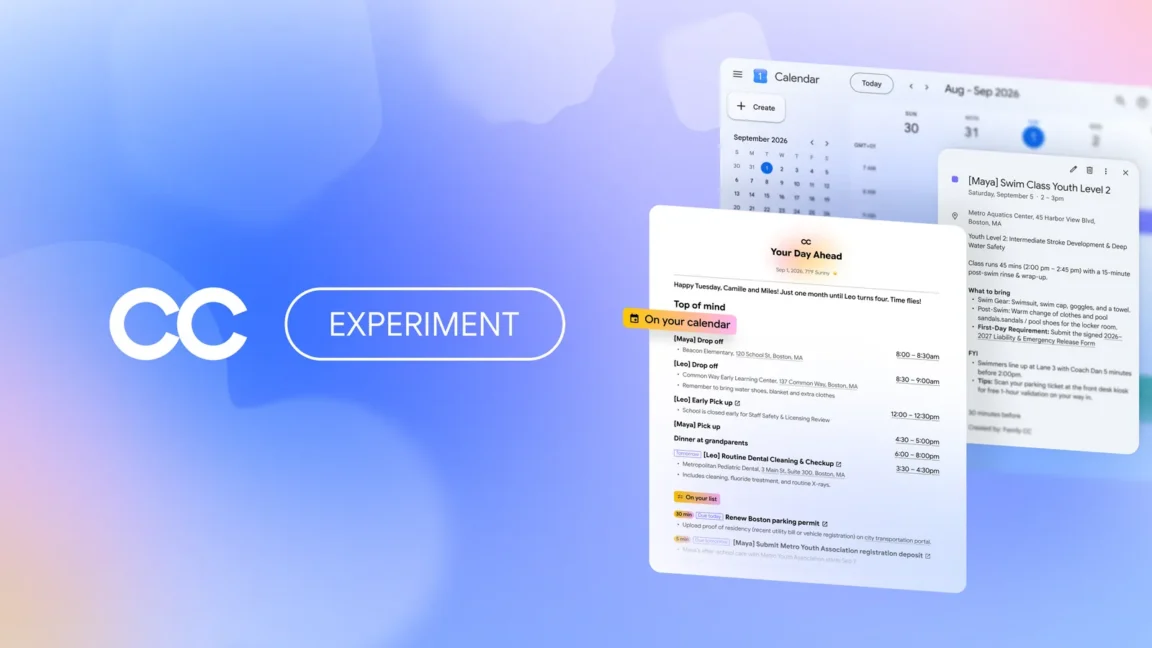
Google’s latest foray into the competitive landscape of generative artificial intelligence represents a strategic pivot toward household utility, moving beyond the individual user experience to capture the dynamics of the modern family unit. The introduction of CC, an experimental tool within Google Labs, marks the next evolutionary step in the company’s efforts to leverage its vast data ecosystem. By integrating Gemini’s processing power with the shared digital lives of up to six family members, Google is attempting to solve the pervasive problem of fragmented household communication, scheduling, and information management.
The Evolution of the AI Assistant: A Chronological Overview
The development of CC is not a spontaneous innovation but rather the culmination of a multi-year roadmap focused on hyper-personalized AI. The journey began in earnest with the foundational AI research conducted at Google DeepMind, which eventually trickled down into consumer-facing features.
In 2025, Google unveiled the initial iteration of its "CC" project—a codename that has since evolved from a simple data-aggregation tool into a full-fledged intelligent agent. This early version was limited in scope, focusing primarily on single-user productivity. It eventually matured into the feature now known as "Gemini’s Daily Brief," a service that parses individual Google account data—including Gmail, Calendar, and Drive—to provide users with prioritized action items and morning summaries.
Following the success of the Daily Brief, engineers at Google Labs identified a clear gap in the market: while individual productivity tools were proliferating, there was no centralized AI capable of managing the collective data of a household. By mid-2026, the company began internal testing of a multi-user, collaborative version of the CC agent. This project sought to maintain the privacy-centric architecture of the original while allowing for the "permission-based" sharing of information between family members. The public launch of this experiment in late 2026 signals Google’s commitment to making its AI models a permanent fixture in the domestic sphere.
Technical Architecture and Data Privacy Protocols
Central to the functionality of CC is its unique account structure. Unlike traditional AI assistants that exist as a service linked to a single primary user, CC operates as an autonomous, independent Google account. This distinction is critical from both a technical and a privacy standpoint. Because CC has its own identity, it functions as a "hub" rather than an extension of one specific user’s profile.
Privacy, a sensitive subject for Google, has been integrated into the core design of the agent. Family members retain granular control over what information CC can access. The agent is blind to a user’s private data unless that user explicitly grants access. For example, a parent can designate specific email threads—such as those from a school administrator or a sports coach—as "always available" to the CC agent. This ensures that the agent can extract relevant scheduling information without gaining access to the entirety of a user’s personal inbox.
The agent also utilizes a pull-and-push interaction model. Users can forward specific documents, invitations, or task lists to the CC agent via email or Google Chat. Furthermore, the agent is capable of monitoring a shared Google Drive folder, acting as a digital filing clerk that organizes household documentation. This architecture addresses the "silo" problem, where documents, calendars, and emails are scattered across different devices and platforms, effectively centralizing the "family brain" into a single, accessible entity.
Functional Capabilities and Daily Integration
The primary value proposition of CC is the "Your Day Ahead" brief. This feature automates the tedious labor of synchronization, a task that often falls on one individual in a household. Each morning, the CC agent synthesizes information from all registered family members’ calendars and shared files to generate a comprehensive digest.
This brief includes:
- Synchronized Schedules: A unified view of upcoming events, ensuring that conflicts are identified before they occur.
- Task Management: Tracking of pending action items assigned to specific family members.
- Document Generation: Using Gemini’s generative capabilities to draft documents, such as meal plans or travel itineraries, based on shared parameters.
By automating these inputs, CC aims to reduce the "cognitive load" on families. Instead of comparing four different calendars to determine who is picking up the children or when a shared bill is due, the AI agent performs these cross-references automatically. The ability for the agent to add items directly to shared calendars and maintain a persistent history of tasks represents a significant step forward from simple voice-activated assistants like the original Google Assistant.
Market Context and Competitive Landscape
Google’s strategic move into the family AI space comes at a time when the broader AI industry is grappling with the challenge of "utility beyond the chatbot." While competitors like OpenAI and Anthropic have focused heavily on raw reasoning capabilities and developer-centric tools, Google has a distinct structural advantage: the data moat.
Most households are already heavily embedded in the Google ecosystem. With Gmail, Google Calendar, Drive, and Photos serving as the digital infrastructure for billions of people, Google is uniquely positioned to offer an agent that already "knows" its users. According to industry analysis from firms like Gartner and IDC, the next phase of the AI boom will not be defined by which model can write better poetry, but by which agent can effectively manage the mundane, high-friction tasks of daily life.
By shifting its focus to the "family unit," Google is targeting a segment that is historically sticky. Once a family has successfully integrated an AI agent into their household management, the cost of switching to a different ecosystem becomes prohibitively high. This is a deliberate defensive and offensive strategy intended to deepen user loyalty and increase the utilization of Google Workspace products.
Official Responses and Ethical Implications
While Google has not released specific internal usage statistics for the CC experiment, official blog statements from the Google Labs team emphasize a "user-first" approach. A spokesperson noted during the announcement that the goal of CC is to provide "a shared resource that acts as a digital glue for the modern family, respecting boundaries while maximizing convenience."
However, the introduction of such a powerful tool has prompted discussion among privacy advocates and digital ethicists. The primary concern lies in the centralization of family data. Even with granular permissions, the existence of an agent that can correlate data across six different users creates a high-value target for security breaches. Google has responded by stating that CC data is encrypted and managed under the same strict security standards as Google Workspace, with the additional benefit of being a sandboxed environment within the Labs ecosystem.
Future Projections and Broader Impact
The implications of CC extend far beyond simple schedule management. As the agent matures, it is likely to incorporate more advanced machine learning capabilities, such as predictive modeling. For instance, if CC notices a recurring pattern in a family’s grocery spending or commute times, it could proactively suggest optimizations.
The success of the CC experiment will likely dictate the future of "Agentic AI." If the system proves to be reliable and easy to use, it could set a new industry standard for how families interact with technology. We may soon see a world where AI agents are standard members of the household, managing finances, health information, and social calendars with minimal human intervention.
However, the technology is not without its limitations. Large Language Models (LLMs) are still prone to "hallucinations"—instances where the AI might misinterpret a scheduling conflict or misidentify a task. For the CC agent to be truly useful, it must maintain a near-zero error rate in scheduling, as a mistake in a family calendar could lead to significant real-world consequences.
Ultimately, the launch of CC is a testament to the current direction of the tech industry. We are transitioning from the "Search" era, where users had to actively hunt for information, to the "Agent" era, where information is proactively curated and managed on the user’s behalf. Google is betting that by positioning itself at the center of the family home, it can secure its relevance in this new, highly automated future. Whether CC becomes a ubiquitous tool or remains a niche experiment will depend on its ability to balance the complex, often chaotic needs of a family with the rigid, binary logic of generative artificial intelligence.