
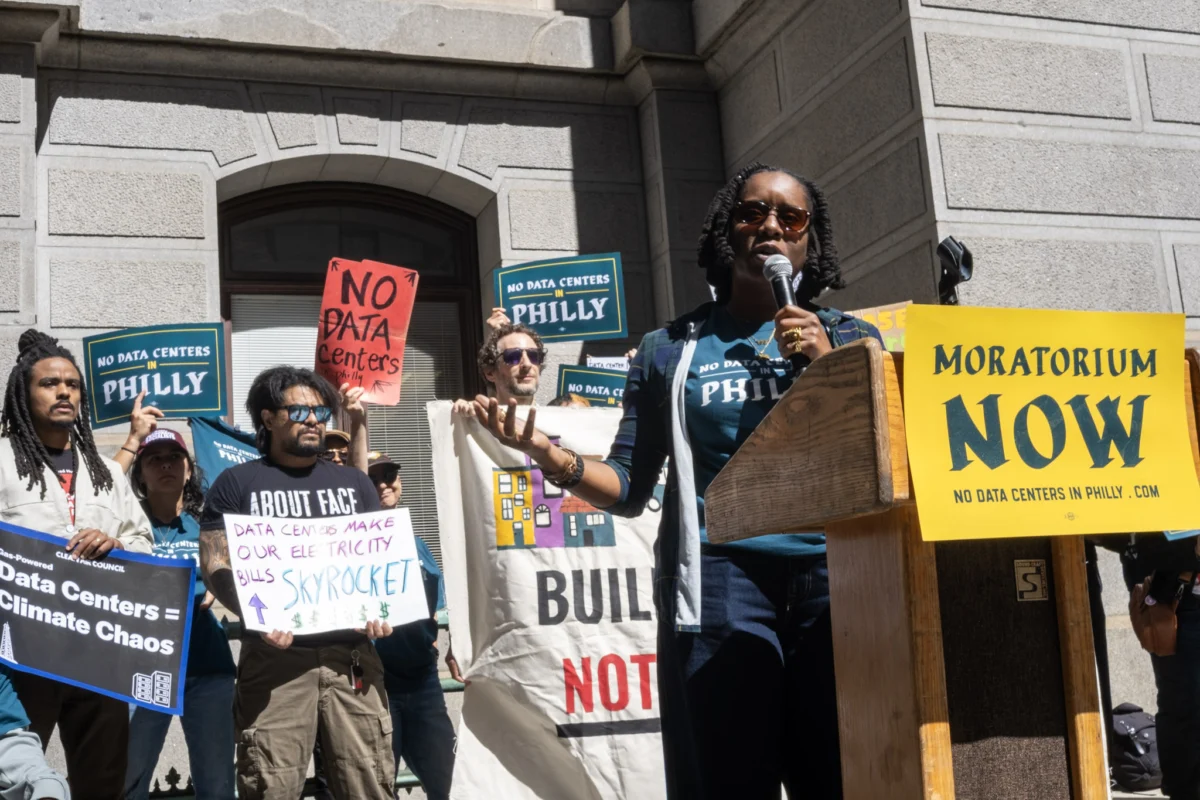
Across the United States, an increasingly contentious debate is unfolding regarding the rapid expansion of artificial intelligence infrastructure and its physical toll on local communities. While technology companies and corporate energy providers pitch multi-billion-dollar data centers as engines of high-tech job creation and municipal economic revitalization, public skepticism has reached an all-time high. Recent polling data indicates that a decisive majority of Americans oppose the construction of large-scale data centers in their immediate neighborhoods. These anxieties are rooted primarily in tangible, pressing concerns over escalating utility costs, excessive water consumption, noise pollution, and the severe environmental degradation associated with powering massive computational workloads.
For grassroots organizers like Shawmar Pitts, the threat posed by heavy industrial development is not an abstract policy discussion. Pitts, a lifelong resident of the Grays Ferry neighborhood in Southwest Philadelphia, has spent his entire life in the shadow of major industrial operations. Growing up adjacent to the sprawling Philadelphia Energy Solutions (PES) oil refinery—historically the largest petroleum processing facility on the East Coast—Pitts witnessed firsthand the toll that heavy industry extracts from surrounding urban populations. Though he and his relatives suffered from a litany of chronic health conditions throughout his youth, the systemic root of these ailments remained unarticulated until 2018. That year, he encountered representatives from Philly Thrive, a local environmental justice organization that was actively campaigning against a proposed expansion of the refinery.
The encounter proved to be a turning point for Pitts, who now serves as the managing co-director of Philly Thrive. Reading through informational pamphlets detailing the toxic health impacts of refinery emissions, he experienced a jarring realization. The medical conditions listed on the literature—respiratory illnesses, cancers, and autoimmune disorders—mirrored the exact ailments plaguing his immediate social circle. Every household in his neighborhood carried a burden of chronic sickness. Today, Pitts channels that foundational revelation into leading municipal resistance against the prospective introduction of AI data centers to Philadelphia.
The Haunting Legacy of Industrial Pollution
The anxieties voiced by Philadelphia residents are historically anchored in catastrophic past failures of environmental oversight. The PES refinery, which operated in the city for over a century before closing its doors following a massive, cataclysmic explosion in 2019, routinely processed upwards of 335,000 barrels of crude oil daily. The toxic legacy left in its wake continues to shape the community’s collective psyche.

During a spirited demonstration outside Philadelphia’s City Hall, Philly Thrive board president Sonya Sanders delivered a passionate condemnation of prospective heavy industrial infrastructure. Sanders, whose husband passed away from a rare bone cancer in 2020 after growing up alongside the refinery, argued that the community has already paid an unacceptable human toll for corporate profit. Noting that her husband neither smoked nor drank, Sanders directly attributed his premature death to airborne toxins released by industrial neighbors.
"We don’t want data centers," Sanders told the crowd of more than 100 demonstrators. "We don’t want the pollution, we don’t want the noise, and we know they’re not going to bring us more jobs. In my eyes, they killed him. The pollution killed him. I believe he would be here today if he wasn’t silently murdered, because it was the pursuit of profit that killed him."
While city officials have not yet received formal, binding construction proposals for AI data centers within Philadelphia city limits, municipal planners have already identified two primary candidate locations for future development: one situated in Northeast Philadelphia and the other in the working-class enclave of Grays Ferry. This revelation has catalyzed immediate pushback from residents and advocacy groups, prompting calls for an immediate municipal moratorium on data center zoning approvals.
The Escalating Energy Crisis and the Rise of Natural Gas
Although a modern server farm does not process crude oil or release petrochemical sludges directly into local waterways, the sheer electrical and thermal footprint of generative AI infrastructure presents a radically different kind of environmental threat. The global race among major technology conglomerates to dominate the artificial intelligence landscape has created an insatiable demand for electricity, threatening to reverse decades of progress in reducing carbon emissions.
Projections from BloombergNEF illustrate the staggering scale of this resource consumption. By the year 2035, U.S. data centers are forecasted to consume more natural gas than the combined national economies of Germany and Japan. This latest projection represents nearly a doubling of the firm’s estimates published just nine months prior, underscoring how rapidly the generative AI boom is outpacing energy sector forecasting.

While natural gas burns cleaner than traditional petroleum products, it is far from an environmentally benign energy source. The combustion of a single cubic foot of natural gas releases approximately 60 grams of carbon dioxide. Industry analysts estimate that the cumulative electricity demands of upcoming data centers will drive an additional one million metric tons of greenhouse gas emissions into the atmosphere every day—a figure equivalent to roughly 12 percent of total contemporary U.S. greenhouse gas output.
Public health experts warn that this surge in fossil fuel combustion will have fatal consequences. Groundbreaking research published by Harvard University in 2021 established that particulate air pollution stemming from fossil fuel combustion is responsible for roughly one in every five deaths globally. Legal experts and clean energy advocates argue that the rapid buildout of AI infrastructure will inevitably exacerbate this mortality rate.
Speaking at the Philadelphia rally, Clean Air Council attorney Annie Fox highlighted a particularly insidious mechanism associated with modern data center planning: the integration of massive backup diesel generators.
"A typical data center planned in Pennsylvania has hundreds of diesel engines that spew air pollution, and even if they’re supposedly reserved for emergencies, the government has already said that the data center should use those rather than drawing from an overstressed electrical grid during some heat waves," Fox stated. "We can expect that to get more frequent… Fossil fuel-hungry data centers will worsen climate change, making those heatwaves more frequent and severe."
National Resistance and Municipal Moratoriums
Philadelphia is far from an isolated battleground. Across the United States, a growing wave of municipal resistance and state-level legislative action is attempting to rein in the unfettered expansion of server farms. Citizens residing in municipalities with finite water resources, strained electrical grids, and vulnerable ecosystems are successfully lobbying elected officials to hit the pause button on new infrastructure approvals.

The regulatory pushback achieved its highest-profile victory to date in New York State, where Governor Kathy Hochul signed a sweeping executive order temporarily halting state agencies from issuing new environmental and construction permits for large-scale data center projects.
"Progress shouldn’t arrive with a higher utility bill, deleted water supply, or noise pollution," Governor Hochul emphasized during a press briefing announcing the moratorium. "These data centers can only be built, should only be built in places that want them."
Similar regulatory interventions have swept across the American landscape. Local governments in major cities and counties—including Denver, Colorado; Indianapolis, Indiana; Asheville and Charlotte, North Carolina; and Reno, Nevada—have enacted temporary or extended moratoriums on data center construction. These legislative pauses are specifically designed to afford municipal planners adequate time to study the long-term strain that high-density computing facilities impose on local municipal water tables, electrical distribution grids, and acoustic environments.
For everyday residents who turned out to make their voices heard at City Hall, the primary concerns extend beyond simple climate anxiety to encompass civil liberties, resource distribution, and corporate accountability.
"I’m worried about pollution," Donna Greenberg, a Philadelphia resident participating in the demonstration, shared with reporters. "I’m worried about surveillance and the fact that they’re going to have access to information they have no business knowing, and I’m concerned that they’re going to be using water and electricity that takes away from the people and the neighborhoods who need it."

Implications for the Future of AI Infrastructure
The collision between Silicon Valley’s relentless pursuit of computational capacity and the lived realities of frontline communities marks a critical inflection point in the deployment of artificial intelligence. As tech companies invest hundreds of billions of dollars into constructing the physical foundations of the AI era, they are increasingly meeting entrenched local opposition that views their facilities not as heralds of progress, but as modern manifestations of environmental injustice.
The outcome of these localized battles in Philadelphia, New York, and cities across the nation will likely establish critical legal and regulatory precedents. If municipalities continue to successfully implement moratoriums and demand rigorous environmental reviews, the geographic distribution of AI infrastructure may be fundamentally altered. Tech firms will be forced to internalize the true resource costs of their operations, potentially accelerating investments in dedicated renewable energy microgrids, closed-loop cooling systems, and geographic decentralization away from densely populated urban centers.
For organizers like Shawmar Pitts and Sonya Sanders, however, the immediate focus remains firmly fixed on protecting their neighborhoods from repeating historical tragedies. As the chants of demonstrators echoed off the stone facade of Philadelphia’s City Hall, the message delivered to local lawmakers was unequivocal.
"I just think that our community standing up and fighting back is tremendous," Pitts reflected as the rally drew to a close. "It takes a lot of effort and a lot of people."