
WASHINGTON — The evolving geopolitical architecture of the Indo-Asia-Pacific region took center stage on January 27, 2016, as the Center for Strategic and International Studies (CSIS) hosted a high-profile Military Strategy Forum event. The gathering featured Admiral Harry B. Harris, then-Commander of the U.S. Pacific Command (PACOM), who delivered keynote remarks focusing on strategic opportunities, emerging defense capabilities, and security frameworks across one of the world’s most dynamic and economically vital regions.
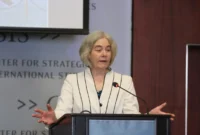
The evening event, running from 6:00 p.m. to 7:00 p.m. EST at the prominent Washington-based think tank, drew defense analysts, military officials, diplomats, and media representatives. The session opened with formal introductory remarks delivered by Dr. John J. Hamre, CSIS President and CEO, setting a sober yet forward-looking tone regarding U.S. strategic commitments in the Eastern Hemisphere. Dr. Kathleen H. Hicks, then serving as Senior Vice President, Henry A. Kissinger Chair, and Director of the International Security Program at CSIS, expertly moderated the ensuing discussion. The forum was made possible through the generous corporate support of Rolls-Royce North America.
Background Context of the Indo-Asia-Pacific Security Environment
The geopolitical landscape of 2016 was characterized by rapid transitions, complex maritime disputes, and shifting regional alliances. The Indo-Asia-Pacific—a vast expanse stretching from the shores of East Africa and the Indian subcontinent to the Western Pacific—represented the epicenter of global economic growth and strategic competition. During this period, the United States military was actively executing its strategic "rebalance" or "pivot" to Asia, a policy initiative designed to refocus diplomatic, economic, and military resources toward the region in response to rising Chinese economic and military power, ongoing nuclear provocations by North Korea, and the imperative to maintain a free and open international order.
Admiral Harris, who assumed command of PACOM in May 2015, had established a reputation for forthright assessments of regional security challenges. As the head of the United States’ oldest and largest combatant command, Harris oversaw a theater encompassing approximately 36 nations, over 50 percent of the global population, and several of the world’s most critical maritime choke points, including the Malacca Strait and the South China Sea. Against this backdrop, the CSIS forum provided a critical public platform for PACOM leadership to articulate how the Department of Defense intended to leverage technological advancements, deepen multilateral partnerships, and capitalize on strategic opportunities to safeguard stability.

Chronology of the Forum Event
The one-hour evening program followed a structured format designed to maximize substantive dialogue on defense strategy:
- 6:00 PM – 6:05 PM: Opening remarks and formal introduction of Admiral Harris by Dr. John J. Hamre, highlighting the critical role of independent policy research in understanding modern defense challenges.
- 6:05 PM – 6:25 PM: Keynote address by Admiral Harry B. Harris, focusing on the strategic imperatives, maritime security concerns, and collaborative opportunities spanning the Indo-Asia-Pacific theater.
- 6:25 PM – 6:55 PM: Moderated discussion and question-and-answer session led by Dr. Kathleen H. Hicks, engaging Admiral Harris on topics ranging from capability modernization and alliance management to freedom of navigation operations.
- 6:55 PM – 7:00 PM: Closing remarks and acknowledgments, formally concluding the Military Strategy Forum session.
Supporting Data and Strategic Priorities
Throughout the discussion, the dialogue frequently returned to the quantitative and qualitative realities shaping the PACOM area of responsibility. While specific classified operational metrics remained restricted, public data regarding the region underscores the immense scale of U.S. defense commitments during the mid-2010s:
- Geographic Scale: The PACOM theater covered roughly 100 million square miles, accounting for approximately half of the Earth’s surface.
- Personnel and Assets: The command routinely stationed over 300,000 military and civilian personnel in the region, supported by advanced naval strike groups, tactical aviation wings, and expeditionary units.
- Economic Stakes: Global commerce heavily relied on the region, with over 30 percent of the world’s maritime trade passing through the South China Sea alone, representing trillions of dollars in economic value annually.
- Key Alliances: The U.S. defense posture heavily relied on formal treaty alliances with nations such as Japan, South Korea, Australia, the Philippines, and Thailand, alongside expanding strategic partnerships with India, Singapore, Vietnam, and Indonesia.
Admiral Harris emphasized that these partnerships were not merely symbolic but served as the bedrock of deterrence against revisionist powers seeking to alter internationally recognized norms through coercion or unilateral action.
Official Responses and Perspectives
The themes addressed by Admiral Harris at CSIS reflected broader interagency discussions within Washington regarding the execution of national security strategy. The Department of Defense consistently highlighted that maintaining a robust forward posture in the Indo-Asia-Pacific was essential for reassuring regional allies and deterring potential adversaries.
Independent defense analysts noted that PACOM’s emphasis on "strategic opportunities" represented a deliberate rhetorical shift away from a purely reactive posture toward proactive capability development. By fostering interoperability with regional partners, the U.S. military aimed to build a collective security architecture capable of addressing non-traditional security threats—such as humanitarian assistance, disaster relief, piracy, and illegal fishing—while simultaneously maintaining high-end conventional deterrence.

Furthermore, academic and policy reactions to the event underscored the delicate balancing act required in U.S. foreign policy. Observers pointed out that while Washington sought deeper cooperation with rising powers like India to ensure a multipolar balance of power, it simultaneously had to manage a complex, competitive relationship with Beijing, particularly regarding territorial disputes in the East and South China Seas.
Broader Impact and Implications for Defense Strategy
The insights shared during the January 2016 Military Strategy Forum resonated across subsequent years, influencing how defense planners conceptualized multi-domain operations, force posture adjustments, and technology investments.
- Technological Modernization: The forum highlighted the urgent need to invest in advanced military technologies—including long-range precision strike systems, electronic warfare capabilities, resilient communications networks, and unmanned maritime vehicles—to counter anti-access/area-denial (A2/AD) capabilities developed by potential adversaries.
- Multilateralism and Networked Security: Admiral Harris’s remarks reinforced the transition from traditional bilateral hub-and-spoke alliance systems toward a more integrated, networked security architecture. This included encouraging deeper defense cooperation between regional allies, such as trilateral security coordination involving the United States, Japan, and South Korea, as well as minilateral dialogues involving India and Australia.
- Norms and International Law: A recurring theme of the discussion was the defense of a rules-based international order. By emphasizing freedom of navigation and overflight, PACOM underscored that international waters and airspace must remain accessible to all nations in accordance with international law, particularly the United Nations Convention on the Law of the Sea (UNCLOS).
The 2016 event at CSIS ultimately served as an important milestone in public discourse regarding American grand strategy in the 21st century. By bringing together military leadership, top-tier research institutions, and defense experts, the Military Strategy Forum provided a transparent window into the strategic calculus guiding the United States military in its most economically and strategically consequential theater of operations.