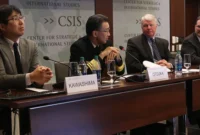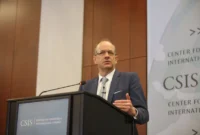

On February 25, 2016, the Center for Strategic and International Studies (CSIS) hosted a high-profile session of its Statesmen’s Forum, featuring a keynote address by Wang Yi, the Minister of Foreign Affairs of the People’s Republic of China. The event, which took place in Washington, D.C., served as a critical platform for exploring the complexities of the U.S.-China bilateral relationship at a time of shifting geopolitical dynamics. The session was introduced by John Hamre, President and CEO of CSIS, and moderated by Christopher K. Johnson, who at the time served as the Freeman Chair in China Studies at the organization.
Context and Geopolitical Setting of the 2016 Forum
The 2016 visit by Foreign Minister Wang Yi occurred during a pivotal window in international relations. The Obama administration was in its final year, and the global security architecture was facing significant strain due to the rise of assertive maritime policies in the South China Sea, ongoing debates regarding cyber-espionage, and the complexities of North Korea’s nuclear program.
The Statesmen’s Forum is designed to bring world leaders to CSIS to articulate their nations’ foreign policy visions. For Wang Yi, the forum provided an opportunity to frame China’s foreign policy as one of "peaceful development" and "win-win cooperation," while simultaneously addressing the growing anxieties among policymakers in Washington regarding China’s rapid modernization and regional influence. The discussion was held against the backdrop of the "Pivot to Asia" policy, which had defined much of the U.S. approach to the region under the Obama administration.
Chronology of U.S.-China Diplomatic Friction
To understand the weight of the 2016 address, one must look at the preceding years of diplomatic friction that led to the event. The early 2010s saw a marked shift from the post-Cold War era of cooperation to a more competitive framework.
- 2012: The U.S. began formalizing its "Rebalance to Asia" strategy, emphasizing increased military presence and economic engagement in the Pacific.
- 2013: Following the Sunnylands Summit between President Barack Obama and President Xi Jinping, both nations sought to establish a "new model of major-country relations," though the terminology remained contentious.
- 2014: The signing of a historic climate change agreement between the U.S. and China marked a high point in cooperation, yet tensions continued to simmer over maritime claims.
- 2015: President Xi Jinping visited the United States for a state visit, where both sides pledged to work together on cyber-security, though deep-seated mistrust remained regarding infrastructure development and naval activities in the South China Sea.
- Early 2016: The lead-up to the CSIS event was dominated by concerns over the militarization of artificial islands in the Spratly archipelago, which the U.S. viewed as a challenge to the freedom of navigation.
Key Themes of the Minister’s Address
Minister Wang Yi’s presentation focused heavily on the necessity of maintaining stability. He argued that the fundamental interests of the United States and China were increasingly intertwined through economic globalization. He emphasized that the "new model of major-country relations" was intended to avoid the "Thucydides Trap"—a historical theory suggesting that when a rising power threatens to displace a ruling power, war is almost inevitable.

Wang stressed that China did not seek to challenge the international order established after World War II but rather aimed to contribute to its evolution. He highlighted China’s commitment to multilateralism, pointing to the Asian Infrastructure Investment Bank (AIIB) as a constructive development for the region, despite initial skepticism from Washington. The Minister also addressed the nuclear situation on the Korean Peninsula, asserting that China supported the denuclearization of the region and favored diplomatic resolutions over punitive sanctions, a point of divergence from the more hardline approaches then being discussed in the U.S. Congress.
Supporting Data: The Economic and Security Landscape
In 2016, the bilateral economic relationship was the anchor of the broader diplomatic tie. Bilateral trade in goods and services between the United States and China had reached approximately $600 billion annually. However, the economic dependency was mirrored by a widening security gap.
Data from the 2016 period indicated that China’s defense budget had seen a consistent increase of nearly 10% year-over-year for over a decade. Concurrently, the U.S. Department of Defense’s "Asia-Pacific Maritime Security Strategy" reported that China had reclaimed over 2,900 acres of land in the South China Sea, creating a strategic challenge for U.S. naval operations. These figures provided the subtext for the questions posed by Christopher K. Johnson during the moderated segment of the forum, where the focus shifted from broad rhetorical flourishes to the specifics of military maneuvers and territorial sovereignty.
Institutional Responses and Expert Analysis
The CSIS event was viewed by regional experts as a tactical effort by Beijing to manage perceptions in Washington. By engaging with a prominent think tank, the Chinese Foreign Ministry sought to reach the broader foreign policy establishment, including officials from the State Department and the National Security Council.
Following the forum, analysts noted that while Wang Yi was successful in presenting a composed image of Chinese diplomacy, the lack of concrete concessions regarding maritime territorial disputes remained a point of frustration for U.S. observers. Reactions from the academic community emphasized that the "cooperative rhetoric" presented at CSIS was often at odds with the "assertive actions" observed in the field. This disconnect became a defining feature of U.S.-China relations for the remainder of the decade.
Broader Implications and Historical Significance
The 2016 Statesmen’s Forum remains a significant artifact in the history of U.S.-China relations. It captured a moment of transition, occurring just months before the 2016 U.S. presidential election, which would usher in a more populist and protectionist era of American foreign policy.

The address by Wang Yi highlights the long-standing efforts by Beijing to convince the U.S. that China’s rise was benign. In retrospect, the event underscores the failure of the "engagement" strategy that had dominated U.S. policy toward China since the 1970s. The arguments made by the Minister regarding "mutual respect" and "win-win cooperation" were soon to be tested by the introduction of tariffs, trade wars, and a fundamental decoupling of the two economies that accelerated in the subsequent years.
The CSIS event served as a reminder that diplomacy, while essential for maintaining channels of communication, often struggles to bridge the fundamental divergence in national interests. The forum was a masterclass in high-level statecraft—a sophisticated delivery of national narrative that nonetheless left the structural tensions of the U.S.-China relationship largely unresolved.
Legacy of the Dialogue
When evaluating the legacy of this event, it is clear that the 2016 session was the last of its kind before the relationship entered a period of rapid deterioration. The dialogue provided a baseline for what China considered its "red lines," particularly regarding Taiwan and regional sovereignty, and what the United States considered its "security commitments" to allies in the Pacific.
By hosting Minister Wang Yi, CSIS fulfilled its mission of providing a venue for critical, sometimes uncomfortable, diplomatic exchange. The event archive, including the video webcast provided by the institution, continues to serve as a vital resource for scholars and policymakers who study the trajectory of global power competition. As the world reflects on the decade that followed, the 2016 Statesmen’s Forum stands as a sentinel of a bygone era in international diplomacy, marking the final stage before the transition into the more volatile and competitive environment that characterizes the current era of great power politics.