
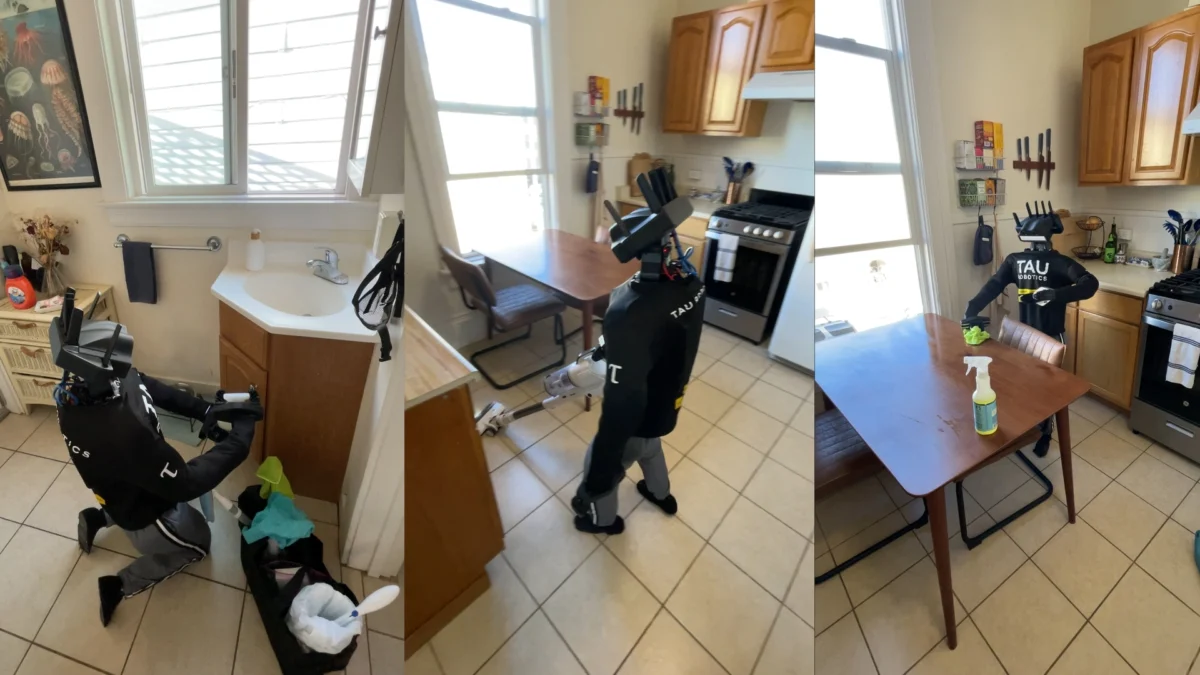
The intersection of artificial intelligence, consumer robotics, and domestic labor has officially entered the residential housing market in San Francisco, California. Tau Robotics, an emerging robotics startup based in the Bay Area, has begun deploying semi-autonomous humanoid robots directly into private apartments to perform routine domestic cleaning services. While the enterprise is ostensibly a commercial house-cleaning venture, industry analysts recognize it as a sophisticated data-gathering operation designed to solve one of robotics’ most formidable engineering challenges: teaching machines to safely and effectively navigate unstructured, human environments.
The deployment of these robotic systems highlights a broader technological shift occurring across Silicon Valley. For years, autonomous vehicles such as Alphabet’s Waymo have grown ubiquitous on San Francisco streets, transitioning from experimental novelties to routine municipal transit. Now, startups like Tau Robotics are attempting to replicate that trajectory indoors. However, the engineering hurdles associated with household chores—ranging from folding irregular textiles to negotiating narrow, obstacle-laden hallways—are vastly more complex than navigating structured roadways. Consequently, the current generation of domestic humanoid robots relies heavily on a model of teleoperation, blending advanced hardware with real-time human oversight.
The Technological Reality Behind the Machine
The hardware deployed by Tau Robotics is designed to balance utility, durability, and cost. Standing approximately four and a half feet tall, each unit features a custom 3D-printed head outfitted with communication antennae to maintain a constant data link with the company’s headquarters. Instead of complex, fragile articulated fingers, the robots utilize sturdy 3D-printed claw hands. According to company engineers, these end-effectors provide superior durability while maintaining adequate dexterity for the majority of household cleaning tasks. To protect client property, the machines wear branded apparel and specialized grippy socks to prevent scratching delicate hardwood flooring.
Despite their futuristic appearance, these units function closer to sophisticated, remotely piloted vehicles than autonomous androids. Many delicate tasks, such as making a bed or sorting laundry, require a methodology known as kinematic guidance. In this paradigm, a human operator at a remote workstation performs the necessary physical motions. Onboard sensors transmit those precise movements to the robot, which mirrors them in real time.
This continuous stream of teleoperated data serves as the lifeblood of Tau Robotics’ overarching business strategy. Every counter wiped, floor mopped, and item folded is recorded, cataloged, and fed into machine learning pipelines. The ultimate corporate objective is to transition these machines from human-piloted tools to fully autonomous agents. While basic, highly repetitive tasks such as vacuuming and floor mopping can already be executed independently by the software, complex physical interactions still demand continuous human cognitive input and sensory interpretation.
A Chronology of the Deployment Experience
The logistical reality of bringing a humanoid robot into a domestic space involves a series of calculated steps, punctuated by the occasional technical hurdle inherent to early-stage beta hardware.
Upon arrival, the deployment process typically begins outside the residence. Transported in standard utility vehicles by company personnel, the robots immediately encounter environmental variables rarely found in controlled laboratory settings. During a documented residential visit, a Tau Robotics unit faced a straightforward exterior architectural feature: a short flight of eight stairs leading to the building’s entrance. Lacking native bipedal stabilization robust enough to handle irregular outdoor elevations seamlessly, the machine navigated the steps with a characteristic, uncoordinated stagger. Although it maintained its footing, the physical ascent demonstrated the distinct gap between theoretical robotics and real-world implementation.
Once inside, environmental challenges continued. Interior carpeted staircases routinely overwhelmed the robot’s locomotion algorithms, requiring human intervention to transport the unit across vertical thresholds. Furthermore, early deployments revealed vulnerabilities to environmental factors such as ambient temperature. On unseasonably warm days, operational anomalies caused the robots to stall—not necessarily due to onboard thermal limits of the robot itself, but occasionally stemming from overheating issues within the remote operator stations located miles away at company headquarters. When connectivity or remote-viewing equipment drops offline, safety protocols dictate that the robot cease operation until the data stream is fully restored.
Despite these operational interruptions, customer service infrastructure surrounding the service operates with high responsiveness. Company representatives routinely follow up on technical glitches by offering complimentary service credits, reflecting the startup’s acute awareness of its position in a competitive, nascent market. Subsequent visits typically proceed with greater operational fluidity as operators grow accustomed to the specific spatial layouts of repeat clients.
Economic Models and Consumer Pricing
The economics of Tau Robotics reflect the immense value the company places on real-world training data. When the service was first introduced to early adopters, introductory rates were set at approximately $30 per hour for a single robotic unit. As the company refined its operational capacity, pricing structures shifted toward tiered subscription models, such as $60 per weekly visit utilizing two synchronized robots, or $100 for a single, comprehensive session.
From a purely utilitarian standpoint, these rates do not yet represent a direct economic bargain for the consumer. The robots operate at speeds significantly slower than a human professional cleaner or an individual performing the tasks independently. Because the machines require intermittent troubleshooting, oversight, and physical adjustments, a consumer standing by to monitor the process often expends more time and attention than the physical labor would otherwise require.
However, consumers purchasing the service are effectively participating in an early-adopter beta test. They trade a portion of their domestic privacy and personal time for discounted cleaning services and the novelty of experiencing consumer robotics firsthand. This symbiotic economic exchange allows the startup to collect invaluable, high-entropy training datasets from actual homes without bearing the prohibitive costs of maintaining a dedicated, warehouse-sized simulation facility.
Performance Metrics and Household Efficacy
When fully operational, the humanoid units demonstrate surprising capability across a variety of domestic chores. Kitchen maintenance, surface wiping, and floor care are handled with methodical thoroughness. One of the most technologically impressive demonstrations of the current hardware involves bathroom sanitation. During testing, when the head of a toilet-cleaning wand repeatedly detached, the robot successfully utilized its onboard spatial awareness and kinematic control to probe the area, locate the handle, and reattach the implement at the precise geometric angle required to resume cleaning.
Nevertheless, the limitations of beta-stage artificial intelligence remain evident during extended operations. Units have been observed leaving water faucets dripping, accidentally toppling closed liquid containers, or failing to upright lightweight objects like fallen air purifiers. These minor physical errors underscore the difficulty of generalized manipulation in homes populated by fragile consumer goods and chaotic spatial layouts.
Company leadership acknowledges these shortcomings while emphasizing the long-term trajectory of the technology. Cornelia Weinzierl, co-founder of Tau Robotics, notes that the immense engineering effort dedicated to latency reduction, connectivity optimization, and mechanical timing represents the foundational bedrock of future automation.
Broader Economic and Societal Implications
The commercialization of domestic humanoid robotics carries significant socioeconomic implications that extend far beyond Silicon Valley novelty. As companies like Tau Robotics inch closer to true autonomy, critical questions arise regarding the future of labor within the domestic service sector.
Proponents of the technology argue that automated cleaning addresses a severe labor shortage in mundane, physically demanding occupations. Domestic cleaning historically suffers from high turnover rates, elevated risks of musculoskeletal injuries, and a general lack of labor supply relative to societal demand. By automating these routines, robotics firms envision a future where hazardous or physically punishing tasks—ranging from residential cleaning to mold remediation and specialized home healthcare—can be absorbed by machines, thereby freeing human workers for higher-level cognitive and interpersonal employment.
Conversely, labor economists and policy analysts express concern over the potential displacement of low-wage workers. Commercial cleaning and residential housekeeping employ millions of individuals globally, many of whom are immigrants or marginalized workers with limited access to safety nets. If startups successfully scale autonomous cleaning fleets, the economic impact on the domestic labor market could be profound. Unlike digital automation, physical robotics directly threatens entry-level manual jobs that currently require no formal academic credentials.
Furthermore, the widespread adoption of camera-equipped robots operating inside private residences introduces complex regulatory and privacy challenges. The continuous transmission of visual and spatial data from living rooms, bedrooms, and bathrooms to remote corporate servers raises critical cybersecurity and data governance questions. While consumers currently consent to data collection as a condition of service, regulatory bodies may eventually demand stricter cryptographic standards and data minimization protocols to prevent unauthorized access to private domestic environments.
Conclusion and Future Outlook
Tau Robotics currently represents a fascinating transitional phase in the evolution of automation. The company has successfully bridged the gap between theoretical laboratory research and commercial deployment, placing functional humanoid robots inside paying customers’ apartments. While these machines remain tethered to human oversight, hindered by connection latencies, and occasionally challenged by simple household obstacles, their mere presence signals a profound shift in consumer technology.
The realization of The Jetsons style domestic automation is no longer confined to science fiction or controlled industrial facilities. As machine learning models ingest millions of hours of real-world cleaning data gathered from homes across San Francisco, the capabilities of these systems will inevitably compound. Whether society is prepared for the economic, regulatory, and cultural ramifications of autonomous humanoid labor remains the defining question as the robotics industry moves from the beta testing phase toward mass commercialization.