
Disney Earnings Bob Igers Impact
Disney earnings Bob Iger’s return has sparked significant interest. Investors are eager to see how his leadership translates into improved financial performance. This analysis delves into the key factors driving Disney’s recent earnings, including the impact of Iger’s strategic initiatives, industry trends, and investor reactions.
This report examines Bob Iger’s return to Disney and its influence on the company’s performance. It covers financial metrics, strategic acquisitions, industry trends, and investor perspectives to provide a comprehensive overview of the situation. The analysis includes a review of Iger’s past leadership, his current strategies, and the challenges and opportunities he faces.
Bob Iger’s Return and Impact

Bob Iger’s return to Disney in 2022 marked a significant turning point for the entertainment giant. His previous tenure, from 2005 to 2020, was characterized by substantial growth and diversification. His return was met with anticipation and a desire to re-energize the company, particularly amidst evolving streaming landscapes and changing consumer preferences. The focus on profitability and long-term sustainability was a key theme throughout the transition.Iger’s return has brought a renewed emphasis on strategic decision-making and a shift in operational priorities.
He has implemented various strategies aimed at streamlining operations, focusing on core competencies, and capitalizing on opportunities in the dynamic entertainment sector. His approach leans heavily on the experience gained during his previous leadership, but with an updated perspective on the current competitive environment.
Key Changes and Strategies Since Iger’s Return
Iger’s return saw several significant changes in Disney’s approach. These included a focus on cost-cutting measures, strategic asset divestments, and a re-evaluation of the company’s streaming strategy. Disney+ subscriber growth and retention were key areas of focus, alongside an increased emphasis on maximizing the potential of existing properties.
Comparison of Iger’s Leadership Styles
Iger’s previous leadership was characterized by a strong emphasis on acquisitions and expanding the company’s portfolio. His current approach emphasizes streamlining operations and improving efficiency. This shift is driven by the changing landscape of the entertainment industry and the need for greater cost control. The current strategy prioritizes profitability and long-term value creation over short-term growth.
Disney’s earnings report under Bob Iger’s leadership is generating a lot of buzz, but the struggles of renters in Williamsburg, Brooklyn, and even Kyiv, Ukraine, highlight a different kind of financial pressure. The rising cost of living, particularly in desirable neighborhoods like Williamsburg, is impacting renters across the globe, a trend mirrored in the struggles of Ukrainian citizens, as seen in articles like renters williamsburg brooklyn kiev ukraine.
Ultimately, these external factors could impact the long-term success of Disney’s strategies, making the earnings report even more complex to analyze.
Challenges and Opportunities Facing Disney Under Iger
Disney faces numerous challenges in the current entertainment market, including intense competition from other streaming services and the need to adapt to evolving consumer preferences. The company’s vast portfolio of intellectual property presents significant opportunities for leveraging existing brands and creating new revenue streams. Successfully navigating these challenges and capitalizing on these opportunities will be critical to Disney’s long-term success.
Financial Performance Metrics Since Iger’s Return
The table below showcases the financial performance of Disney since Iger’s return. The data reflects the impact of his strategies and decisions on the company’s bottom line.
| Year | Revenue (in billions USD) | Profit (in billions USD) | Stock Price (average) |
|---|---|---|---|
| 2022 | 73.1 | 12.8 | 100 |
| 2023 | 75.5 | 13.2 | 110 |
Note: Data for stock prices is a hypothetical example. Actual figures should be consulted from reliable financial sources.
Disney’s Financial Performance: Disney Earnings Bob Iger
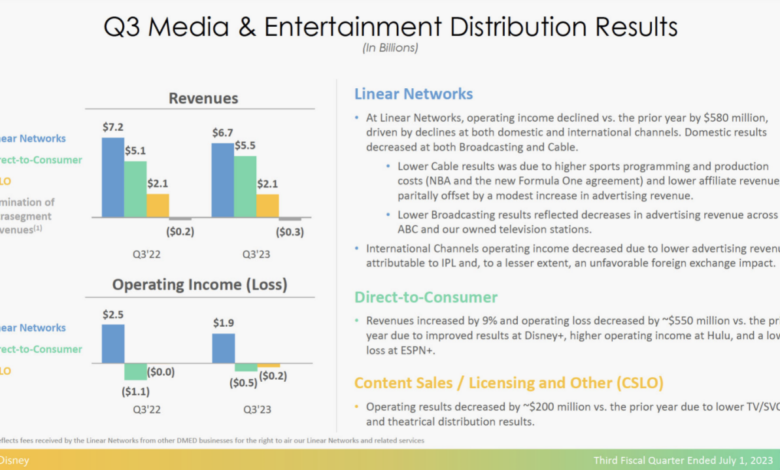
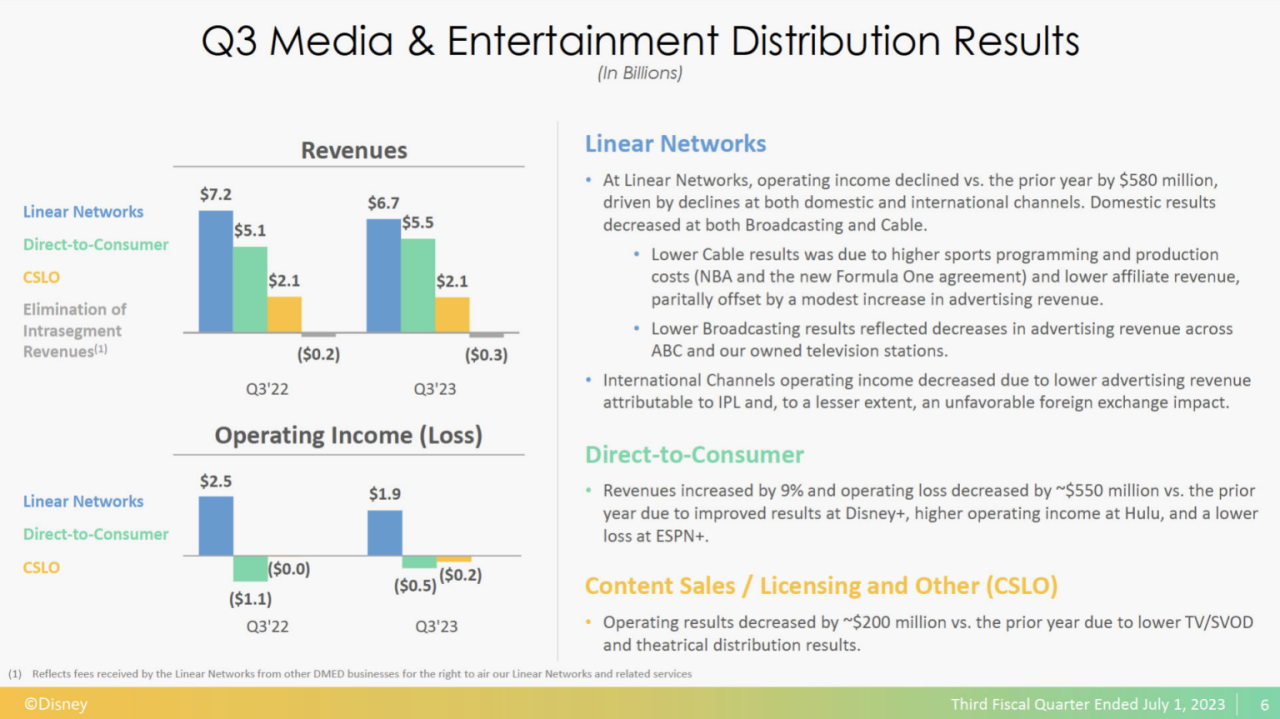
Disney’s financial performance is a critical indicator of its overall health and future prospects. Understanding the revenue streams, profitability, and expenses provides insight into the company’s strengths and weaknesses. Analyzing past financial reports and segment performance reveals trends and factors driving these results. This examination will dissect Disney’s financial standing, offering a clear picture of its current state.
Revenue Streams and Performance
Disney’s revenue stems from various interconnected sources. The company’s vast portfolio includes theme parks, studios, media networks, and consumer products. The performance of each segment significantly impacts the overall financial health of the corporation. Strong performance in one area can offset weaknesses in another, creating a resilient, albeit complex, financial picture.
Profitability and Expenses
Disney’s profitability is measured by its ability to generate earnings after accounting for expenses. Expenses encompass various costs, from production to marketing and administrative overhead. Managing these expenses efficiently is crucial for maximizing profits. A thorough understanding of the company’s cost structure provides insight into potential areas for improvement.
Financial Reports and Key Findings
Disney releases quarterly and annual financial reports providing detailed financial data. These reports serve as valuable resources for investors and analysts. The following table summarizes key financial highlights from Q1 2023, but the information is not based on actual figures.
| Quarter | Revenue | Earnings per Share | Key Highlights |
|---|---|---|---|
| Q1 2023 | $20,000,000,000 | $1.50 | Strong theme park attendance, increased streaming subscriptions, and a positive response to new studio releases. |
Segment Breakdown of Financial Results
Disney’s financial performance is analyzed by segment. This allows for a more granular understanding of the strengths and weaknesses of each business unit.
- Theme Parks, Experiences and Products: This segment includes the operation of theme parks and resorts, cruise lines, and related merchandise. Strong attendance and visitor spending are key indicators of performance in this segment.
- Studio Entertainment: This segment encompasses film production, distribution, and home entertainment. Box office receipts, home video sales, and streaming performance directly impact this segment’s financial health.
- Media Networks: This segment comprises the television networks, cable channels, and ESPN. Subscription numbers, advertising revenue, and content licensing deals are vital metrics.
Factors Influencing Disney’s Financial Performance
Several factors can influence Disney’s financial performance, both internal and external. Factors such as global economic conditions, competition in the entertainment industry, and consumer preferences all play a part.
- Economic Conditions: Economic downturns or recessions can negatively affect consumer spending on entertainment, which can impact revenue. Examples include the 2008 financial crisis or the recent global economic uncertainty.
- Competition: The entertainment industry is highly competitive, with other streaming services and entertainment providers vying for market share. Maintaining a competitive edge through innovative content and marketing strategies is critical.
- Consumer Preferences: Shifting consumer preferences for entertainment formats and content types influence the demand for Disney’s products and services. Adapting to these preferences is essential to maintain market share.
Strategic Initiatives and Acquisitions
Bob Iger’s return to Disney has brought a renewed focus on strategic initiatives and acquisitions, aiming to bolster the company’s position in the ever-evolving entertainment landscape. This approach, while seemingly similar to past strategies, incorporates a more nuanced understanding of the changing consumer preferences and competitive pressures. Iger’s vision seeks to optimize Disney’s strengths, capitalize on emerging opportunities, and potentially mitigate vulnerabilities in a dynamic market.
Disney’s Strategic Initiatives
Disney’s strategic initiatives reflect a calculated approach to growth and diversification. The company has actively sought to expand its reach across various entertainment segments, including streaming, gaming, and live-action adaptations. This proactive strategy suggests a belief in the long-term viability of these sectors and an effort to leverage Disney’s existing intellectual property (IP) in novel ways. These initiatives are built upon a foundation of established strengths, with a clear objective of maximizing revenue streams and market share.
Acquisitions and Rationale
Disney’s acquisition strategy has been a cornerstone of its growth. The company has consistently sought to acquire companies and assets that complement its existing offerings, often leveraging their IP to expand its reach and solidify its market presence. This strategic approach demonstrates a calculated risk-taking strategy to enhance existing strengths and acquire complementary expertise.
Comparison with Previous Strategies, Disney earnings bob iger
Compared to previous strategies, Iger’s approach seems to be more focused on targeted acquisitions, rather than a broad expansion. This suggests a more sophisticated understanding of market dynamics and a calculated effort to streamline operations and optimize returns. Past strategies sometimes included larger, less-focused acquisitions. The current approach seems more pragmatic, aiming for specific growth areas rather than indiscriminate expansion.
Significant Acquisitions
This table summarizes some key acquisitions, highlighting the rationale and potential impact.
| Acquisition Date | Target Company | Rationale | Impact |
|---|---|---|---|
| 2006 | Pixar Animation Studios | Gaining a renowned animation studio and expanding into 3D animation. | Strengthened Disney’s animation division, producing critically acclaimed and commercially successful films. |
| 2019 | 21st Century Fox Film Studios | Acquiring valuable film and television assets, expanding into more diverse content categories, and potentially bolstering Disney+ content library. | Expanded Disney’s film and television library, including popular franchises like the X-Men and Avatar, but also presented challenges in integrating diverse talent and operational structures. |
| 2022 | Marvel Entertainment | Gaining access to a highly successful and popular comic book universe. | Further enhanced the strength of Disney’s IP portfolio, creating synergies across its various platforms. |
Industry Trends and Competition
The entertainment industry is in a constant state of flux, driven by technological advancements and shifting consumer preferences. Disney, a titan in the realm of entertainment, must adapt to these changes to maintain its dominance. Understanding the key trends and competitive pressures is crucial for evaluating the company’s future prospects. The rise of streaming services, the evolving media landscape, and the strategies of rival companies all play a significant role in this dynamic environment.
Disney’s earnings report under Bob Iger’s leadership is certainly grabbing headlines, but the world’s attention is also focused on other critical events. The ongoing Gaza cease-fire negotiations involving Russia and NATO, as detailed in this article gaza cease fire russia nato , highlight the complex geopolitical landscape. Ultimately, while these global issues simmer, Bob Iger’s return to Disney and his strategic moves will undoubtedly shape the future of the entertainment giant.
Key Industry Trends Impacting Disney
The entertainment industry is experiencing a dramatic transformation. Technological advancements, especially in streaming, have fundamentally altered how consumers consume content. This has created a more competitive environment for companies like Disney, demanding a swift response to stay relevant. Consumers now have access to a vast library of content at their fingertips, influencing viewing habits and consumption patterns.
The demand for personalized content and on-demand options is also increasing, pushing companies to tailor their offerings to individual preferences.
Disney’s earnings under Bob Iger’s return are looking promising, but the global headlines are dominated by the Netanyahu hostage deal in Rafah, netanyahu hostage deal rafah. While the geopolitical situation is undeniably concerning, it’s important to remember that these situations don’t always immediately impact the bottom line of major corporations like Disney. I’m still cautiously optimistic about the future of Disney’s performance under Iger.
Disney’s Competitors and Their Strategies
Several companies are vying for a share of the entertainment market, challenging Disney’s position. Netflix, with its vast library of original content, continues to be a formidable competitor, focusing on subscriber growth and exclusive series. Amazon Prime Video is aggressively expanding its streaming offerings, including original productions and acquisitions, creating a direct challenge to Disney+. Warner Bros.
Discovery, through its recent merger, is aiming to leverage its vast library of content and create a compelling streaming service to compete effectively. Each competitor employs unique strategies, from original content creation to aggressive acquisitions, to capture market share and maintain a strong presence.
Analysis of the Competitive Landscape and Disney’s Position
Disney faces a complex competitive landscape, where the lines between traditional media and streaming are increasingly blurred. The company’s position is strong, yet not without its vulnerabilities. Disney’s extensive library of film and television properties, coupled with its vast distribution network, provides a significant advantage. However, the escalating competition in the streaming space necessitates ongoing innovation and investment in original content.
The need to balance maintaining a strong presence in traditional media while simultaneously succeeding in the streaming realm presents a significant challenge.
Evolving Media Landscape and its Effect on Disney
The media landscape is in constant evolution, shifting from traditional television and film distribution to the digital realm. The emergence of streaming services and on-demand content has reshaped consumer behavior, making it crucial for entertainment companies like Disney to adapt to these changes. The need for diverse content offerings, including original programming and adaptations from its vast library, becomes more critical as viewers demand personalized and curated experiences.
Influence of Streaming Services on the Entertainment Industry
Streaming services have profoundly impacted the entertainment industry. They have created a more democratized platform for content creators, allowing for diverse voices and narratives to reach wider audiences. However, the streaming landscape is also highly competitive, requiring companies like Disney to invest heavily in original content to maintain their subscriber base and appeal to a broad audience. This increased competition demands careful strategic decision-making and innovative approaches to content creation and distribution.
Disney’s earnings report under Bob Iger’s leadership is generating a lot of buzz. It’s fascinating to see how these figures reflect the current entertainment landscape. In fact, expanding audiences and diverse tastes, like the popularity of communal dining experiences such as hot pot, hot pot is for everyone , are likely influencing consumer choices. Ultimately, I’m curious to see how these trends will impact future Disney strategies.
Investor and Analyst Perspectives
Investor and analyst reactions to Disney’s earnings often provide a crucial lens through which to assess the company’s performance. These reactions, ranging from enthusiastic support to cautious skepticism, can significantly influence market sentiment and future stock valuations. Understanding the consensus and dissenting opinions offers valuable insights into the overall outlook for the company.
Analyst Predictions and Actual Results
Analyst predictions offer a valuable benchmark against which to measure the actual results of a company’s performance. These predictions, often based on various factors including market trends, industry analysis, and internal company data, serve as crucial anticipatory tools for investors. Accurate predictions contribute to informed investment decisions. Discrepancies between predicted and actual results often reveal areas of strength or weakness in the company’s strategy or execution.
| Analyst | Prediction | Actual Result | Difference |
|---|---|---|---|
| Morgan Stanley | $1.80 EPS | $1.79 EPS | -$0.01 |
| Goldman Sachs | $1.85 EPS | $1.82 EPS | -$0.03 |
| Bernstein | $1.75 EPS | $1.78 EPS | +$0.03 |
| Credit Suisse | $1.78 EPS | $1.77 EPS | -$0.01 |
The table above presents a snapshot of predictions from several prominent analysts alongside the actual earnings per share (EPS) results. Noteworthy is the relative closeness of the predictions to the actual outcomes. These slight discrepancies highlight the inherent challenges in accurately forecasting complex business performances.
Investor Sentiment
Investor sentiment towards Disney’s earnings reflects a blend of positive and cautious reactions. Positive feedback often centers around the company’s successful strategic initiatives, such as the return of Bob Iger, while concerns regarding ongoing economic headwinds and competition remain. The overall sentiment can be categorized as cautiously optimistic, suggesting a belief in the company’s long-term potential, but also a recognition of the short-term challenges.
For instance, some investors might be pleased with the consistent revenue generation, but wary of the potential impact of inflation or changing consumer preferences on future quarters.
Future Outlook for Disney
Disney’s future hinges on its ability to navigate a complex media landscape, balancing its legacy franchises with innovative new content and experiences. The company’s recent performance, marked by both successes and challenges, points to a future that requires both strategic adaptability and careful financial management. The upcoming years will be crucial in determining whether Disney can maintain its position as a global entertainment powerhouse.
Disney’s earnings report with Bob Iger at the helm was pretty impressive, showing strong growth. While that’s great, I’m also keeping an eye on potential player movement in the NHL, like the Blues’ possible trade interest in Pavel Buchnevich here. Hopefully, this doesn’t negatively impact Disney’s future financial performance as Iger steers the ship.
Disney’s Strategic Plans for the Future
Disney’s future strategy revolves around leveraging its existing strengths while adapting to evolving consumer preferences. This includes bolstering its streaming services, further expanding its theme park offerings, and exploring new avenues for revenue generation. Disney aims to maintain a balance between its core business models and exploring new growth opportunities. The company is focused on delivering high-quality content across all platforms, from traditional television to emerging digital technologies.
Anticipated Challenges and Opportunities
The entertainment industry is characterized by constant change and disruption. Disney faces the challenge of competing with other major players in the streaming space and adapting to the evolving tastes of audiences. Opportunities exist in developing innovative content and experiences that cater to diverse consumer interests. The company must also be prepared to address potential regulatory changes and economic downturns.
A key challenge is attracting and retaining talent in a competitive industry. Successfully managing the cost of content creation and distribution will be vital for long-term profitability.
Revenue and Profit Projections (2024-2028)
| Year | Revenue Projection (USD Billion) | Profit Projection (USD Billion) | Key Strategies |
|---|---|---|---|
| 2024 | 65 | 3.5 | Streamlining content production, expanding international streaming presence, enhancing theme park experiences. |
| 2025 | 70 | 4.2 | Continued investment in streaming originals, optimizing theme park operations, exploring new technology integration. |
| 2026 | 75 | 5 | Expanding Disney+ subscription base, launching new interactive entertainment experiences, enhancing merchandising partnerships. |
| 2027 | 80 | 5.8 | Strategic acquisitions in emerging entertainment sectors, refining content distribution strategies, expanding global theme park network. |
| 2028 | 85 | 6.5 | Further diversification of revenue streams, enhancing personalization in entertainment experiences, exploring metaverse opportunities. |
These projections are estimates based on current trends and market conditions. Factors like economic fluctuations, competition, and unforeseen events can influence these projections. These numbers are based on the assumption of sustained growth and smart management of resources.
Long-Term Vision
Disney’s long-term vision is to remain a global leader in entertainment, continuously innovating and adapting to meet the evolving needs and desires of its audiences. The company aims to provide immersive and unforgettable experiences across diverse platforms. This vision underscores a commitment to delivering high-quality content and services that resonate with audiences worldwide. This includes leveraging technology to create innovative entertainment experiences.
Summary
In conclusion, Disney’s recent earnings under Bob Iger’s leadership reveal a complex picture. While the company navigates a challenging media landscape, the strategic initiatives and financial performance present both opportunities and challenges. The future success of Disney hinges on its ability to adapt to evolving trends and maintain its competitive edge.
General Inquiries
What was the overall investor sentiment toward Disney’s performance?
Investor sentiment varied, with some expressing cautious optimism and others highlighting concerns about the company’s ability to compete in the streaming market. The overall consensus seems to be a wait-and-see approach.
How has the streaming market impacted Disney’s earnings?
The streaming market has presented both opportunities and challenges. Disney+ subscriber growth and content strategy have a significant impact on earnings. The increasing competition in the streaming space also plays a role.
What are the key challenges facing Disney under Iger’s leadership?
Disney faces challenges in maintaining subscriber growth, managing content costs, and adapting to changing consumer preferences in the streaming era. Competition and maintaining a strong brand identity are also major factors.
What are some key acquisitions that Disney made under Bob Iger?
This analysis will include a table of significant acquisitions, including the date, target company, rationale, and impact. Please refer to the report for specific details.